

North Texas summers push ornamental shrubs to their limits. Temperatures regularly exceed 105 degrees Fahrenheit across Tarrant County, and shrubs planted near concrete, brick walls, or south-facing exposures absorb reflected heat that pushes soil temperatures even higher. For homeowners in Fort Worth, Arlington, Mansfield, and surrounding communities, summer heat stress is one of the most common reasons ornamental shrubs decline and die.
Heat stress in ornamental shrubs shows up as wilting, scorched leaf margins, premature leaf drop, and tip dieback. The good news is that most affected shrubs recover with the right intervention at the right time. The key is recognizing symptoms early, watering correctly, and avoiding common mistakes that make stress worse.
This guide covers what heat stress looks like across common North Texas shrub species, how to treat it, and how to protect ornamentals before peak heat arrives.
What Does Heat Stress Look Like in Ornamental Shrubs?
Heat stress produces a recognizable set of symptoms that progress from mild to severe. Identifying the stage of stress helps determine how quickly intervention is needed and what steps will be most effective.
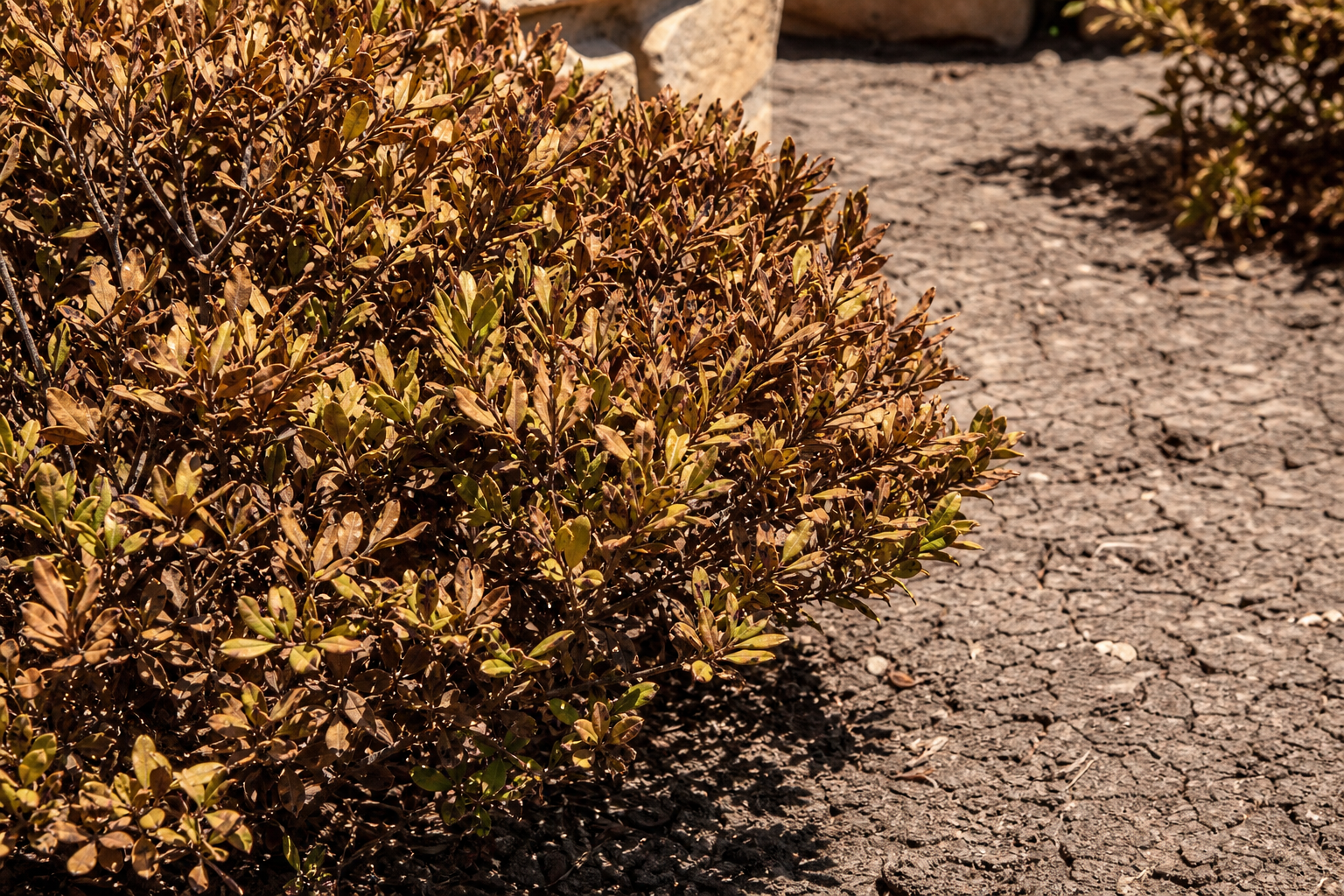
The earliest and most visible sign is leaf wilting. Droopy or limp foliage during or after the hottest part of the day signals the shrub cannot move water from roots to leaves fast enough to keep pace with evaporation. As stress continues, additional symptoms appear:
- Leaf scorch: Brown, crispy edges along leaf margins, often progressing inward across the leaf surface
- Sunburn: Bleached or pale patches on leaves that were previously shaded and are now exposed
- Premature leaf drop: Evergreen shrubs like hollies and Indian hawthorn dropping leaves earlier than normal
- Tip dieback: The outermost branch tips dying back while interior growth remains green
- Reduced new growth: Little or no new shoot development during periods when growth should be active
- Premature flower or fruit drop: Ornamentals dropping blooms or fruit before they develop fully
A shrub showing leaf wilt alone has likely not suffered permanent damage. A shrub showing tip dieback, significant leaf drop, and scorching across multiple branches is under serious stress and needs immediate attention.
Which Ornamental Shrubs Are Most Vulnerable in North Texas Summers?
Shrubs with smaller root zones hold less water and deplete their moisture reserves faster during drought and extreme heat. The species most commonly affected in Tarrant County include hollies, Indian hawthorn, boxwood, wax myrtle, and dwarf yaupon. These shrubs appear throughout residential landscapes across Fort Worth, Arlington, Keller, and Grapevine.
Shrubs in high-risk situations face compounding stress from multiple sources:
- Reflected heat sites: Plants within a few feet of south-facing brick walls, concrete driveways, or paved surfaces experience temperatures significantly above air temperature
- Compacted clay soil: Tarrant County's heavy clay soil repels water when it dries out. Water runs off the surface instead of soaking into the root zone, leaving roots without moisture even after rain or irrigation
- Recent planting: Shrubs planted within the past one to two years have not established deep root systems and exhaust available moisture faster than established plants
- Full shade to full sun transitions: Shrubs that lost their shade canopy (from tree loss or pruning) and are suddenly exposed face both heat stress and sunburn simultaneously
Why Does North Texas Clay Soil Make Heat Stress Worse?
Tarrant County's clay soil holds water when moist, but when it dries out completely, it pulls away from itself and forms cracks. Water applied to dried clay runs into cracks and along the surface rather than absorbing gradually into the root zone. This means a shrub can sit in visibly cracked soil with no accessible moisture even after a watering session.
Aeration and soil amendment help break the dry crust and allow water to penetrate where roots can reach it. This is why surface watering alone, without attention to soil condition, often fails to rescue stressed shrubs during a North Texas summer drought.
The Biology Behind Heat Stress: Why It Happens
Plants use transpiration to regulate temperature. Water moves from the root zone up through the plant and evaporates from leaf surfaces, carrying heat away in the process. During moderate summer heat, this system keeps leaf temperatures within a safe range.
When soil moisture runs low during extreme heat, plants face a difficult trade-off. The stomata (tiny cell structures on leaf surfaces that control water vapor release) close to conserve water. Closed stomata stop transpiration, which stops the cooling process. Leaf temperature rises beyond what the plant's cells can tolerate, and damage begins.
The visible symptom of this process is leaf scorch. The brown margins appear first at the tips and edges of leaves because those cells are farthest from the vascular supply and dry out fastest when the plant restricts water movement.
How to Water Ornamental Shrubs During Extreme Heat
Watering correctly during extreme heat is different from routine irrigation. The goal is to move water into the root zone efficiently and reduce evaporation loss.
- Water at the soil level, not overhead. Apply water directly to the root zone. Overhead watering loses a significant portion to evaporation before it reaches the soil surface.
- Water in the early morning. Watering before 8 a.m. reduces evaporation and gives foliage time to dry before evening, which reduces fungal disease risk.
- Water slowly and deeply. A slow trickle from a hose moved around the root zone allows water to penetrate rather than run off. Fast application to compacted clay runs off before it can soak in.
- Check soil moisture before watering. Insert a screwdriver or garden stake six inches into the soil at the edge of the root zone. If it slides in with little resistance, the soil has adequate moisture. If the soil is hard and the tool stops short, water is needed.
- Do not fertilize during active heat stress. Fertilizer stimulates new growth, which increases the plant's water demand. Applying fertilizer to a stressed shrub adds pressure it cannot handle until stress passes.
Mulch and Soil Moisture During Texas Summer
Mulch is the single most effective passive protection for shrub root zones during a North Texas summer. Two to three inches of organic mulch applied over the root zone performs three functions: it reduces soil temperature, it slows moisture evaporation from the soil surface, and it gradually improves soil structure as it breaks down.
Apply mulch from six inches away from the stem outward to the edge of the plant's canopy spread. Mulch piled directly against stems traps moisture against the bark and promotes fungal disease and crown rot.
For properties where consistent watering is difficult, a root zone moisture manager called Hydretain significantly reduces watering frequency. Hydretain holds water molecules at the root level rather than allowing them to evaporate or drain past the root zone. This service is particularly effective in North Texas clay soil, where water retention at the root zone is often the core problem. Learn more about moisture management services for shrubs and trees.
Oregon State University Extension has published detailed guidance on identifying and responding to heat wave plant stress, available at extension.oregonstate.edu.
When to Prune Heat-Stressed Shrubs
Pruning during active heat stress causes more harm than good. Live tissue removal during extreme heat forces the plant to redirect energy toward wound response at exactly the time it needs that energy for basic survival. Wait until conditions improve before addressing dead or damaged growth.
The right window for pruning heat-damaged shrubs is late summer or early fall, after temperatures drop consistently below 95 degrees Fahrenheit and the plant has resumed normal water uptake. At that point, removing dead tip growth and scorched branches allows the shrub to direct energy toward healthy regrowth rather than maintaining damaged tissue.
The full-service lawn and ornamental package includes scheduled monitoring through the summer season, which helps catch heat stress symptoms at the early stage rather than after serious damage has occurred.
How to Protect Ornamental Shrubs Before Summer Heat Peaks
The most effective heat stress management starts before July temperatures arrive. Shrubs that enter summer well-watered, properly mulched, and growing in aerated soil handle extreme heat far better than those starting the season already depleted.
Steps to take in spring and early summer:
- Apply organic mulch in April or May, before soil temperature peaks
- Deep water the root zone in the weeks before the first heat wave
- Address compacted soil around shrubs through aeration to improve water penetration
- Identify shrubs in reflected heat situations and consider temporary shade cloth during the peak of summer
- Schedule a spring assessment with a Licensed Plant Health Care Professional to evaluate soil moisture, root health, and fertilization needs before heat stress season begins
The ornamental care program includes scheduled applications timed to the North Texas growing calendar, with biostimulant treatments that support root health and stress resistance before summer pressure peaks.
Heat Stress in Ornamentals Across Tarrant County
The same shrub species planted in different Tarrant County neighborhoods face meaningfully different heat loads depending on local conditions. Shrubs in newer subdivisions in Mansfield, Burleson, or North Richland Hills often grow in recently disturbed, compacted soil with limited organic matter. Established landscapes in Southlake, Colleyville, and Grapevine deal with mature tree canopy loss and changing exposure as the urban forest shifts over time.
Regardless of location, the combination of North Texas clay soil and triple-digit summer temperatures creates consistent pressure on ornamental plantings year after year. Proactive summer care prevents most acute heat stress damage from reaching the point of plant loss.
Frequently Asked Questions About Heat Stress in Ornamental Shrubs
Will a heat-stressed shrub recover on its own?
Some will, if temperatures moderate and rainfall resumes before the root system dries out completely. Most benefit significantly from deep watering, mulching, and removal of dead tip growth once stress passes. Shrubs showing widespread tip dieback, significant leaf loss, or bark splitting need a professional evaluation to determine whether root damage has occurred.
Should I water every day during a Texas heat wave?
Daily shallow watering is less effective than deeper watering every two to three days. Shallow daily watering keeps moisture near the soil surface where evaporation removes it quickly. Deep, slow watering every few days moves moisture into the root zone, where it is available to the plant for longer periods. Early morning application reduces evaporation loss.
Can shrubs get too much water during extreme heat?
Yes. Constantly saturated soil drives out oxygen and suffocates roots, which creates the same wilting symptom as drought stress. Check soil moisture before each watering rather than watering on a fixed schedule. Clay soil in particular can hold water at the surface while appearing dry below, or crack and drain from the bottom while holding moisture above. A moisture check before watering prevents overwatering in clay soils.
Protect Your Ornamental Shrubs This Summer
Trees Hurt Too Inc. has served Fort Worth and surrounding Tarrant County for over 28 years. Call or text to schedule a consultation.
Call: (972) 521-1552 | Text: (972) 521-1552 | treeshurttoo.com