

Wood boring insects regularly affect landscaped trees across North Texas, especially in areas where trees experience environmental stresses from heat, compacted clay soil, and changing growing conditions.
Trees growing in urban and suburban environments often experience stress from drought, soil disturbance, and the extreme summer temperatures. These conditions make trees more vulnerable to insect damage, especially from wood boring pests that target your weakened trees first.
Many homeowners and property managers usually don't notice any damage until a tree begins showing visibly declining health. By understanding how tree borer infestations develop can help property owners recognize these problems earlier and respond before any serious structural damage occurs.
If you want to learn about other insect threats affecting your landscape trees, visit our Shrub and Tree Pests guide.
The Tiny Insects That Can Destroy a Tree
Tree borers are insects that spend a good part of their life cycle inside the bark or wood of trees. Their larvae tunnel through the tree's inner tissue where water and nutrients move throughout the trunk. This feeding disrupts the vascular system that carries moisture from the roots and energy from the leaves, gradually weakening the tree, and leading to decline or death.
Because this larvae activity all happens beneath the bark, infestations often develop before any visible symptoms appear. As the tunnels start expanding, trees may begin showing red flags like small exit holes in the bark, fine sawdust buildup near the base of the trunk, sap staining, thinning foliage, or gradual branch dieback.
Common wood boring insects affecting Texas trees include:
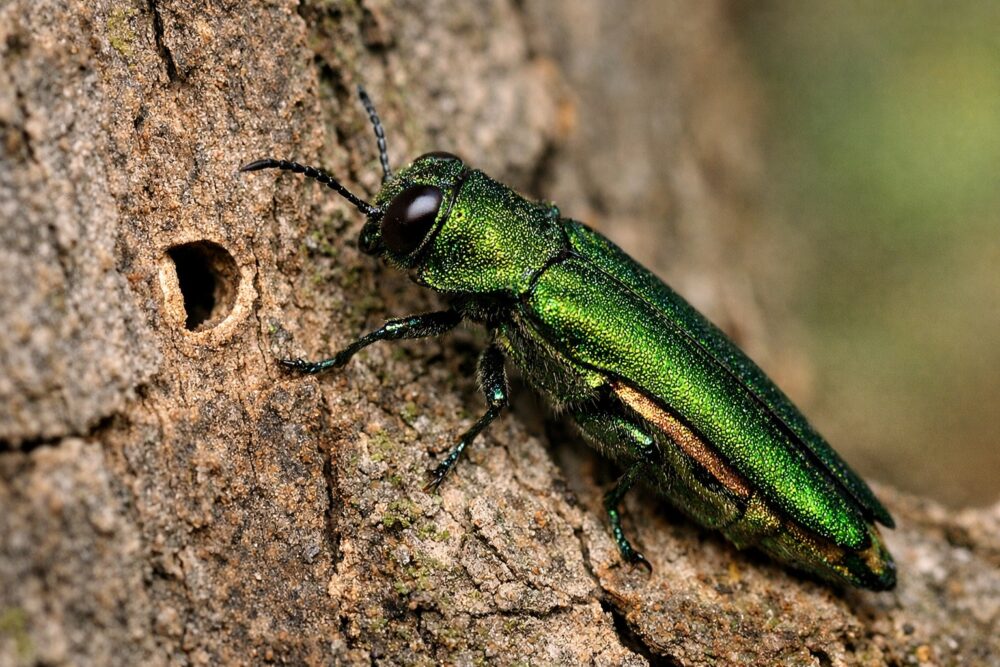
- Emerald ash borer
- Flatheaded borers
- Roundheaded borers
- Bark beetles
- Metallic wood boring beetles
Each species targets different tree varieties, but they share one important trait. They all prefer trees that are already stressed and weakened. Heat, drought, soil compaction, storm injury, or nutrient imbalance can weaken a tree’s natural defenses, making it way easier for wood boring insects to nest ands spread within the trunk.
Tree borers are insects that spend part of their life cycle inside the bark or wood of trees. The larvae tunnel through inner tissue where nutrients and water move through the tree.
This feeding activity disrupts the vascular system and can eventually lead to decline.
For information about one of the most serious invasive pests affecting ash trees in North Texas, visit our Emerald Ash Borer in Tarrant County post.
Why Stressed Trees Attract Borers
Healthy trees aren't passive. They actively defend themselves against insects, disease organisms, and environmental threats. When a tree is sturdy and growing normally, it has multiple biological defense systems that make it extremely difficult for wood boring insects to establish themselves inside of the tree trunk or branches.
One of the most important defenses a tree has is sap flow. When boring insects try to penetrate bark, healthy trees can often push them out with resin or sap pressure. This sticky flow can physically trap insects or flush them from the entry point before they are able to tunnel any deeper.
Trees also produce protective chemical compounds that act as natural insect deterrents. These compounds can make the internal wood tissue toxic or unattractive to insects attempting to colonize the tree.
Because of these defenses, many borers avoid strong trees altogether. Instead, they search for trees that are already weak. Once environmental stress weakens those defense systems, the tree becomes far easier for insects to invade and conquer.
Borers are remarkably efficient at detecting a vulnerable host. Research has shown that stressed trees release specific chemical signals into the air. These signals act almost like a beacon to insects searching for trees.
In our North Texas landscapes, several common environmental stress factors can significantly increase the likelihood of borer infestation.
Heat Stress And Drought
Texas summers are among the most challenging environments for landscape trees. Extended periods of extreme heat combined with irregular rainfall or drought, can place enormous strain on a tree's internal systems.
During drought conditions, trees close up tiny leaf openings called stomata in order to conserve moisture. While this helps reduce water loss, it also limits photosynthesis and slows down energy production inside the tree.
Over time, this energy deficit weakens the tree's ability to maintain their defensive compounds and normal sap pressure. With reduced internal pressure, the tree can no longer push invading insects out of entry holes as effectively.
Heat stress also disrupts root function. When soil temperatures climb, tree roots may struggle to absorb water efficiently, even when moisture is available. This leads to a condition called physiological drought, where trees suffer water stress despite having moisture in the soil.
Borers often take advantage of these weakened conditions. Trees that have endured multiple seasons of drought or intense summer heat frequently become prime targets for borer infestation.
Soil Compaction
Healthy soil contains thousands of tiny air pockets that allow oxygen, water, and nutrients to move freely around tree roots. Unfortunately, urban and suburban landscapes rarely provide ideal soil conditions.
Construction activity, vehicle traffic, and even consistent foot traffic can all compress soil particles together. When soil becomes compacted, those air pockets collapse and oxygen movement through the soil is massively reduced.
Tree roots need oxygen to survive. Without it, root systems begin to decline, which affects the entire tree above ground.
Compacted soil can lead to several problems that indirectly invite insect attack:
- Reduced root growth
- Poor water absorption
- Limited nutrient availability
- Declining canopy vigor
- Slower wound recovery
As root systems weaken, trees produce less energy and fewer defensive chemicals. The reduction in overall health creates conditions that wood boring insects are quick to take advantage of.
Urban soil compaction is one of the most common hidden causes of tree stress in residential landscapes.
Storm Damage
Severe storms are a regular occurrence across many parts of North Texas. High winds, hail, and lightning can cause significant structural injuries to trees, even when the damage isn't immediately obvious.
When bark is torn or cracked, the tree's protective outer barrier is compromised. These wounds expose the inner wood tissue and provide direct entry points for insects.
However, the problem goes deeper than just physical access.
Damaged trees release volatile organic compounds that act as chemical distress signals. Many wood boring insects are able to detect these signals from long distances and use them to locate weakened hosts.
This is one reason why insect infestations often appear after major storm events. A landscape may contain dozens of injured trees that are silently signaling for help.
Even minor injuries can attract insects if they remain untreated. Branch splits, bark abrasions, and lightning scars all increase the likelihood of borer activity.
Nutrient Imbalance
Trees rely on balanced soil nutrition to maintain healthy growth. Essential nutrients such as nitrogen, phosphorus, potassium, iron, and micronutrients support everything from root development to leaf production.
When soil nutrients become depleted or unbalanced, tree growth slows and internal stress gradually increases.
Nutrient deficiencies often develop slowly, making them difficult to notice early. Over time, several warning signs may appear:
- Smaller or pale leaves
- Reduced annual growth
- Thin canopy density
- Premature leaf drop
- Delayed spring growth
As these symptoms develop, the tree's ability to defend itself against insects declines.
Nutrient-stressed trees produce fewer protective chemical compounds and may struggle to seal up small wounds in their bark tissue. These weaknesses provide ideal entry opportunities for wood boring insects searching for new hosts.
Long term soil health plays a major role in determining whether trees remain resilient or become vulnerable to infestation.
Research conducted by forest health specialists consistently shows a strong relationship between environmental stress and insect outbreaks. Trees weakened by drought, soil problems, storm damage, or nutrient imbalance are significantly more likely to experience borer activity.
For additional research on how environmental stress influences insect infestations in forests and landscapes, the United States Forest Service provides extensive resources on forest health and pest behavior.
Life Cycle Of Wood Boring Insects
Most wood boring insects follow a similar development process.
Adult beetles locate weakened trees and deposit their eggs within bark crevices. After hatching, the larvae start tunnelling beneath the bark where they feed and grow.
The larval stage causes the most damage for a tree. Feeding tunnels restrict water and nutrient movement through the trunk.
Once mature, adult insects emerge through small exit holes in the bark. By the time these holes appear, the infestation could've been present for months or longer.
How To Identify Tree Borers In Texas In 30 Seconds
Homeowners searching for borers often want a fast way to recognize possible insect activity. The following quick inspection method can help you spot early warning signs in less than a minute.
Look for these indicators when examining a tree trunk and lower canopy:
- Small round or D shaped holes in the bark
- Fine sawdust material near the base of the trunk
- Bark that appears cracked, loose, or separating
- Increased woodpecker activity around the trunk
- Sections of the canopy showing thinning leaves
If several of these symptoms appear together, wood boring insects may already be active inside the tree. Early pest control evaluation is important because much of the damage occurs beneath the bark where it cannot be seen immediately.
For additional insect identification resources affecting landscape trees, review our Shrub and Tree Pests guide.
Trees Most At Risk From Borers In Texas
Certain tree species are more vulnerable to wood boring insects, especially when environmental stress weakens their natural defenses.
Trees frequently affected by tree borers include:
- Ash trees
- Oak varieties
- Elm trees
- Maple trees
- Crepe myrtle
- Birch trees
- Fruit trees like peach and plum
These trees can become more attractive to wood boring insects during periods of drought, soil stress, storm damage, or nutrient imbalance.
Early Signs Of Tree Borers Texas Homeowners Should Watch For
Many property owners usually don't recognize borer activity until the damage becomes advanced. However, several early warning signs can indicate a potential infestation. Catching these indicators early can make a significant difference in protecting long term tree health, especially during periods of environmental stress, common across North Texas.
Exit Holes In Bark
Small, round or D-shaped holes appear in the bark as adult insects emerge. These openings are often one of the first visible signs that borers have completed part of their life cycle inside the tree.
The size and shape of these holes can vary depending on the species. For example, flatheaded borers often leave D-shaped exit holes, while round-headed borers create perfectly circular openings. These holes may be scattered across the trunk or concentrated in specific areas where the borer infestations are heavier.
Homeowners and property managers should look closely at the main trunk and larger branches during their tree and shrub care practices, as these areas commonly show early signs before the damage spreads further into the canopy.
Sawdust Or Frass
Fine wood particles, often referred to as frass, may collect near the base of the tree, along bark ridges, or within crevices. This material is produced as the larvae tunnel through the inner wood.
Frass can appear as:
- Fine powder resembling sawdust
- Small compact pellets
- Light colored or dark depending on tree species and moisture levels
This is one of the most overlooked signs of borer activity. Because it can blend into the surrounding soil or mulch, it's usually missed unless specifically inspected. By regularly checking around the root flare and bark texture, you can help catch infestations early.
Bark Cracking
As the larvae feed beneath the tree bark, they disrupt the internal structures that supports healthy growth. Over time, this causes the bark to loosen, split, or appear cracked.
These cracks may be subtle at first and often follow the natural lines of the tree, making them easy to ignore as something natural. However, expanding splits or sections of bark that feel hollow when tapped indicate more advanced internal feeding.
In some cases, bark can begin to peel away entirely, exposing the damaged inner wood.
Woodpecker Activity
Woodpeckers are natural predators of wood boring insects. Increased woodpecker activity is often a strong natural indicator that larvae are present beneath the bark.
You may notice:
- Repeated pecking in the same area
- Small scattered holes created by birds searching for insects
- Bark flaking off where feeding has occurred
While occasional woodpecker presence is normal, concentrated activity on a single tree shouldn't be ignored. These birds are highly efficient at locating insect infestations long before humans can.
Thinning Canopy
As internal damage increases, the tree’s ability to move water and nutrients around becomes restricted. This disruption often shows up in the canopy first.
Early signs include:
- Smaller than normal leaves
- Delayed leaf development
- Sparse foliage at branch tips
- Sections of the canopy appearing uneven
Over time, this can progress into larger areas of decline if the infestation continues unchecked. Because canopy symptoms can resemble drought stress or nutrient imbalance, it is important to inspect the trunk and branches for additional borer indicators.
Recognizing these early warning signs allows Texas homeowners and property managers to take action before structural damage becomes severe. Regular inspection, especially during high stress periods like summer heat or drought, is one of the most effective ways to detect and manage borer activity before it spreads.
Why Early Detection Matters
Early detection greatly improves the ability to protect trees from long term damage.
If infestations remain undetected, internal damage can eventually lead to:
- Reduced water transport
- Increased susceptibility to other pests
- Declining canopy density
- Structural instability
- Progressive decline over multiple seasons
Monitoring tree health allows arborists to evaluate conditions before damage becomes severe.
Protecting Trees Across Texas
At Trees Hurt Too, our focus is on education, inspection, and monitoring of tree pests affecting our North Texas landscapes. Every property presents a unique set of environmental conditions, and understanding how those conditions influence tree health is the foundation of long-term protection.
Trees across the DFW metroplex are constantly exposed to stress from heat, drought, soil conditions, and seasonal weather swings and storms. These factors quietly weaken a tree's natural defenses, making it easier for insects like borers to establish themselves before visible damage appears. That's why a proactive approach centered on awareness and early evaluation is so important.
Education First Approach
Our process begins with helping property owners understand what to look for and when to take action. Many infestations go unnoticed simply because the early symptoms are subtle and often mistaken for general stress.
We work to simplify complex tree health issues by focusing on:
- Recognizing early warning signs of insect activity
- Understanding how environmental stress increases vulnerability
- Identifying high risk periods throughout the year
- Monitoring changes in canopy density and bark condition
This approach allows homeowners to stay ahead of potential problems rather than reacting after damage has progressed.
Detailed Tree Health Inspections
If you suspect tree borer infestations may be affecting your trees, scheduling a professional tree health inspection is a critical next step. A thorough inspection goes beyond surface level observations and evaluates the overall condition of the tree.
During an inspection, key areas of focus include:
- Trunk and bark condition for exit holes or cracking
- Presence of frass or other signs of internal feeding
- Canopy density, leaf size, and overall vigor
- Root flare condition and surrounding soil environment
By combining visual assessment with experience in Texas specific pest patterns, inspections can uncover issues that aren't immediately obvious.
Ongoing Monitoring Matters
Conditions can change quickly, especially during extended heat or drought cycles. Monitoring allows small issues to be identified before they develop into widespread damage.
Consistent observation helps track:
- Changes in canopy fullness over time
- New or expanding areas of bark damage
- Increased insect or bird activity around the tree
- Signs of stress following storms or temperature extremes
This ongoing monitoring is one of the most effective ways to reduce long term risk and maintain healthy trees across your property.
Preserving Long Term Tree Health
Early detection can help protect valuable landscape trees, maintain yard shade coverage, and preserve the long-term health of your property. Mature trees provide significant environmental and curb appeal benefits, but they require attention to remain strong and resilient.
Taking action early can help:
- Reduce the spread of insect activity within the tree
- Maintain structural integrity and canopy coverage
- Support consistent growth and seasonal performance
- Protect overall property value and curb appeal
Protecting trees across Texas starts with informed decisions and timely inspections. When property owners stay proactive, they create an environment where trees can better withstand stress and resist pest pressure over time.