

Trees dropping leaves in July in DFW are not necessarily dying. Summer leaf drop is a documented heat and drought survival response, and it happens across the Dallas-Fort Worth area every year. The tree is shedding surface area to reduce its total water demand when soil moisture cannot keep pace with what the canopy requires.
This is different from spring leaf shed in Texas live oaks, which is a normal part of the annual growth cycle. July leaf drop is an emergency response to conditions the tree cannot sustain. Most trees that drop leaves in summer recover fully once watering improves and temperatures moderate. The questions to answer are whether this is heat and drought stress, or whether something more serious is happening.
This post covers why trees drop leaves in DFW summers, how to tell heat stress from disease, which trees in Tarrant County are most vulnerable, and when to call an ISA Certified Arborist.
Why Trees Drop Leaves in Summer
Trees lose water faster than they can replace it during extreme summer heat. The process that normally cools the tree (transpiration, where water moves from roots to leaves and evaporates) requires a steady supply of soil moisture. When that supply runs out, the tree closes the tiny pores on leaf surfaces called stomata to stop water loss. But closed stomata also stop the cooling process, so leaf temperature rises.
Faced with that situation, the tree begins dropping leaves to reduce its total canopy surface area. Fewer leaves means less total water demand. The tree is not dying; it is calculating a survival trade-off. As chlorophyll degrades in leaves scheduled for drop, yellow pigments in the leaf become visible before the leaf falls. This yellowing before July drop is part of the process, not a disease symptom on its own.
Some species go further and enter partial summer dormancy, dropping most of their leaves and suspending active growth until conditions improve. This is distinct from disease or death. Certain elms, hackberry trees, non-native maples, and some fruit trees and ornamentals use this strategy regularly in North Texas summers.
What Is Normal Summer Leaf Drop and What Is Not?
Normal summer leaf drop from heat and drought stress follows a consistent pattern. Leaves yellow and fall, usually starting at branch tips and progressing inward. Scorched brown leaf margins may appear before or alongside the drop. The drop happens across multiple branches at roughly the same time. The tree often retains some leaves near the trunk and main branches. No unusual growth, lesions, or discoloration appears on the bark itself.
A tree following this pattern is responding to stress, not disease. It needs water and time, not a chemical treatment program.
Is Summer Leaf Drop Normal in North Texas?
Summer leaf drop is common enough in North Texas that it should not cause immediate alarm on its own. The DFW region sees drought pressure most summers, and July and August are the months when cumulative heat stress peaks for trees that did not receive adequate water in spring and early summer.
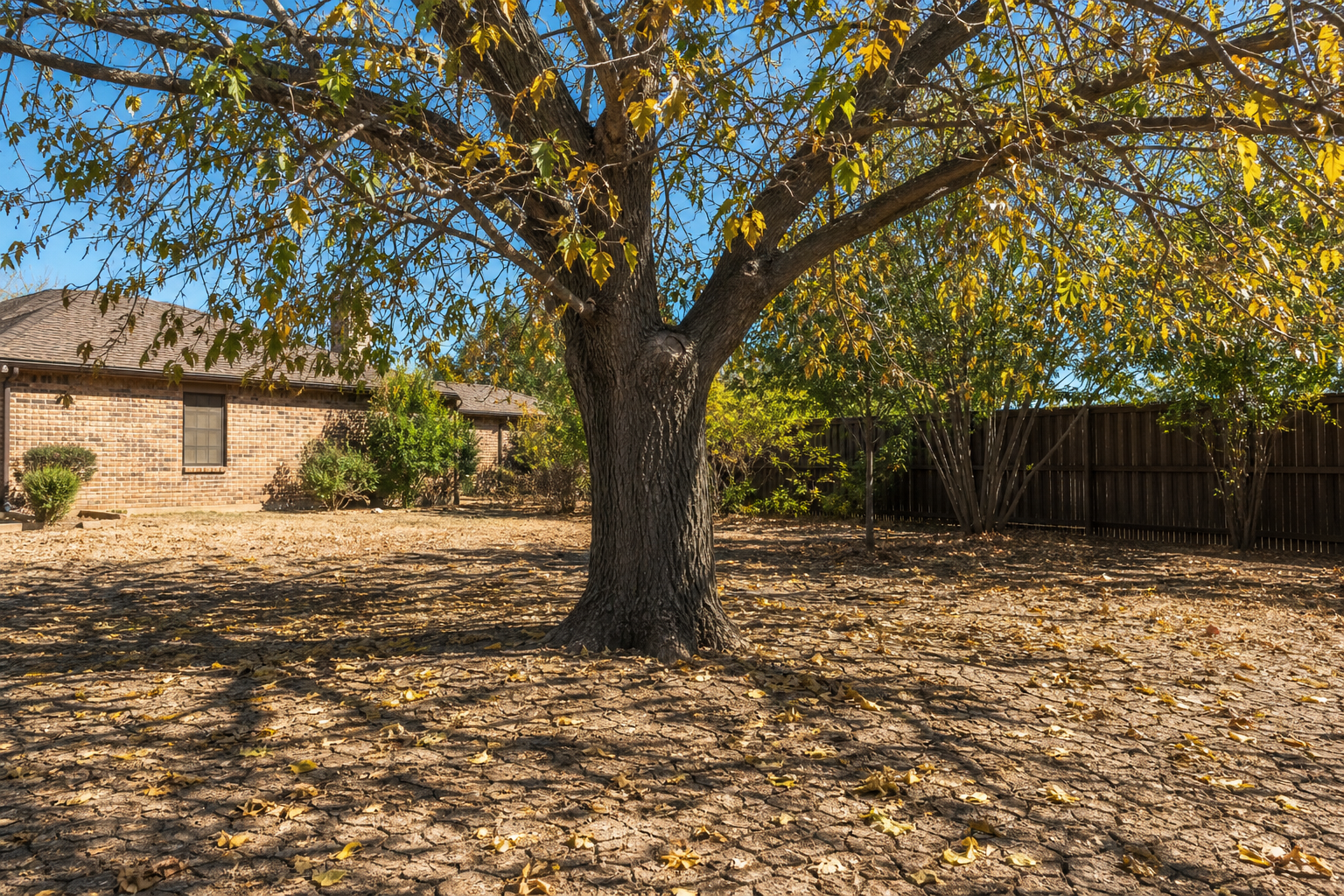
Trees in Fort Worth, Arlington, Keller, and surrounding Tarrant County communities face the same conditions: clay soil that dries hard and resists water penetration, air temperatures regularly above 100 degrees Fahrenheit, and often weeks without meaningful rainfall. Summer leaf drop is this region's trees making the best available choice under conditions that exceed what their root systems can support.
Texas Trees Foundation has published guidance on recognizing and responding to heat-related tree stress, available at texastrees.org.
Signs of Heat Stress vs. Signs of Disease in Leaf Drop
The critical skill during July leaf drop is distinguishing drought and heat stress from a disease or pest problem that requires different intervention. Most summer leaf drop in DFW is stress-related, but a portion of cases involve underlying disease that the stress has accelerated or revealed.
Signs that leaf drop is heat and drought stress:
- Leaves yellow, then drop, typically starting at branch tips
- Scorched brown margins appear before or during leaf drop
- Drop occurs across multiple branches at roughly the same time
- Tree retains some leaves near the trunk
- No visible cankers, lesions, or unusual growths on bark
- Drop occurs during or immediately after a heat wave or extended dry period
- Tree shows improvement within one to two weeks of consistent deep watering
Signs that leaf drop may indicate disease and warrant an arborist evaluation:
- Drop confined to one section of the canopy while other sections look normal
- Visible lesions, discoloration, or oozing on bark near affected branches
- Leaf drop preceded by early spring flagging (a classic oak wilt warning sign)
- Drop combined with wilting and branch dieback progressing in sequence
- Black or orange spore patches on the bark (signs of hypoxylon canker)
- Drop that shows no improvement after two weeks of consistent watering
When leaf drop is asymmetric, involves bark changes, or follows a pattern inconsistent with the whole-canopy stress response, contact a tree health diagnostic professional before drawing conclusions.
Which Trees Are Most Vulnerable to Summer Leaf Drop in DFW?
Any tree can drop leaves during an extreme summer, but certain situations create significantly higher risk regardless of species.
Young trees planted in the last three years have not yet developed the extensive root systems that allow established trees to draw moisture from a wide soil area. A young tree in a Fort Worth or Mansfield yard without supplemental watering through July faces real risk of permanent decline.
Trees in reflected heat situations absorb heat from adjacent pavement, concrete walls, and south-facing exposures. These trees experience conditions significantly more severe than air temperature measurements suggest.
Trees in compacted clay soil with restricted root zones cannot expand roots into new moisture reserves when the soil near the trunk dries out. Tarrant County's heavy clay is prone to this problem, particularly in established neighborhoods where decades of surface compaction have reduced soil structure.
Trees that did not receive supplemental water in spring entered the summer season already depleted. July heat pushes them past a threshold their reserves cannot support.
Heat-tolerant native tree species handle North Texas summer conditions better than non-native species. Texas Trees Foundation lists cedar elm, chinquapin oak, bur oak, lacey oak, live oak, Shumard oak, Chinese pistache, and Texas buckeye as species with strong drought and heat tolerance for this region.
What to Do When Your Tree Drops Leaves in July
When a tree begins dropping leaves in July, address water first. Most heat and drought leaf drop stabilizes quickly with proper watering. Follow these steps:
- Water deeply and immediately. Apply water to the entire area beneath the canopy (the dripline), starting at least 10 inches from the trunk. Use a slow trickle that allows penetration into clay soil rather than running off the surface.
- Apply two to three inches of organic mulch. Mulch under the canopy retains soil moisture and reduces surface temperature. Keep it away from the trunk.
- Do not fertilize. Fertilizer stimulates new growth and increases the tree's water demand. A tree under active heat stress cannot support new growth requirements.
- Do not prune dropping branches yet. Wait until fall when temperatures moderate consistently. Pruning live tissue during summer stress requires energy the tree needs for survival.
- Monitor for improvement. A tree responding to heat stress shows stabilization and some recovery within one to two weeks of consistent watering. If it does not improve, or if symptoms change to include bark discoloration or progressing dieback, request an arborist evaluation.
- Call an ISA Certified Arborist if the pattern is asymmetric or accompanied by bark changes. Asymmetric drop (one side of the canopy while others look normal) or bark symptoms alongside leaf drop require professional diagnosis before treatment decisions are made.
Moisture Management and Root Zone Support
Trees recovering from summer leaf drop benefit from root zone support beyond surface watering alone. Root zone moisture management using Hydretain holds water molecules at the root level, reducing how quickly the root zone dries between watering sessions. This is particularly valuable in North Texas clay soil, which repels water and drains unevenly when dry.
The tree care program from an ISA Certified Arborist includes evaluation of root zone soil conditions, moisture needs, and the presence of secondary pest or disease threats that summer stress may have activated. Addressing the full picture of a stressed tree produces better outcomes than responding to symptoms one at a time.
When to Call an Arborist About Summer Leaf Drop
A tree dropping leaves in July does not automatically need professional intervention. Most recover with consistent watering and mulching. Call an ISA Certified Arborist when any of the following are true:
- Leaf drop is limited to one side or section of the canopy
- Bark shows discoloration, lesions, oozing, or orange or black spore patches
- The tree showed signs of decline in spring before July heat arrived
- No improvement appears after two consistent weeks of deep watering
- Dieback is progressing from branch tips downward through the canopy in a spreading pattern
- The tree is high-value (large mature oak, significant landscape specimen) and the risk of loss is substantial
An arborist evaluation in late July or early August can distinguish heat stress from oak wilt, hypoxylon canker, root rot, or other conditions that require specific treatment. Waiting until fall to investigate a July decline risks losing the treatment window for diseases that respond to timing-sensitive intervention.
Summer Leaf Drop Across the DFW Region
Summer leaf drop affects trees throughout the DFW region every year. Established neighborhoods in Fort Worth and Arlington lose mature trees to compounding drought stress when consecutive dry summers exhaust their reserves. Newer communities in Burleson, Mansfield, and Keller face higher risk from young trees still establishing root systems. Grapevine, North Richland Hills, Irving, and Southlake landscapes all contain the same vulnerable species under the same summer pressure.
The pattern repeats annually because the combination of Tarrant County clay soil and North Texas summer heat creates conditions that consistently push trees toward their limits. Understanding that cycle and responding with appropriate watering, mulching, and professional evaluation when warranted keeps most trees healthy through summer and into fall recovery.
Frequently Asked Questions About Trees Dropping Leaves in July
Is a tree that drops leaves in July dead?
Not necessarily. A tree dropping leaves in July is most likely responding to heat and drought stress, which is a survival mechanism. Many trees recover fully when watered consistently and conditions improve. A dead or dying tree shows no response to watering, has brittle branches that snap without bending, and may show bark peeling or slipping from the trunk. An arborist evaluation distinguishes stressed from non-viable trees.
How long does it take a tree to recover from summer leaf drop?
Most trees showing heat and drought leaf drop stabilize within one to two weeks of consistent deep watering. Full canopy recovery with new leaf growth typically happens in fall, after temperatures moderate. Trees that experienced severe root zone desiccation may produce sparse canopy the following spring before recovering fully by the second growing season after the stress event.
Should I call a tree company the same week my tree starts dropping leaves?
Start with deep watering and monitor for one to two weeks. If the tree stabilizes and shows signs of holding remaining foliage, heat and drought stress is the likely cause and the immediate response is appropriate. Call an ISA Certified Arborist the same week if you notice asymmetric drop, bark changes, or if the tree showed any decline in spring before July arrived. Early diagnosis on a disease issue is always better than a delayed one.
Not Sure What Is Happening to Your Tree? Get a Professional Eye on It
Trees Hurt Too Inc. has served Fort Worth and surrounding Tarrant County for over 28 years. Call or text to schedule a consultation.
Call: (972) 521-1552 | Text: (972) 521-1552 | treeshurttoo.com