

Sunscald and Bark Damage Trees DFW
Protect Your Trees from Sunscald and Bark Damage As May arrives in the Dallas-Fort Worth area, homeowners begin to enjoy …


Locally owned and family operated, proudly serving North Texas. Get your free, no-obligation quote. Or call (972) 521-1552.
Free QuoteIf you have noticed clean-cut twig sections accumulating under your oaks or pecans in late summer and fall, you are almost certainly dealing with the twig girdler, Oncideres cingulata. This longhorned beetle is a consistent presence in North Texas wherever oaks and pecans are grown, with adult beetles active from late August through October, chewing the distinctive circumferential cuts around twigs that give the insect its name. The girdled twig tips die and fall, often leaving a quantity of fallen twigs that looks alarming but in most cases represents a cosmetic nuisance rather than a serious health threat to established trees. Trees Hurt Too, Inc. evaluates twig girdler infestations throughout North Texas, accurately distinguishes twig girdler activity from other causes of twig loss, and provides management guidance calibrated to the actual impact on each specific tree.
"Twig girdlers are one of those insects where the most effective management tool costs nothing but time. Picking up and disposing of the girdled twigs that fall in September and October removes the eggs and larvae that would otherwise overwinter and produce next year's adult population. On established oaks and pecans I rarely recommend chemical treatment because the trees tolerate the girdling well. On young trees where the structural development is being affected, or on high-value specimens with heavy infestations, the calculus changes." Ken, ISA Certified Arborist Tx-3265-A | Owner, Trees Hurt Too, Inc.
We provide free on-site evaluations throughout North Texas. Call (972) 521-1552 if you see clean-cut twig sections falling from your trees, or visit our Tree Health Care and Arborist Services page.
Understanding the twig girdler life cycle is essential to understanding why twig collection is such an effective management tool:
Because twig girdler larvae overwinter in the fallen twig sections, collecting and disposing of fallen girdled twigs in September through November removes the developing larval population before it can emerge as adults. This directly reduces next year's breeding population without any chemical intervention. On properties where twig collection is consistently practiced, twig girdler populations decline over time as the local reproductive cycle is disrupted year after year.
Oakley says...
No charge. No obligation. An ISA Certified Arborist visits your property and gives you honest answers before recommending anything.
The most effective twig girdler management step is collecting all girdled twigs that fall in September through November and disposing of them away from the property. Bags or containers that prevent larval emergence are preferable to composting on-site, which can allow adults to emerge and reinfest. Consistent twig collection over multiple years reduces local twig girdler populations progressively.
For young trees where structural development is being affected by heavy twig girdler activity, or for high-value specimen trees with severe infestations, systemic insecticide applications can reduce adult feeding activity. Timing is critical as applications must contact the adult beetles during their August through October feeding period. Our certified arborist determines whether treatment is warranted and selects appropriate timing and products. Learn more about our integrated pest management approach at our shrub and tree pest control page.
Established healthy trees tolerate twig girdler activity without serious health consequences. Maintaining tree vigor through our deep root feeding program and moisture management program keeps trees above the stress threshold where pest pressure becomes a more serious concern.
We evaluate twig girdler infestations throughout the DFW metroplex wherever oaks and pecans are established. Twig girdler activity is especially common in communities with significant oak canopy throughout Tarrant County and Dallas County. Call (972) 521-1552 to schedule your free evaluation.
Your Tree Cannot Wait
Early diagnosis is the difference between saving and losing a tree. Call our ISA Certified Arborist directly for same-week evaluations throughout the DFW area.
(972) 521-1552Free on-site evaluation • No obligation • Honest answers
The twig girdler is a longhorned beetle that chews circumferential rings around pencil to finger-thick twigs of oaks, pecans, and other trees, laying eggs beyond the cut in the soon-to-die twig section. Larvae overwinter in the fallen girdled twigs. Adult beetles are active in North Texas from late August through October.
Clean-cut twig sections falling from oaks and pecans in late summer and fall, with a distinctive clean circumferential bark cut at the broken end. The clean ring cut distinguishes twig girdler activity from storm damage and from twig pruner damage which has a frayed interior surface.
Rarely fatal to established healthy trees. Established oaks and pecans tolerate twig girdler activity for multiple seasons without serious health consequences. Young trees where structural development is affected and heavily infested high-value specimens warrant closer attention and may benefit from treatment.
Oaks and pecans are most frequently and heavily infested throughout the DFW area. Hickories, elms, and hackberries are also susceptible at lower intensity.
Collecting and disposing of fallen girdled twigs in September through November is the most effective management step, removing overwintering larvae before they can emerge as adults. Consistent collection over multiple years progressively reduces local population. Insecticide applications are available for high-value trees with heavy infestations where the certified arborist determines treatment is warranted.
No. Twig girdlers cut clean rings in the outer bark. Twig pruners tunnel internally through the wood. Both cause twig drop in North Texas and may affect the same trees simultaneously, but produce different damage patterns that a certified arborist can distinguish during evaluation.
Yes. Trees Hurt Too provides completely free on-site tree evaluations throughout the DFW area with no obligation. Call (972) 521-1552 or request your evaluation through our contact page.
Trees Hurt Too provides ISA Certified Arborist twig girdler diagnosis and management throughout North Texas. View our complete service area or call (972) 521-1552. For additional information on twig girdler research visit the Texas A&M AgriLife Extension.
Protect Your Trees Year-Round
Our certified arborist-supervised annual programs include:
On-site evaluation and custom program quote
Get My Custom Program QuoteNo contracts • Cancel anytime
Stay informed about lawn care, tree care and pest related issues in your area!
Protect Your Trees from Sunscald and Bark Damage As May arrives in the Dallas-Fort Worth area, homeowners begin to enjoy …
Why Trees Drop Leaves in May in the Dallas-Fort Worth Area If you’ve noticed leaves scattered across your lawn in …
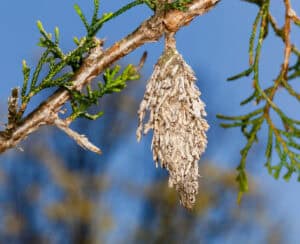
Identify and control bagworms before they damage your North Texas trees and shrubs this season.