

Trees have no internal water storage system. Unlike cacti or succulents, they cannot hold water reserves in their tissue. Every hour of a hot Texas summer, trees pull water from the soil, move it through their vascular system, and release it through their leaves. When the soil runs dry, that process stops and the tree begins to fail.
Knowing how to water trees during a Texas drought comes down to getting the right amount of water into the right location at the right time. For a normal North Texas summer, most established trees need two to three gallons of water per inch of trunk diameter, applied two to three times per week. During an extreme drought, one to two gallons per inch of trunk diameter once per week keeps most established trees stable without overwatering.
This guide covers how much to water, where and when to apply it, which trees in Tarrant County are most at risk, and what mistakes to avoid when summer drought sets in.
Why Texas Droughts Are Especially Hard on Trees
Texas experiences drought pressure nearly every summer, and the 2022 drought covered over 99 percent of the state simultaneously. The combination of extreme heat, low humidity, and clay soil creates conditions that deplete root zone moisture far faster than in other regions.
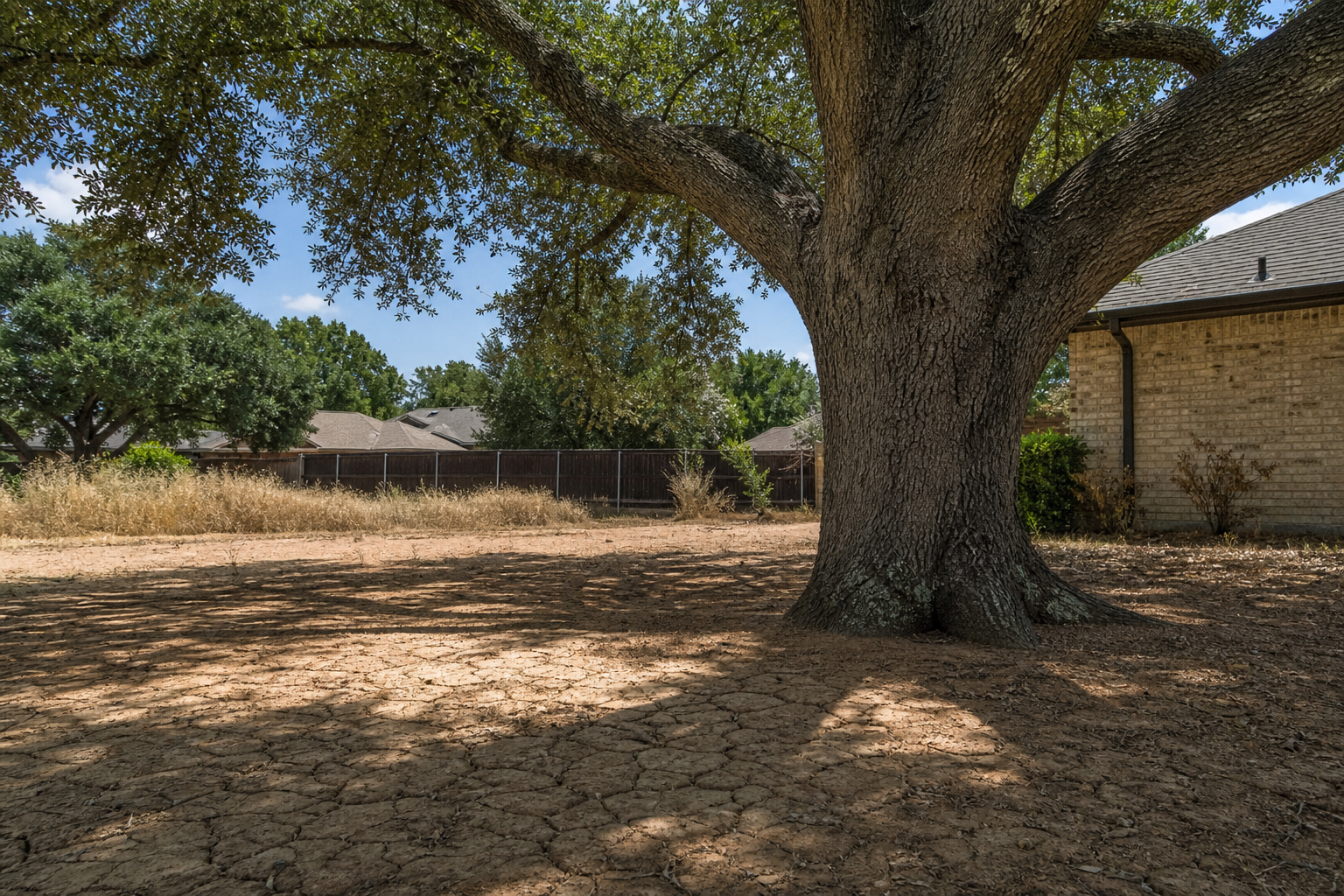
Tarrant County's clay soil behaves inconsistently under drought. When moist, clay holds water well. When it dries out completely, it contracts, pulls away from itself, and forms cracks at the surface. Water applied to bone-dry clay runs along the surface and into cracks rather than soaking through to the root zone. A tree can sit in soil that looks watered but has no accessible moisture in the layer where roots actively absorb water.
Secondary pressure follows drought stress. Trees weakened by water deficit become targets for bark beetles, borers, and opportunistic fungal infections. The root cause of those secondary problems is still drought. Treating the pests or fungi without addressing the water deficit rarely produces lasting recovery. For more detail on tree health care in North Texas, the full range of drought-related threats is covered there.
Texas A&M Forest Service maintains detailed guidance on watering trees during drought, available at tfsweb.tamu.edu.
Which Trees Are Most Vulnerable to Drought in Tarrant County?
Established mature trees in good soil with deep root systems handle drought better than young or recently planted trees. The species most commonly lost to drought stress in Tarrant County include oaks, elms, hackberry trees, and junipers. Oaks represent the most common loss because they are the most widely planted landscape tree in the region and homeowners often underestimate their water needs during a severe drought.
Young and recently planted trees face far greater risk than mature specimens. A tree planted within the last three years has not yet developed the extensive root system that draws moisture from a wide soil area. These trees depend almost entirely on the water available in their original root ball and the small zone of soil immediately surrounding it.
Trees in high-risk situations regardless of species include:
- Any tree planted within the past three years
- Trees growing in compacted soil or restricted root zones (parking lots, narrow planting strips, clay hardpan)
- Trees in reflected heat situations near pavement or south-facing walls
- Trees that did not receive supplemental water during the previous spring
- Trees showing signs of other stress, including previous insect damage or disease
How Much Water Do Trees Need During Drought?
Watering amounts vary by tree size, species, soil type, and current drought severity. These guidelines from Texas A&M Forest Service provide a reliable starting framework for North Texas conditions.
Normal summer watering (no active drought):
- 2 to 3 gallons per inch of trunk diameter, applied 2 to 3 times per week
- Example: A tree with a 4-inch diameter trunk needs 8 to 12 gallons per watering session
Extreme drought conditions:
- 1 to 2 gallons per inch of trunk diameter, once per week
- This reduced volume prevents overwatering while maintaining minimum moisture in the root zone
Newly planted and young trees (April through October):
- 5 to 15 gallons per week, depending on tree size and current temperature
- Young trees need consistent weekly watering throughout the growing season regardless of rainfall
Mature established trees showing no stress signs:
- May not need supplemental watering during normal drought periods
- If showing early stress signs (premature leaf drop, wilting), begin supplemental watering immediately
The Screwdriver Test: How to Check Soil Moisture Before Watering
Before each watering session, test soil moisture with the screwdriver test. Insert a long screwdriver or metal rod into the soil within the tree's root zone. If it slides in six to eight inches with reasonable effort, the soil has adequate moisture and watering can wait. If the tool stops short or meets hard resistance in the first few inches, the soil is dry and needs water.
This test takes thirty seconds and prevents two of the most damaging watering mistakes: underwatering because a schedule says to skip a day, and overwatering because a schedule says to water when the soil is already moist.
Where to Apply Water to Trees
Water applied to the wrong location does not reach the roots that need it. This is one of the most common and consequential watering mistakes homeowners make during drought.
Apply water to the entire area beneath the tree's canopy, called the dripline. Tree roots extend outward in all directions from the trunk, often reaching past the canopy edge. The feeder roots that actively absorb water and nutrients concentrate in the outer portion of this zone, not near the trunk.
Keep these guidelines in mind when positioning water:
- Start at least 10 inches from the trunk. Applying water directly against the trunk promotes bark decay and root rot at the crown. Keep all water and mulch away from the trunk flare.
- Water the entire root zone. Move the application point around the dripline rather than saturating one spot. Concentrated watering in one area creates uneven moisture distribution in the root zone.
- Extend beyond the canopy edge. For large established trees, roots may extend 1.5 to 2 times the canopy width. If drought stress is severe and the tree is large, extend the watering zone beyond the visible drip line.
When and How to Water Trees in Texas Summer
Timing and method affect how much water actually reaches the root zone rather than evaporating before it penetrates the soil.
When to water: Water in the morning or evening only. Avoid applying water between 10 a.m. and 6 p.m. during summer. Water applied to hot, dry soil during the hottest part of the day loses a significant portion to evaporation before it can penetrate the surface. Morning watering is preferred because it allows the soil surface to dry somewhat before nightfall, which reduces fungal disease risk.
How to water: Use a hose on a slow trickle setting, a bubbler attachment, or a drip system rather than an overhead sprinkler. The goal is slow application that gives water time to absorb into the soil rather than running off the surface. Moving the hose slowly around the dripline over thirty to sixty minutes delivers better penetration than standing in one spot for ten minutes.
Overhead sprinklers deliver water to leaf surfaces and the area immediately around the trunk rather than to the root zone. During drought, overhead irrigation for trees wastes a significant portion of applied water before it reaches the soil where roots can access it.
How to Prioritize Which Trees to Water First
When water access is limited or time is short, prioritize trees in this order:
- Newly planted trees. Any tree planted in the past three years faces the highest risk of death during drought and depends most directly on supplemental watering.
- Trees already showing stress signs. Premature leaf drop, wilting, and tip dieback signal that a tree has already depleted its available soil moisture.
- High-value specimen trees. Large established oaks and other mature trees that would be difficult or impossible to replace represent the highest landscape investment.
- Trees in high-risk sites. Compacted soil, reflected heat locations, and restricted root zones create accelerated drought stress.
- Healthy established trees. These can often tolerate the longest intervals between watering during moderate drought.
Mulch and Root Zone Protection During Drought
Two to three inches of organic mulch applied over the root zone (keeping it away from the trunk) is one of the most effective drought protection steps a homeowner can take. Mulch reduces soil temperature by shielding the surface from direct sun, slows moisture evaporation from the soil surface, and moderates the wide temperature swings that cause clay soil to crack and repel water.
Without mulch, bare soil in a North Texas summer loses moisture to evaporation from the surface rapidly. The same soil volume under two inches of organic mulch retains moisture significantly longer between watering sessions.
For properties where consistent watering is a challenge, root zone moisture management using Hydretain holds water molecules at the root level rather than allowing them to evaporate or drain past the root zone. This service significantly reduces how often trees need supplemental watering, which is particularly valuable during extended drought periods in clay soil.
What Not to Do When Trees Are Drought Stressed
Several common responses to drought-stressed trees make the situation worse rather than better.
- Do not fertilize during drought. Fertilizers stimulate new growth and increase the tree's water demand. Applying fertilizer to a drought-stressed tree adds pressure the root system cannot support.
- Do not dig holes around the root zone to try to water more deeply. This practice disturbs roots and dries out surrounding soil faster by increasing surface area exposed to air. It does not improve water penetration and causes direct root damage.
- Do not let soil stay constantly saturated. Waterlogged soil lacks oxygen and suffocates roots, producing the same wilting symptoms as drought. The screwdriver test prevents both under and overwatering.
- Do not apply pesticides or fungicides to address secondary symptoms without addressing water first. Borers, fungi, and other secondary problems on drought-stressed trees result from the tree's reduced defenses. Treating the symptom without addressing the water deficit does not resolve the underlying cause.
Deep Root Feeding and Moisture Management for Drought Recovery
Trees that have already experienced significant drought stress benefit from more than surface watering alone. Deep root feeding delivers carbon-based nutrients and mycorrhizal fungi directly into the root zone, supporting the root growth and soil biology that allow trees to access water more efficiently. Mycorrhizal fungi can expand the effective root surface area by up to 700 times, dramatically increasing the volume of soil a tree can draw moisture from during drought.
This treatment is particularly effective in Tarrant County's compacted clay soil, where restricted root zones limit the moisture available to trees even when surface watering is adequate.
Tree Drought Care Across Tarrant County
Summer drought pressure affects every community in the region, from established Fort Worth neighborhoods with large oaks to newer developments in Mansfield, Keller, and Burleson where trees are still establishing root systems. Irving, Grand Prairie, and North Richland Hills landscapes face the same clay soil and triple-digit temperature combination that drives drought stress throughout Tarrant County.
Trees planted along streets, in HOA common areas, and in commercial properties face added stress from pavement heat and restricted root zones. These trees often show drought stress symptoms earlier and more severely than trees in open residential yards.
Frequently Asked Questions About Watering Trees During Texas Drought
How do I know if my tree is drought stressed or dying?
Drought-stressed trees show symptoms including premature leaf drop, wilting, and leaf scorch. These symptoms appear across multiple branches simultaneously. A tree that responds to deep watering by resuming normal appearance within days is stressed, not dying. A tree that continues to decline after consistent watering, or shows branch dieback progressing from the top downward, needs evaluation by an ISA Certified Arborist.
Can a tree die from one summer of drought?
Young trees planted in the last three years can die in a single severe drought season without supplemental watering. Established mature trees can survive one moderate drought season but accumulate stress that makes them vulnerable the following year. Trees that survive without visible symptoms one summer may show delayed decline the next spring, particularly oaks and elms in Tarrant County clay soil.
Does mulch really make a difference during a drought?
Yes, measurably. Organic mulch at two to three inches depth significantly reduces soil temperature and slows moisture evaporation from the soil surface. A tree root zone covered with mulch retains available moisture substantially longer between watering sessions compared to bare soil. Over time, decomposing mulch also improves clay soil structure, making it less prone to surface cracking and runoff.
Get Your Trees Through This Summer
Trees Hurt Too Inc. has served Fort Worth and surrounding Tarrant County for over 28 years. Call or text to schedule a consultation.
Call: (972) 521-1552 | Text: (972) 521-1552 | treeshurttoo.com