

Brown patch lawn fungus hits Fort Worth lawns twice a year, and the fall window, running from September through November, is the more damaging of the two. August is the right time to recognize the warning signs, understand what triggers the disease, and get a treatment plan in place before the problem spreads across a St. Augustine lawn in a matter of days.
The pathogen responsible is Rhizoctonia solani. It attacks warm-season grasses including St. Augustine, Bermuda, and zoysia. In Fort Worth, St. Augustine takes the hardest hit because the disease spreads rapidly when leaves stay wet for more than 10 hours continuously, a condition North Texas clay soil creates by holding surface moisture far longer than sandy soils do. This post explains how to identify brown patch, how it differs from drought stress, and what treatments stop active disease and prevent recurrence.
What Brown Patch Lawn Fungus Looks Like in Fort Worth
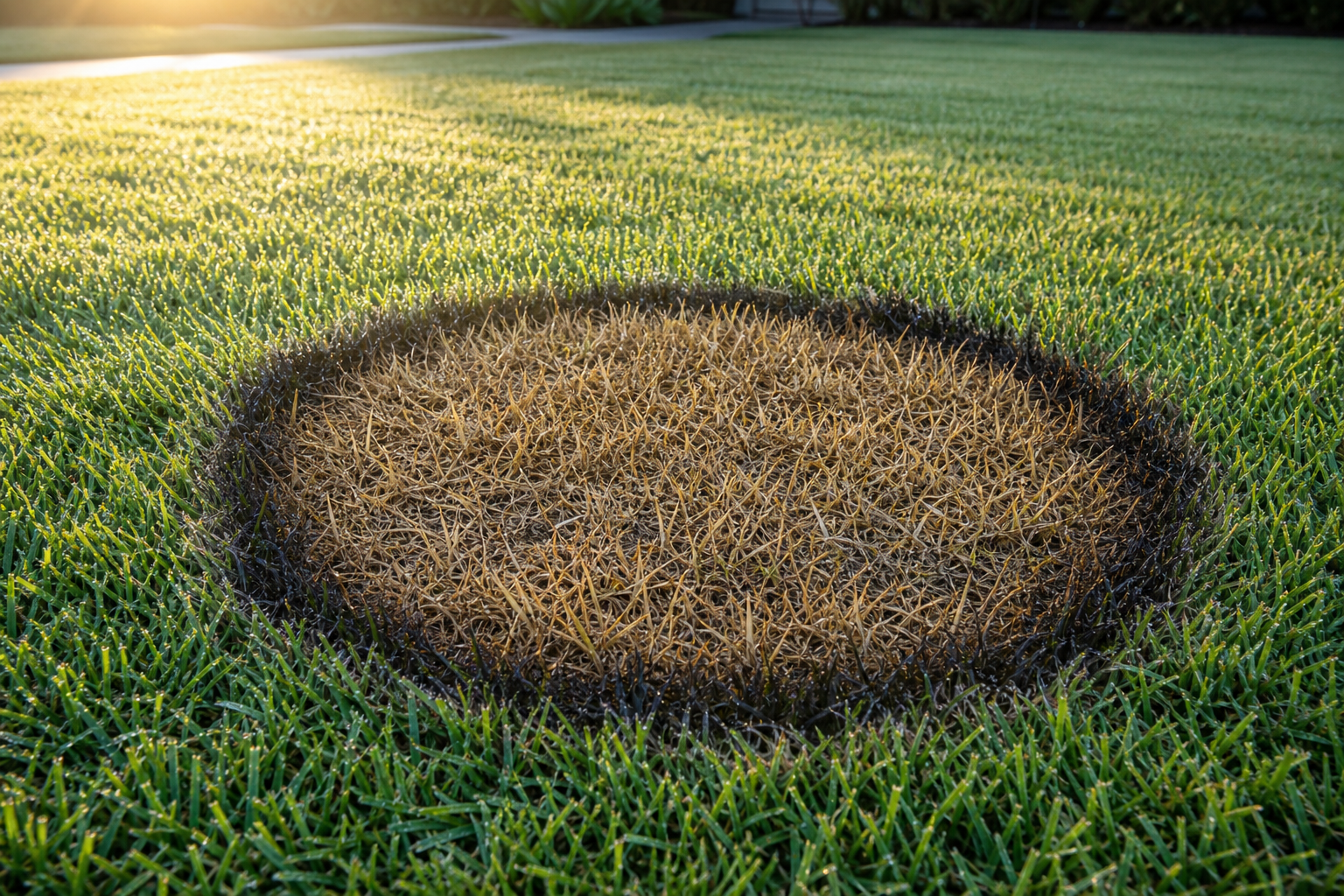
Brown patch appears as circular patches of light tan or brown grass, ranging from a few inches to several feet in diameter. The patches often develop a doughnut shape as the center recovers while fungal activity continues pushing outward through the lawn.
In warm-season grasses like St. Augustine, the disease attacks the leaf sheaths near the soil surface, where the leaf blades attach to the stem. A simple field test confirms the diagnosis: gently tug leaves at the edge of a brown patch. If they pull free easily with no resistance, brown patch is the likely cause. Healthy grass does not release this way.
Look for one more sign in early morning. Active fungal growth produces a faint smoky brown border around the patch edge, most visible just after sunrise when dew is present. This smoke ring is a reliable indicator that the disease is actively spreading.
In heavily shaded, moist areas, St. Augustine may show large irregular dead zones rather than clean circular patches. The same pathogen is at work, but the visual pattern shifts with moisture and light conditions.
What Causes Brown Patch in North Texas Lawns?
Brown patch requires a combination of conditions to take hold. Fort Worth lawns provide several of them naturally from late summer through fall.
The primary driver is extended leaf wetness. When grass leaves stay wet for more than 10 continuous hours, Rhizoctonia solani has what it needs to spread. North Texas clay soil contributes directly to this condition. Water pools on the surface or sits in the top few inches, keeping the root zone and leaf bases damp long after irrigation stops.
Other factors that accelerate brown patch development include:
- Watering in the evening, when leaves remain wet through the night
- High nitrogen fertilization rates applied in late fall or early spring
- Thatch buildup, which holds moisture against the soil surface
- Poor drainage and compacted soil in Colleyville and Bedford neighborhoods with clay-heavy lots
- Mowing too high or too low for the grass species
St. Augustine mowed at 3.5 to 4 inches in summer creates the right canopy density. Going lower or higher than this range increases disease pressure by either concentrating moisture or reducing airflow through the turf.
Brown Patch vs. Drought Stress: How to Tell the Difference
Drought stress and brown patch both turn grass brown. The visual pattern separates them clearly, and getting this distinction right matters before applying any treatment.
What Does Each Problem Look Like?
Drought stress causes even, uniform thinning or browning across sections of the lawn without a circular pattern. Entire sections brown together. The lawn looks tired everywhere, not sick in specific spots. Blades from drought-stressed areas resist when you tug them.
Brown patch produces distinct circular or irregular patches with apparently healthy grass between them. The patches have defined edges. Leaves at the patch perimeter pull free easily. A smoke ring border may be visible in early morning. Drought does not produce smoke rings or defined circular edges.
Both can appear during the same hot, dry August. A lawn can show drought stress broadly while brown patch develops in the wetter, shadier sections. A correct diagnosis determines whether treatment should address moisture, fungus, or both.
When Does Brown Patch Hit North Texas Lawns?
Fort Worth lawns face two active windows for brown patch each year.
The first window runs from late April through June, when nighttime temperatures consistently reach 65 degrees Fahrenheit or higher and spring rains keep the lawn damp. This window tends to be smaller and shorter-lived than the fall window.
The second and more damaging window runs from September through November. Warm days, cooler nights, and fall moisture create the conditions Rhizoctonia solani thrives in. This is the window that causes significant damage to St. Augustine lawns across Fort Worth, Arlington, and Mansfield before homeowners realize the disease is active.
August is the preparation window. Treating now, before the September peak, stops the disease from building to a level that requires multiple applications to contain.
How to Treat Brown Patch in St. Augustine and Bermuda Grass
Fungicide treatments for brown patch fall into two categories: preventive and curative. Timing and fungicide selection both affect how well the treatment works.
What Are the Treatment Options and Timing?
For warm-season grasses in Fort Worth, the preventive window is early October, with a repeat application 2 to 4 weeks later before the turfgrass goes dormant. A spring re-application in April addresses the first active window. These timings give the best protection coverage through both brown patch seasons.
When symptoms are already visible, curative treatment is needed. Fungicide applications stop disease spread at the active edge within 7 to 10 days of treatment. Visible recovery in the affected patches takes 4 to 6 weeks as the grass regrows into damaged areas.
Effective fungicides for brown patch in North Texas lawns include:
- Azoxystrobin: Excellent control, 28-day residual activity
- Propiconazole: Fair to good control, 14-day residual
- Pyraclostrobin with triticonazole: Excellent control, broad-spectrum activity
Rotate between fungicide classes with each application. Using the same fungicide repeatedly allows resistant populations of Rhizoctonia solani to develop. Alternating products maintains effectiveness across the season.
Preventing Brown Patch Before Fall in Fort Worth
Reducing the conditions that allow brown patch to develop is more effective long-term than repeated curative treatments. Several management changes address the core risk factors:
- Water only in the early morning. Grass leaves dry during the day. Evening watering leaves leaves wet through the night, when temperatures drop and fungal activity increases.
- Never exceed 10 hours of continuous leaf wetness. This is the threshold where brown patch spread accelerates significantly.
- Avoid high nitrogen rates in fall. Excess nitrogen in September and October pushes soft, lush growth that is highly susceptible to fungal infection.
- Aerate compacted soil. Aerating Fort Worth lawns before fall improves drainage, reduces surface moisture pooling, and lowers the leaf wetness period after rain and irrigation.
- Remove clippings during active brown patch conditions. Grass clippings hold moisture against the soil surface and can spread fungal spores across the lawn during mowing.
- Mow St. Augustine at 3.5 to 4 inches. Proper height maintains airflow through the canopy and reduces the humid microclimate near the soil surface.
Brown Patch and Fort Worth's Clay Soil
Poor drainage is the underlying condition that makes Fort Worth lawns more vulnerable to brown patch than lawns in areas with sandier soils. Euless, Hurst, and North Richland Hills neighborhoods built on heavy clay see repeated brown patch problems year after year because the soil itself holds moisture long after the disease-spreading threshold has been reached.
Addressing soil compaction through core aeration is one of the most effective long-term steps a Fort Worth homeowner can take. Aeration opens channels in the clay profile, allowing water to move into the soil rather than pooling at the surface. Fewer hours of surface moisture means fewer hours of leaf wetness and less opportunity for brown patch to spread.
For more on lawn disease identification and treatment options, the Clemson Extension brown patch factsheet provides detailed agronomic reference information.
Brown Patch FAQ
Does brown patch kill St. Augustine grass permanently?
Brown patch rarely kills St. Augustine outright. The disease damages leaf tissue and can thin the lawn significantly in a severe outbreak. St. Augustine recovers through stolons and regrowth from unaffected areas once conditions become unfavorable for the fungus. Recovery takes 4 to 6 weeks after curative fungicide treatment stops active disease spread.
Can I treat brown patch myself or do I need a professional?
Small patches caught early can be addressed with retail fungicide products. Larger outbreaks covering multiple areas, recurring infections in the same spots each year, or lawns where the cause of browning is uncertain are better handled by a professional. A licensed plant health care professional can identify the pathogen, select the right fungicide, and apply it at the correct rate and timing.
Why does brown patch keep coming back to the same spots?
Brown patch returns to the same areas because the underlying conditions that support it persist. Low spots that collect water, areas near downspouts, and shaded sections under tree canopies stay wet longer than surrounding lawn. Correcting drainage, adjusting irrigation coverage, or aerating those specific areas reduces repeat infections more effectively than fungicide alone.
Trees Hurt Too Serves Fort Worth and Surrounding Cities
Trees Hurt Too Inc. treats brown patch and other lawn diseases across Fort Worth, Arlington, Mansfield, Euless, Hurst, Colleyville, Bedford, and North Richland Hills. Our Licensed Plant Health Care Professionals identify the specific pathogen and apply treatments based on your grass type, soil conditions, and the season. We have served Tarrant County for over 28 years.
Fungal disease diagnosis and treatment is part of our full-service lawn and ornamental package. Learn more at our lawn care page, our lawn pests page, or review the full-service lawn and ornamental package.
Get Ahead of Fall Brown Patch Before It Spreads
Trees Hurt Too Inc. has served Fort Worth and surrounding Tarrant County for over 28 years. Call or text to schedule a consultation.
Call: (972) 521-1552 | Text: (972) 521-1552 | treeshurttoo.com