

August is peak season for crape myrtle aphids in Fort Worth and across the DFW area. The sticky drip onto car hoods and patio furniture, the black coating on leaves, and the clusters of tiny yellow-green insects on leaf undersides all point to one specific species: Tinocallis kahawaluokalani, the crape myrtle aphid. This pest is distinct from general garden aphids and specifically adapted to crape myrtles.
Crape myrtle aphids pose little long-term threat to tree health in most cases. The damage is primarily aesthetic: honeydew buildup, sooty mold, and reduced plant vigor in heavy infestations. Knowing which treatments are safe in August heat, and which ones cause more harm than good, separates effective control from wasted effort. This guide covers identification, treatment options specific to North Texas summer conditions, and prevention for next season.
What Are Crape Myrtle Aphids?
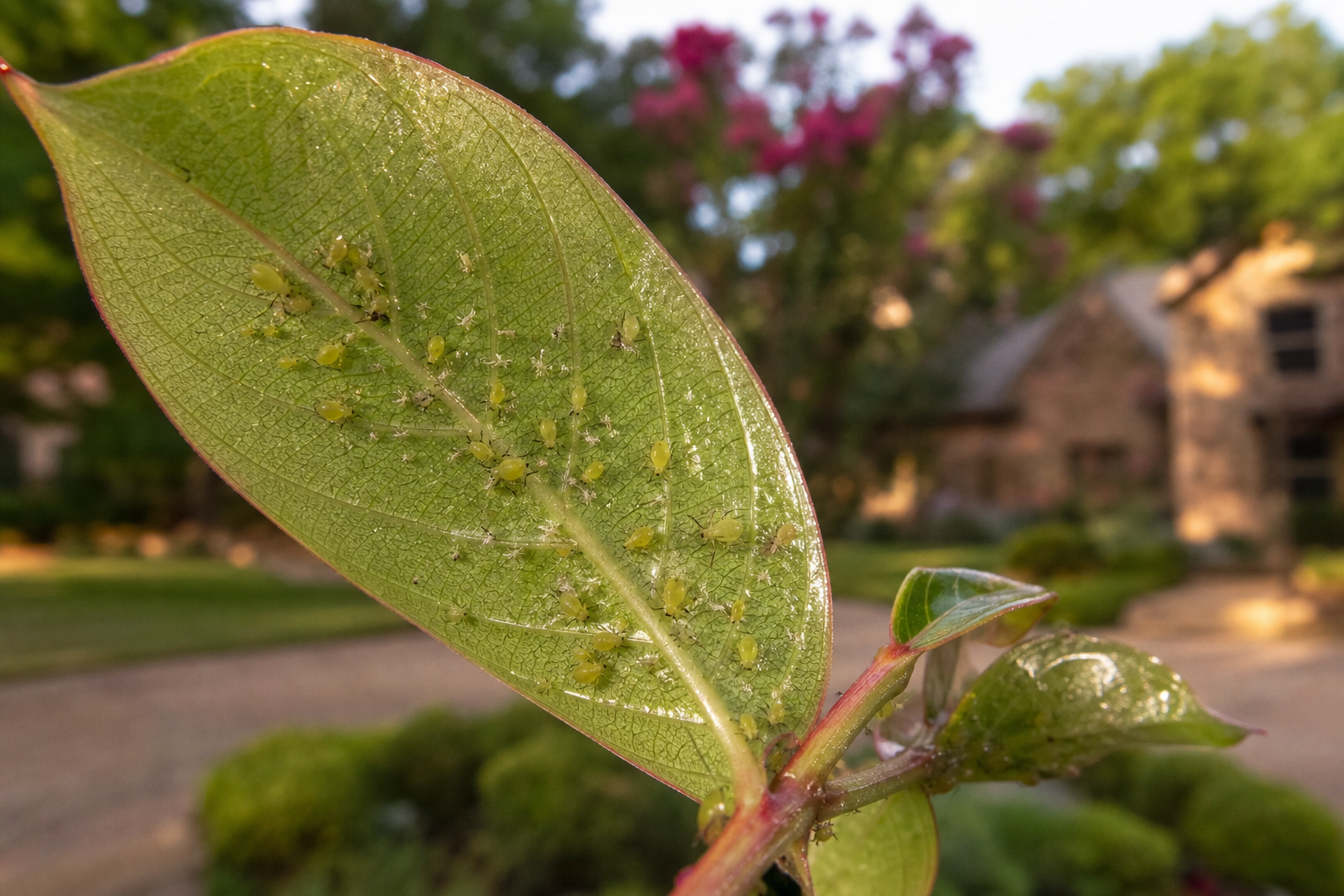
Crape myrtle aphids are a species unique to crape myrtles. They do not jump between plant species the way many aphid types do. The adults are pale yellow-green with distinctive black spots on the abdomen, measuring about 2mm in length. They feed in clusters on the undersides of leaves, making them easy to miss during a casual inspection from the ground.
The infestation cycle peaks in July and early August in DFW. Population levels typically decline in September as temperatures moderate. Heavy infestations produce large amounts of honeydew, the sticky liquid that drips from the tree onto everything beneath it.
Finding clusters of tiny yellow-green insects on leaf undersides is the most reliable identification step. Look up from below the canopy rather than scanning from the side or above.
How to Identify Crape Myrtle Aphids in August
Several visible signs point to an active aphid infestation before you even inspect the leaves directly.
What Are the Signs of Crape Myrtle Aphids?
- Sticky liquid dripping from the tree onto cars, furniture, sidewalks, and anything positioned beneath the canopy. This is honeydew, a waste product the aphids excrete while feeding.
- Shiny or varnished-looking leaves from a coating of dried honeydew on leaf surfaces.
- Black sooty mold growing on honeydew-coated bark, branches, and leaves. The mold is secondary and not the primary pest, but it signals that an active population has been feeding for days or weeks.
- Yellow or stippled leaves on affected branches, caused by the feeding damage itself.
- Clusters of tiny yellow-green insects on leaf undersides, visible on close inspection.
Sooty mold on foliage typically weathers off after rain once honeydew production stops. Mold on bark can be scrubbed away with mild soap and water. Controlling the aphid population stops the honeydew production that feeds new mold growth.
Crape Myrtle Aphids vs. Bark Scale: Telling Them Apart
Two distinct pests commonly affect crape myrtles in Fort Worth, and they require different approaches. Knowing which one you are dealing with matters before selecting a treatment.
Crape myrtle aphids live on the leaf undersides. They are soft-bodied, mobile, yellow-green in color, and active primarily in summer. They produce honeydew and can lead to sooty mold on both leaves and bark.
Crape myrtle bark scale appears on bark and branches as white or gray waxy clusters. Scale insects are stationary and can be active year-round. They also produce honeydew and contribute to sooty mold on bark.
A heavily infested crape myrtle may carry both pests simultaneously. Inspect both the leaves and the bark. Treatment timing and product selection differ between the two, so a correct identification guides the right response. Learn more on our shrub and tree pest control page.
Why August Is Peak Aphid Season in North Texas
Crape myrtle aphid populations follow heat and humidity. July and early August bring both. The warm temperatures accelerate the aphid reproductive cycle, and the dense crape myrtle canopy creates a humid microclimate on leaf undersides that supports colony growth.
Population levels begin to drop in September as overnight temperatures fall and the summer heat cycle breaks. By October, aphid pressure on crape myrtles in Southlake, Keller, and Colleyville neighborhoods is typically minimal without any treatment. But waiting out August means accepting weeks of honeydew drip, sooty mold buildup, and stressed trees during the hottest period of the year.
Treating in August stops new honeydew production, prevents mold buildup from worsening, and gives the tree a cleaner finish through the end of summer.
How to Treat Crape Myrtle Aphids Safely in Summer Heat
Not every aphid treatment is safe to apply in August in North Texas. Oil-based products in high summer temperatures can scorch leaves and add stress to a tree that is already working hard in the heat. Understanding what works, and what to avoid, protects the tree while controlling the pest.
What Products Are Safe for August Aphid Treatment?
Do not use neem oil in August. Oil products applied in high summer temperatures can cause leaf scorch and additional plant stress. Reserve oil-based treatments for spring or fall applications when temperatures are consistently below 85 degrees Fahrenheit.
Safe August treatment options include:
- Strong stream of water. A forceful spray directed at leaf undersides physically removes aphids from the feeding surface. Repeat daily during active infestation. This is the fastest, lowest-risk first response. It does not require checking temperature or soil moisture before use.
- Insecticidal soap in the early morning or late evening. Apply when temperatures are below 90 degrees Fahrenheit. Check soil moisture first. Do not spray onto wilted, recently drought-stressed, or water-deprived plants, as soap products can increase stress in those conditions.
- Contact insecticides. Effective when applied with enough pressure to reach the undersides of leaves where aphids are feeding. Coverage is the critical factor.
- Systemic soil-applied insecticides. The most effective option for sustained, season-long control. Applied once to the soil at the base of the tree, the product is absorbed by roots and moves through the vascular system into leaf tissue. Aphids feeding on treated leaves are controlled. This approach works better as a preventive measure for next season, applied in spring before populations establish.
Natural Predators and Biological Control
Crape myrtle aphids have natural enemies that reduce populations without any chemical input. Ladybugs and green lacewings are the primary predators. Both species are present throughout Fort Worth, Arlington, Grapevine, and Mansfield during summer and seek out aphid colonies as a food source.
Heavy use of broad-spectrum pesticides that contact and kill beneficial insects disrupts biological control. When natural predator populations are healthy, aphid colonies often decline on their own before reaching the level where honeydew damage becomes significant. This is one reason targeted, lower-impact treatments are preferable to broad-spectrum applications as a first response.
If your property hosts regular crape myrtle aphid pressure, evaluating the overall insect management approach across the yard matters. Preserving beneficial insect populations helps keep multiple pest problems in check, not just aphids.
Preventing Crape Myrtle Aphid Infestations Next Season
Prevention is more effective than curative treatment, and it costs less in time and product. Several practices reduce aphid pressure before populations establish in summer.
Systemic soil-applied insecticide in spring. Applying a soil systemic in March or April, before aphid populations begin building in June and July, provides season-long prevention. The product is already distributed through the tree's tissue when the first aphids begin feeding. A single spring application typically covers the entire summer season.
Tree health maintenance. Healthy, well-fed trees are less susceptible to severe pest infestations. Proper fertilization, soil moisture management through summer, and an annual arborist assessment keep the tree in a condition where it tolerates pest pressure better and recovers faster when populations do build.
Canopy structure and air circulation. Dense canopies with poor air circulation create the humid microclimate that aphids prefer on leaf undersides. Appropriate canopy management reduces that microclimate effect.
Learn more about protecting crape myrtles and other ornamentals through our ornamental care page and tree injection services. For additional background on crape myrtle care in North Texas, the Crape Myrtle Trails of McKinney provides educational care information from a regional non-profit organization.
Crape Myrtle Aphid FAQ
Will the sticky drip from aphids damage my car or patio furniture?
Honeydew is a sugar-rich liquid that can damage car paint if left on the surface in hot sun. It also supports sooty mold growth on any surface it contacts. Washing affected surfaces promptly limits damage. Controlling the aphid population stops new honeydew production, though any mold already present requires separate cleaning once the infestation is resolved.
Do crape myrtle aphids spread to other plants?
No. Tinocallis kahawaluokalani is a host-specific species that feeds only on crape myrtles. Treating aphids on your crape myrtle protects those trees but does not address other aphid species that may be present on roses, oaks, or other plants in the yard. Each plant type hosts its own specific aphid populations.
When is the best time to apply a preventive systemic insecticide?
March or April is the optimal timing for a preventive soil-applied systemic insecticide on crape myrtles in North Texas. Applying before aphid populations begin establishing in June gives the product time to move through the root system and into leaf tissue. A spring application typically provides protection through the entire summer season.
Trees Hurt Too Serves Crape Myrtle Owners Across Fort Worth
Crape myrtles are one of the most visible trees in Fort Worth, Arlington, Irving, Keller, Southlake, Grapevine, Colleyville, and Mansfield. Trees Hurt Too Inc. provides aphid treatment, bark scale treatment, and complete ornamental tree care for crape myrtles throughout Tarrant County. Our ISA Certified Arborists and Licensed Plant Health Care Professionals have treated North Texas trees for over 28 years.
An on-site assessment identifies the exact pest, confirms whether both aphids and scale are present, and recommends the treatment approach that fits the tree's condition and the season. No guesswork, no blanket protocols.
Treat Crape Myrtle Aphids Before Summer Ends
Trees Hurt Too Inc. has served Fort Worth and surrounding Tarrant County for over 28 years. Call or text to schedule a consultation.
Call: (972) 521-1552 | Text: (972) 521-1552 | treeshurttoo.com