

Most homeowners stop thinking about tree care the moment leaves drop in November. The trees themselves do not stop. Above-ground growth shuts down after the first hard frost in Tarrant County, but roots remain active in the soil, absorbing nutrients that will fuel the first flush of spring growth. Dormant season fertilization targets that root activity directly.
Fertilizing North Texas trees during dormancy, from mid-November through February, delivers nutrients at the precise moment the root system can store and use them. Applied after frost, nitrogen does not stimulate vulnerable new growth above ground. Instead, it loads the root system with the stored energy and minerals that drive the strongest spring canopy expansion possible.
This guide covers when to fertilize, why DFW soil conditions make dormant feeding more important here than in most parts of the country, how deep root feeding differs from surface broadcast, and which trees benefit most from a winter application.
Do Trees Need Fertilization When They Are Dormant?
Yes. Trees appear dormant above ground, but their root systems remain active throughout winter. Roots continue absorbing water and nutrients from the soil even when the canopy is bare. The nutrients absorbed during November and December are stored in the root system and mobilized when spring growth begins.
The common assumption that dormant trees do not need feeding misses what is happening underground. A tree that enters spring with a full reserve of stored nutrients grows faster, leafs out more densely, and resists early-season pest and disease pressure better than a nutrient-depleted tree. Dormant season fertilization is an investment in spring performance, not a warm-season supplement.
Why North Texas Trees Need Dormant Season Feeding More Than Most
Several factors specific to Fort Worth and the broader DFW region make dormant feeding more important here than in other parts of the country.
First, homeowners rake leaves. In a natural forest, fallen leaves decompose over winter, releasing nutrients back into the soil and feeding the root zone organically. In North Texas landscapes, leaves are removed as yard waste, and that organic matter never returns to the soil. The natural nutrient cycle is broken every fall.
Second, DFW soil is problematic for trees. Most of Tarrant County sits on alkaline clay over shallow limestone bedrock. This soil is naturally compacted, drains poorly, and holds nutrients in forms that tree roots struggle to access. The alkaline pH locks up iron in particular, making it chemically unavailable even when it is physically present in the soil.
The result is iron chlorosis, the yellowing between leaf veins that homeowners across Mansfield, Keller, and Southlake notice each spring on oaks, elms, and ornamental trees. Chelated iron delivered directly to the root zone during dormancy corrects this deficiency before symptoms appear in the growing season.
Third, North Texas trees run a nutrient deficit year after year without supplemental feeding. Summer drought depletes reserves. Fall leaf removal removes what would have replenished them. Without intervention, trees in DFW landscapes gradually lose vigor, become more vulnerable to pests and disease, and show decline years before homeowners recognize the cause.
When Is the Right Time to Fertilize Trees in November?
Timing dormant fertilization correctly matters. The window opens after the first hard frost in Tarrant County, typically mid-November, and remains open through February.
After first frost, above-ground growth has stopped. Nitrogen applied at this point will not stimulate tender new growth that would be vulnerable to cold damage. The plant cannot use nutrients above ground, so the root system is where all absorption and storage happens.
Why should you never fertilize trees before the first frost in fall?
Fertilizing between August and the first frost triggers new vegetative growth above ground. That growth is soft, frost-vulnerable, and easily damaged by the first hard freeze. This causes more harm than the fertilization was meant to prevent. The closed window runs from late August through the first hard frost. After frost, the window opens and stays open through late winter.
Do not apply fertilizer to soil that is waterlogged or frozen solid. Waterlogged soil dilutes liquid applications before nutrients reach feeder roots. Frozen soil cannot be penetrated by roots for uptake. Applications made to dry, unfrozen soil in the 40 to 55 degree Fahrenheit range reach the root zone most effectively.
Deep Root Feeding vs. Surface Fertilization in Winter
Surface broadcast fertilizer scattered across compacted Tarrant County clay often never reaches the roots that need it. The feeder roots responsible for nearly all nutrient uptake live 6 to 18 inches below the soil surface. Surface applications must penetrate compacted clay to reach that depth, and in most DFW landscapes, they do not.
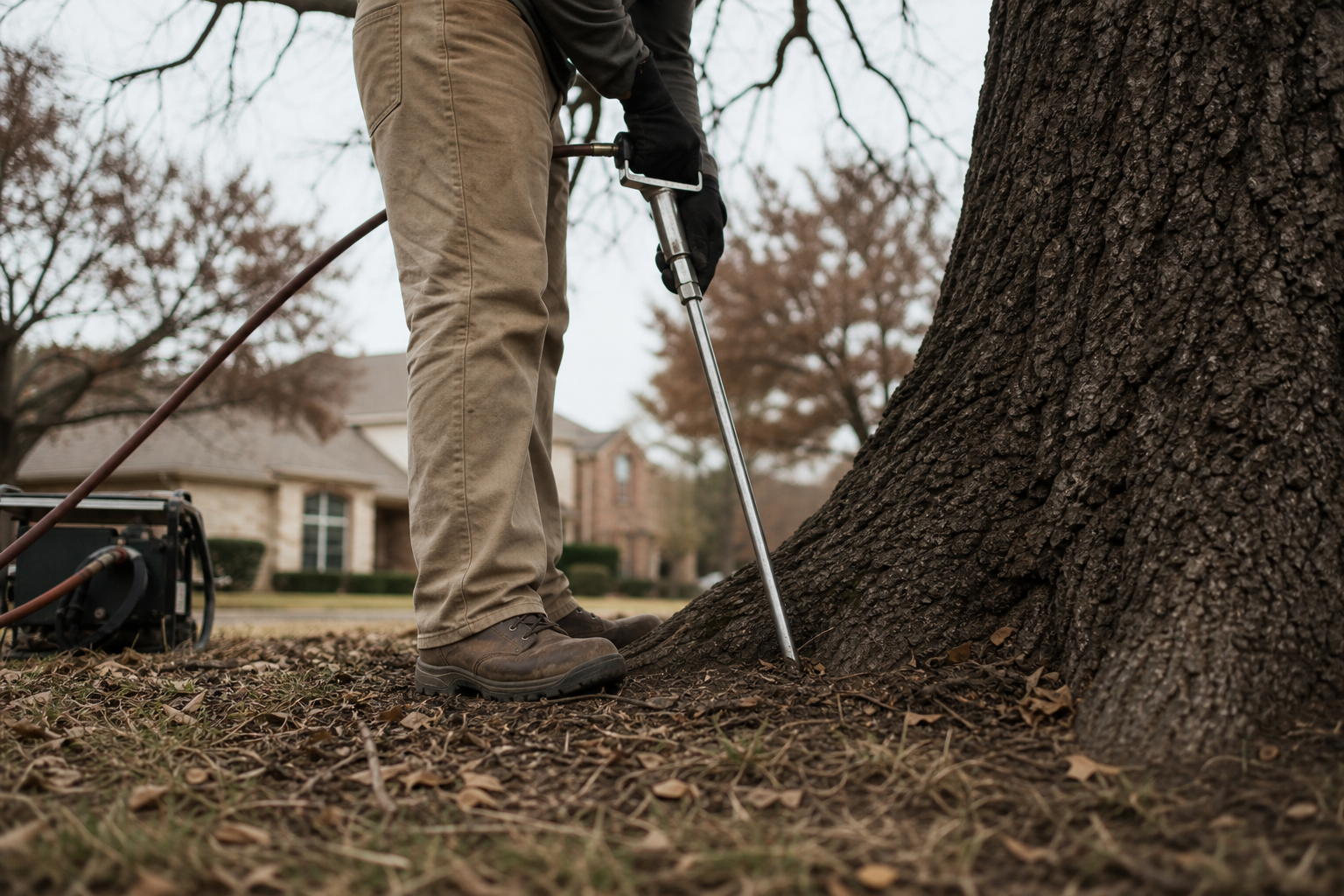
Deep root feeding uses a pressurized probe inserted directly into the soil at feeder root depth. Liquid fertilizer is injected under pressure into the root zone, bypassing surface compaction entirely. The nutrients arrive where feeder roots can immediately access them, not sitting on the surface waiting for rain and soil structure to carry them down.
What is the difference between deep root feeding and surface fertilizing a tree?
The key difference is delivery depth. Surface broadcasting places nutrients on top of compacted soil where they may or may not reach feeder roots. Deep root feeding injects nutrients directly into the root zone at 6 to 18 inches depth, where feeder roots are active and can absorb immediately. The probe also aerates the root zone with each injection, improving water movement and reducing compaction around feeding roots.
For Arlington and Fort Worth homeowners with established trees showing signs of decline, deep root feeding during dormancy often produces the most visible spring response of any single care service.
What Nutrients Do Trees Need in the Dormant Season?
A dormant season application is not a generic fertilizer dump. The formulation matters, and it differs from a spring or summer application.
- Balanced nitrogen, phosphorus, and potassium: Nitrogen feeds stored energy reserves. Phosphorus supports root development during the winter months. Potassium strengthens cell walls and supports the tree's natural defenses.
- Chelated iron: Standard iron fertilizers do not remain available in alkaline DFW soil. Chelated iron is chemically bound to stay soluble in high-pH conditions, making it accessible to roots in Tarrant County clay. This is the primary correction for iron chlorosis.
- Carbon-based organic matter: Carbon feeds soil biology, which in turn supports root function. Trees growing in biologically active soil access more nutrients than trees in sterile, depleted clay. Carbon additions over multiple seasons gradually rebuild soil structure and nutrient cycling.
- Mycorrhizal fungi inoculants: Mycorrhizal fungi form partnerships with tree roots, extending the effective root surface area by up to 700 times according to research cited by Texas A&M AgriLife. Inoculants applied in winter develop over the dormant season and are active and expanding when spring growth begins, dramatically increasing the tree's capacity to absorb water and nutrients. The Texas A&M AgriLife guide on fertilizing woody ornamentals provides additional background on nutrient needs and timing for North Texas conditions.
Which Trees Benefit Most from Dormant Season Feeding
Every established tree in a North Texas landscape benefits from dormant season feeding. Certain trees and situations produce the most noticeable responses.
Trees recovering from summer drought stress enter winter with depleted reserves. A dormant feeding restores stored nutrients and supports root recovery through the cooler months. Trees in Tarrant County that showed wilting, early leaf drop, or tip dieback in the summer are prime candidates.
Trees that experienced pest pressure, disease treatment, or defoliation during the growing season used significant energy reserves fighting those stresses. Dormant feeding replenishes what the growing season consumed. This is especially true for oaks treated for oak wilt, elms treated for borers, and any tree that received multiple treatments during summer.
Trees showing nutrient deficiency symptoms, including small leaves, pale or yellowing foliage, reduced annual growth, and twig dieback, tell you directly that the soil is not meeting their needs. Dormant feeding with chelated iron and a full nutrient package addresses the root cause rather than the visible symptoms.
Young trees in their first three to five winters benefit from dormant feeding as they establish root systems in challenging Tarrant County soil. Early feeding during establishment sets up better long-term structure and vigor than waiting until problems appear.
Iron Chlorosis and Winter Treatment in DFW
Iron chlorosis is the most widespread nutrient deficiency in North Texas trees. The characteristic symptom is yellowing leaf tissue with green veins remaining visible, most prominent on new growth in spring. The cause is not a lack of iron in the soil. It is the alkaline pH of DFW soil, typically above 7.5, making iron chemically unavailable.
Treating chlorosis during dormancy with chelated iron delivered via deep root feeding allows the correction to be in place before spring growth begins. Oaks, elms, pecans, and ornamental trees across Fort Worth, Mansfield, and North Richland Hills commonly show chlorosis when growing in Tarrant County clay without supplemental iron.
Surface broadcast iron products on alkaline soil revert to unavailable forms within weeks. Only chelated iron delivered below the alkaline surface layer remains effective for a full growing season in DFW conditions. Trees Hurt Too's deep root feeding service uses formulations specifically designed for Tarrant County soil, including chelated iron and carbon-based nutrients. Full tree fertilization services and tree care programs are available across the service area.
Frequently Asked Questions About Dormant Tree Fertilization
Can I fertilize my trees in November in North Texas?
Yes, after the first hard frost. Once above-ground growth has stopped, typically mid-November in Tarrant County, nitrogen applied to the root zone loads stored reserves without triggering frost-vulnerable new growth. The dormant feeding window runs from first frost through February and produces the strongest spring growth response of any fertilization timing.
Why is deep root feeding better than surface fertilizer for North Texas trees?
Tarrant County soil is compacted alkaline clay. Surface broadcast fertilizer sits on top of that clay and rarely penetrates to feeder root depth at 6 to 18 inches. Deep root feeding injects nutrients under pressure directly into the root zone, bypassing compaction. The probe also aerates the root zone with each injection, improving both water movement and nutrient access.
What is iron chlorosis and how does dormant feeding treat it?
Iron chlorosis causes yellowing between leaf veins on North Texas trees, particularly oaks and elms in alkaline DFW soil. The soil contains iron, but the high pH locks it in forms roots cannot absorb. Chelated iron delivered via deep root feeding during dormancy stays soluble in alkaline conditions and corrects the deficiency before symptoms appear in spring.
Feed Your Trees This Winter Before Spring Demands It
Trees Hurt Too Inc. has served Fort Worth and surrounding Tarrant County for over 28 years. Call or text to schedule a consultation.
Call: (972) 521-1552 | Text: (972) 521-1552 | treeshurttoo.com