

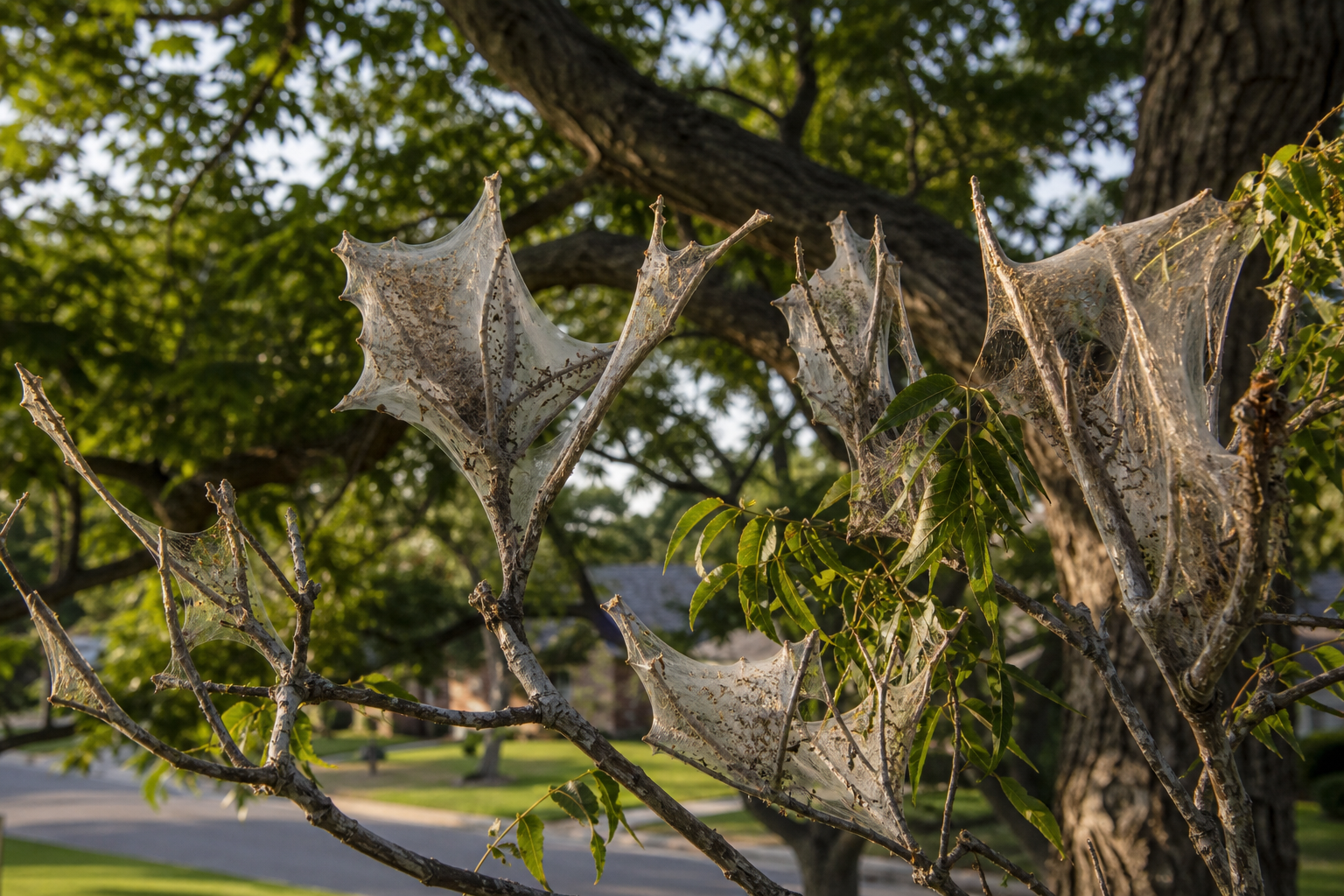
Fall webworms arrive in North Texas yards every summer, and August is when the second generation peaks. Homeowners across Fort Worth, Arlington, and Keller spot the silky, tangled webs covering branch tips on pecan, sweetgum, and elm trees and wonder what went wrong. The good news: fall webworms are more of a nuisance than a serious threat to tree health. The key is acting before a large second-generation population builds.
Fall webworms (Hyphantria cunea) produce two generations per year in North Texas, possibly more in the far south. The second generation, arriving in late August and September, is the wave most homeowners notice. This post covers how to identify fall webworms, how they differ from tent caterpillars, and the most effective control options for Tarrant County trees.
What Are Fall Webworms?
Fall webworms are the larvae of a small native moth called Hyphantria cunea. The adult moths are white with dark spots on their wings, reaching about 1.5 inches in wingspan, and appear in Texas by May. They lay eggs in small masses on the undersides of leaves, covered with tiny hairlike scales that give them a cottony, white appearance.
Once hatched, the larvae are pale green to yellow, about 1 inch long when fully grown, and covered with tufts of long hairs. Those hairs look alarming but are not stinging. The larvae feed together inside a communal web they build around the leaves at the end of a branch.
Young larvae start by skeletonizing the upper surface of leaves. As they mature, they consume entire leaves, leaving only the large veins and midrib behind. By the time a web becomes visible from the ground, the larvae have been feeding for days.
Fall webworms feed on more than 100 species of broadleaf trees. In North Texas, the most commonly affected trees include:
- Pecan
- Persimmon
- Sweetgum
- Elm
- Hickory
- Maple
- Black walnut
How to Tell Fall Webworms Apart from Tent Caterpillars
Web location is the single most reliable way to distinguish fall webworms from tent caterpillars. These two insects are often confused, but they behave differently and require different timing and approaches.
Where Does the Web Appear?
Fall webworms build their webs at branch tips, enclosing the foliage at the end of a branch. Tent caterpillars build their webs in branch crotches or along flat mats on branches, well back from the tips.
Season also separates them clearly:
- Fall webworms: Active in summer and fall; peak in August and September in North Texas; webs appear at branch tips and look flimsy and messy
- Tent caterpillars: Active in early spring only; webs appear in branch crotches and look more structured
If you see webs on your trees in August, they are fall webworms. Tent caterpillars are long gone by then.
When Do Fall Webworms Appear in North Texas?
North Texas sees two generations of fall webworms each year. The first generation arrives in May and June but tends to be small and easy to overlook. The second generation arrives in late August and September, and that is the wave that covers pecan and sweetgum trees across Mansfield, Burleson, and North Richland Hills yards with visible webs.
August is the critical month to act. Catching and opening webs before the second generation fully develops limits how many larvae reach the pupation stage. Larvae develop over 4 to 8 weeks, then leave the webs to spin cocoons in leaf litter or just beneath the soil surface. Reducing the number of larvae that complete that cycle reduces the population overwintering in your yard.
Nature does part of the work on its own. More than 50 species of parasites and 30 species of predators in North America feed on fall webworms. Disease, starvation, and weather all push populations back to tolerable levels. Still, when a single pecan tree hosts dozens of webs, natural controls need a hand.
How to Treat Fall Webworms on Your Trees
Treatment works best when you open the web first. Spraying the outside of an intact web does almost nothing because the product never reaches the caterpillars inside. Opening the web exposes the larvae to both predators and any treatment you apply.
What Steps Work for Homeowners?
- Open or disrupt the web. Use a long stick, a broom handle, or a strong jet of water to tear open the web. This alone exposes larvae to birds and beneficial insects.
- Remove the infested branch tip if accessible. On smaller trees or lower branches, cutting off the infested tip and placing it directly into a sealed bag removes the entire nest. Do not drop it on the ground and walk away.
- Apply Bt after opening. Bacillus thuringiensis var. kurstaki (Bt) is a naturally occurring bacterium that targets caterpillars without harming birds, beneficial insects, or mammals. Spray it directly onto the opened web and surrounding foliage.
- Other targeted options include spinosad, azadirachtin, and pyrethrins. All three reach caterpillars without broad collateral damage to the surrounding insect population.
For large trees with multiple high webs that are out of reach, a professional treatment is the practical choice. Proper equipment is needed to get coverage into the canopy where the webs are forming.
Systemic Tree Injections for Caterpillar Pests
When fall webworm pressure is high year after year, or when infestations affect large trees that homeowners cannot treat from the ground, systemic tree injections offer a broader, longer-lasting approach. A licensed arborist injects insecticide directly into the tree's vascular system. The tree moves the product into its own tissue, reaching caterpillar pests feeding anywhere in the canopy.
Systemic treatments can protect trees through the remainder of the season and beyond, depending on the product and timing. An ISA Certified Arborist can assess the infestation level and recommend whether a systemic approach makes sense for your specific trees.
Learn more about tree injection treatments or visit our shrub and tree pest control page for a full picture of what affects North Texas trees.
Which Trees in North Texas Are Most at Risk?
Pecan trees take the hardest hit from fall webworms in most Tarrant County yards. Pecans are common in Fort Worth and Arlington neighborhoods and can host dozens of webs across a single large canopy. Sweetgum trees in Southlake and Grapevine also see heavy infestations in most years.
The good news for property owners is that a healthy, established pecan or sweetgum can tolerate significant webworm defoliation without long-term damage. The concern rises when a tree is already stressed, such as during a drought year, or when defoliation happens repeatedly in the same season.
Trees weakened by root problems, disease, or drought stress have less energy to recover from insect damage. Treating the tree's overall health alongside controlling the pest gives the best outcome. A root zone assessment and a check for secondary disease problems is a reasonable step if a tree has been heavily infested for two or more consecutive years.
Should You Call a Professional for Fall Webworms?
Most small infestations on accessible trees can be managed by homeowners with a stick, a hose, and a bottle of Bt. Call a professional arborist when:
- The webs are in the upper canopy of a large tree and cannot be reached safely
- Multiple trees on the property are affected at the same time
- The same tree has been heavily infested for two or more seasons and shows signs of overall decline
- You suspect a secondary problem such as disease or drought stress compounding the damage
For more information on tree pest identification and treatment options specific to North Texas, the Texas A&M Forest Service provides reliable reference material on fall webworm biology and control.
Fall Webworm FAQ
Are fall webworms dangerous to trees?
Fall webworms are generally not a serious threat to tree health. Established trees in good condition tolerate webworm defoliation without lasting harm. The risk increases when a tree is already under stress from drought, disease, or root problems. Repeated heavy infestations over multiple years can weaken a tree's overall condition.
Can fall webworm hairs sting or irritate skin?
No. Fall webworm larvae are covered with tufts of long hairs, but those hairs are not stinging. Handling the caterpillars or webs directly may cause mild skin irritation in sensitive individuals, but they are not in the same category as stinging caterpillars such as the puss caterpillar.
Will fall webworms come back next year?
Yes. Fall webworms overwinter as cocoons in leaf litter and soil beneath host trees. Adults emerge in spring and restart the cycle. Removing leaf litter and debris beneath heavily infested trees in fall reduces the number of overwintering cocoons. Monitoring for first-generation webs in May and treating early limits how large the second-generation population becomes in August.
Trees Hurt Too Serves Fort Worth and Tarrant County
Fall webworm season hits yards across the region at the same time. Trees Hurt Too Inc. works in Fort Worth, Arlington, Keller, Mansfield, Burleson, Southlake, Grapevine, North Richland Hills, and communities throughout Tarrant County. Our team includes ISA Certified Arborists and Licensed Plant Health Care Professionals with 28 years of experience treating North Texas trees.
An on-site evaluation from a certified arborist identifies which trees are most vulnerable and what treatment approach fits the size and health of each tree. We treat the whole tree, not just the visible pest problem.
Schedule a Fall Webworm Assessment for Your Trees
Trees Hurt Too Inc. has served Fort Worth and surrounding Tarrant County for over 28 years. Call or text to schedule a consultation.
Call: (972) 521-1552 | Text: (972) 521-1552 | treeshurttoo.com