

Fire ants in North Texas reach their second peak of the year in fall. The first peak runs from spring into early summer. The second arrives in late September and runs through October, when cooler temperatures pull colonies toward the surface and keep workers foraging actively during daylight hours. For homeowners in Fort Worth, Arlington, Burleson, and across Tarrant County, October is one of the most effective months of the year to apply fire ant treatment.
This timing advantage comes from fire ant biology, not coincidence. Treatment applied in fall works through winter while homeowners are indoors, reduces the number of colonies entering spring, and directly limits the mound explosions that appear in April and May. Spring-only treatment leaves fall populations intact and untreated, which means spring infestations start from a higher baseline every year.
The following sections explain the biology behind fall treatment, the Texas A&M-recommended two-step method, and the critical application rules that determine whether bait succeeds or fails.
Why Fall Is One of the Best Times to Treat Fire Ants in North Texas
Texas A&M Fire Ant Research has documented two reasons why fall treatment outperforms spring-only control programs over time. The first is bait uptake reliability. In fall, ants forage during the cooler parts of the day, morning and afternoon, rather than retreating during the hottest midday hours. Weather is more predictable in fall than in spring, which means bait sits on the soil surface long enough for worker ants to find and carry it back to the queen before a rainstorm washes it away.
The second reason is population math. Bait products are slow-acting, typically taking several weeks to months to reduce colony numbers significantly. Applying bait in fall means the product works quietly through winter, reducing colony counts before the explosive spring growth period begins. Consistent fall treatments, applied year after year, build cumulative suppression that spring-only programs cannot match.
Studies from the Texas A&M Fire Ant Research and Management Project show that combining fall and spring treatments produces better long-term suppression than spring treatment alone. A single October application is more valuable, per treatment event, than a single spring application because of how it interrupts the colony cycle before spring population growth begins.
How Fire Ant Behavior Changes in October
Red imported fire ants in Tarrant County are most active when soil temperatures fall between 70 and 85 degrees Fahrenheit. October soil temperatures in Fort Worth and the surrounding area typically sit squarely in this range, making ants accessible, active, and responsive to bait.
In summer, fire ants move deeper into the soil to escape extreme heat. Surface foraging slows during the hottest part of the day, and midday bait applications often fail because workers are not present to pick them up. In October, ants forage throughout the morning and afternoon without the heat retreat that limits summer treatment windows.
October rain events are particularly useful for fire ant management. When rain falls, ants move upward toward the soil surface. New mounds appear across lawns, landscaping beds, and yard edges in the days following a rain event. These fresh mounds represent active colonies that are highly accessible for both bait and mound treatment.
Colonies in October are also in a different phase of their growth cycle than spring colonies. Spring colonies are expanding rapidly and producing new reproductive ants. Fall colonies are preparing to hunker down for winter, which means the queen and core workers are more concentrated near the surface and more reliably reached by slow-acting bait.
The Two-Step Method for Fall Fire Ant Control
Texas A&M Fire Ant Research recommends a two-step approach for homeowners in North Texas. Both steps serve different functions and work better together than either does alone.
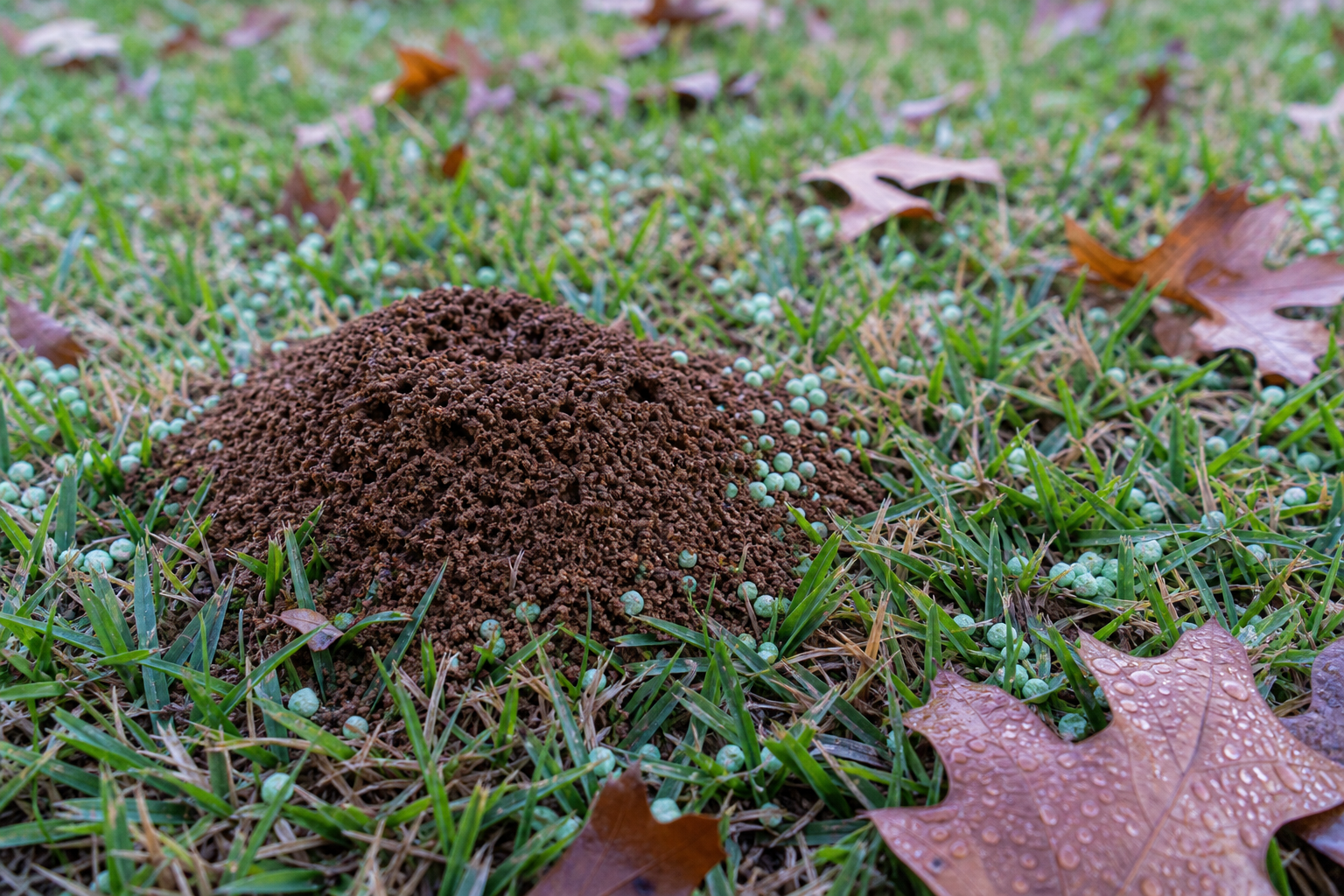
Step One: Broadcast bait over the entire treatment area. Apply granular bait insecticide over the full lawn and yard perimeter in late September through mid-October. Do not apply bait only to visible mounds. Fire ant colonies extend well beyond the visible mound, and foraging workers range far from the mound center. Broadcasting ensures coverage across the entire foraging territory rather than just the points where mounds have broken the surface.
Bait works because worker ants treat it as food and carry it back to the colony. Once inside, the active ingredient spreads to the queen through trophallaxis, the process by which workers share food with other colony members. A dead queen means no new eggs and eventual colony collapse. This process takes weeks to months, which is why fall timing matters. The bait has a long runway to work before spring arrives.
Step Two: Treat individual problem mounds. After broadcasting bait, treat persistent or newly visible mounds with a fast-acting mound drench, granule, or contact dust. This addresses colonies that pose immediate risk to children, pets, or high-traffic areas while the slower bait program works on the broader population. Mound treatments act within hours, while bait acts over weeks.
How to Apply Fire Ant Bait Correctly
Bait application errors are the most common reason fall fire ant treatments fail. Four rules determine whether bait performs or goes to waste.
Confirm ants are foraging before applying. Place a small amount of food, such as a potato chip, near an active mound. If worker ants investigate within 30 minutes, they are actively foraging. Bait applied when ants are not foraging simply sits on the soil surface until it degrades or washes away. Always verify activity before application.
Apply bait only when soil is dry. Moist bait degrades quickly and loses the oils that attract ants. Apply when the soil surface is dry and no rain is expected for at least 24 to 48 hours after application. Morning applications on dry fall days, when ants are already active, are the most reliable timing for Fort Worth and Tarrant County conditions.
Use fresh bait only. Fire ant bait is oil-based and has a limited shelf life. Old bait that has lost its attractive oil will be ignored by worker ants. Bait stored in warm conditions, direct sunlight, or a garage through a Texas summer may have degraded significantly. Open a new bag each season rather than relying on leftover product from previous years.
Do not water after applying bait. Irrigation after bait application washes the product off the soil surface and into the soil before ants can pick it up. Turn off irrigation timers on the day of application. If unexpected rain arrives in the hours after treatment, reapplication may be necessary once the soil surface dries again.
What Happens If You Skip Fall Treatment
Fire ant colonies that survive fall and winter untreated enter spring with full populations intact. When soil temperatures warm above 65 degrees Fahrenheit in March and April, those colonies expand rapidly. Reproductive ants emerge and found new colonies through swarming flights. A yard with ten untreated fall colonies may have twenty or thirty active mounds by May.
Spring treatment under these conditions plays catch-up against a population that has had all winter to consolidate. The same bait and contact treatments that would have worked efficiently on a smaller fall population now face a much larger challenge. Results from spring-only programs tend to be inconsistent from year to year because population pressure varies with winter weather, not just treatment timing.
Homeowners who treat both fall and spring build cumulative suppression over multiple seasons. Each fall treatment reduces the baseline population entering spring. Each spring treatment addresses whatever colonies established or expanded through the winter. The combination produces steady improvement rather than a cycle of treatment and reinfestation.
Fire Ants and Your Family: Why Control Matters in Tarrant County
Red imported fire ants, Solenopsis invicta, are the dominant species across Tarrant County. They build mounds in open lawns, landscaping beds, and yard edges, and they protect those mounds aggressively when disturbed. A single disturbed mound can produce hundreds of stings in seconds.
Fire ants sting repeatedly. Each ant can sting multiple times, unlike bees that sting once and die. The venom causes an immediate burning sensation followed by itching and pustule formation within hours. Most stings cause local reactions that resolve in a few days. For people with fire ant venom allergies, multiple stings can trigger anaphylactic reactions that require immediate medical attention.
Children and pets face elevated risk because they move through yards at ground level and often disturb mounds without warning. In Mansfield, Euless, Hurst, and Grand Prairie, fire ant activity in untreated yards is a genuine hazard for families who use their outdoor spaces through fall and into early winter before mounds become dormant.
North Texas winters are mild enough that fire ant colonies rarely become fully inactive. Even in January, a warm afternoon can bring workers to the surface. True dormancy does not occur in Tarrant County the way it does in colder northern climates. Year-round attention to fire ant populations keeps risk consistently low rather than spiking in late spring.
Protecting Your Yard from Fire Ants Through Winter
A neighborhood-wide perspective on fire ant control matters. Fire ant colonies expand through swarming flights that can cover hundreds of yards. A single treated yard surrounded by untreated neighbors will face reinfestation from adjacent properties. Neighborhood or community-level treatment programs produce significantly better long-term suppression than isolated yard-by-yard efforts.
If neighbors are not treating, the solution is maintaining an aggressive treatment program on your own property and applying a yard perimeter treatment to intercept ants moving in from adjacent areas. Perimeter treatments with contact insecticide around lawn edges, fence lines, and landscaping beds reduce inbound pressure from untreated neighboring properties.
Trees Hurt Too Inc. includes fire ant control in the Lawn Package Annual and Total Lawn Pest Protection Package. The ants page covers fire ant biology and treatment options. The lawn pests page covers the full range of turf-damaging insects in North Texas. For complete protection, the Total Lawn Pest Protection Package includes fire ants alongside all other significant lawn pest threats.
Texas A&M Fire Ant Research and Management Project provides research-based guidance on fire ant biology and control at fireant.tamu.edu. For yard-specific assessment and treatment scheduling in Fort Worth and Tarrant County, a consultation with a licensed plant health care professional gives you the most accurate picture of your property's fire ant pressure.
Schedule Fall Fire Ant Treatment for Your Fort Worth Area Yard
Trees Hurt Too Inc. has served Fort Worth and surrounding Tarrant County for over 28 years. Call or text to schedule a consultation.
Call: (972) 521-1552 | Text: (972) 521-1552 | treeshurttoo.com