

Holiday lights add warmth and character to trees across Fort Worth and Southlake neighborhoods every November and December. The same lights can also cause real, lasting damage when hung incorrectly. Trees are living organisms with protective bark, active vascular tissue, and branches that grow outward every year. Any material wrapped around a branch must account for that growth, or the tree pays for it.
Girdling, bark wounds, heat damage, and structural stress are the four main ways holiday lighting hurts trees. Most of the damage is preventable with the right approach. LED lights, soft fasteners, proper installation technique, and timely removal protect trees while still producing a full, bright display.
This guide covers how damage happens, what to do and what to avoid, which trees should never carry lights, and what signs to look for after the holiday season ends.
How Holiday Lights Can Damage Trees
Holiday light damage to trees is real and documented by arborists across North Texas. Four specific mechanisms cause most of the harm seen in Tarrant County yards each January.
Girdling occurs when lights or their fasteners wrap too tightly around branches. As the tree grows outward through spring and summer, the constrictive material cuts deeper into the branch. This restricts water and nutrient movement through the cambium layer, the living tissue just beneath the bark. A single season of tight wrapping rarely causes permanent damage. Lights left on for multiple years without removal absolutely can. What feels comfortably loose in November feels like a tourniquet by July.
Bark wounds from nails, staples, screws, or any fastener that pierces the bark create open entry points for insects and fungal pathogens. The bark is the tree's protective layer. Puncturing it invites borers, scale insects, and fungal spores including oak wilt and hypoxylon canker. Even a small staple wound provides access to organisms that can cause serious disease in North Texas trees.
Heat damage from traditional incandescent bulbs can burn foliage and bark on direct contact. LED lights produce far less heat and are the recommended choice for any tree in the landscape. Beyond protecting the tree, LED lights use less electricity and last longer than incandescent options.
Weight and structural stress from heavy light strands increases wind-load on branches. This matters most for young trees still developing their structure and for smaller ornamental trees in Colleyville and Keller landscapes where branch diameter is limited.
Girdling: Why Tight Wrapping Hurts Branches
Girdling is the most serious damage mechanism from holiday lights and the most commonly underestimated. The cambium layer, which moves water and nutrients between roots and canopy, sits just beneath the bark surface. Any material that constricts this layer interrupts that flow.
Branches grow in diameter every year. A strand wrapped snugly in November will sit tighter on the same branch by February, tighter still by May. By midsummer, what started as a decorative wrap can function as a tourniquet on the living tissue inside the bark.
How can you tell if a tree has been girdled by lights?
After removing holiday lights, examine branches for spiral indentations where strands were wrapped. Discoloration or sunken areas in the bark along the spiral path indicate previous girdling pressure. Dieback in limbs above the tightest wrapping points is a late sign that vascular flow was disrupted. Trees Hurt Too ISA Certified Arborists can assess girdling damage during a tree health diagnosis visit.
How Bark Wounds from Fasteners Invite Pests and Disease
Every puncture in tree bark creates an opening in the tree's immune system. Bark is not just a physical shell. It contains the tree's active defense and transport systems. A nail hole, staple, or screw driven into bark bypasses every protective mechanism the tree has.
In Grapevine and Arlington, where oak wilt pressure is documented and active, even a small wound during the growing season creates an entry point for Ceratocystis fagacearum, the fungal pathogen that causes oak wilt. Hypoxylon canker spores, which are present in the environment year-round, also enter through bark wounds. Boring insects locate stressed trees partly through the odors released at wound sites.
The rule is simple: nothing that pierces bark belongs on a tree. Soft ties, velcro straps, plastic clips, and natural twine are the only fasteners that belong near tree bark. Nails, screws, staples, zip ties pulled tight, and stiff wire twisted around branches all cause damage over time.
How to Choose the Right Lights and Hardware
The equipment choices made before installation determine most of the outcome.
- Lights: LED lights only. They run cool, resist moisture, use less power, and last longer. Avoid traditional incandescent strands for any outdoor tree application.
- Extension cords: Outdoor-rated only. Indoor-rated cords fail in moisture and create fire risk. Check the rating label on every cord before use.
- Fasteners: Soft ties, velcro straps, plastic S-hooks or clips, or natural twine. Nothing that pierces, cuts, or digs into bark. Never use nails, screws, staples, rigid wire, or zip ties cinched tight.
- Tension test: After securing any wrap or tie, you should be able to slip one finger under it at any point around the branch. If you cannot, it is too tight.
How to Hang Lights Safely on Outdoor Trees
Safe installation protects both the tree and the display. Following these steps produces a full, well-distributed light arrangement without causing bark wounds, girdling, or structural stress.
What is the right way to hang lights on trees without damaging them?
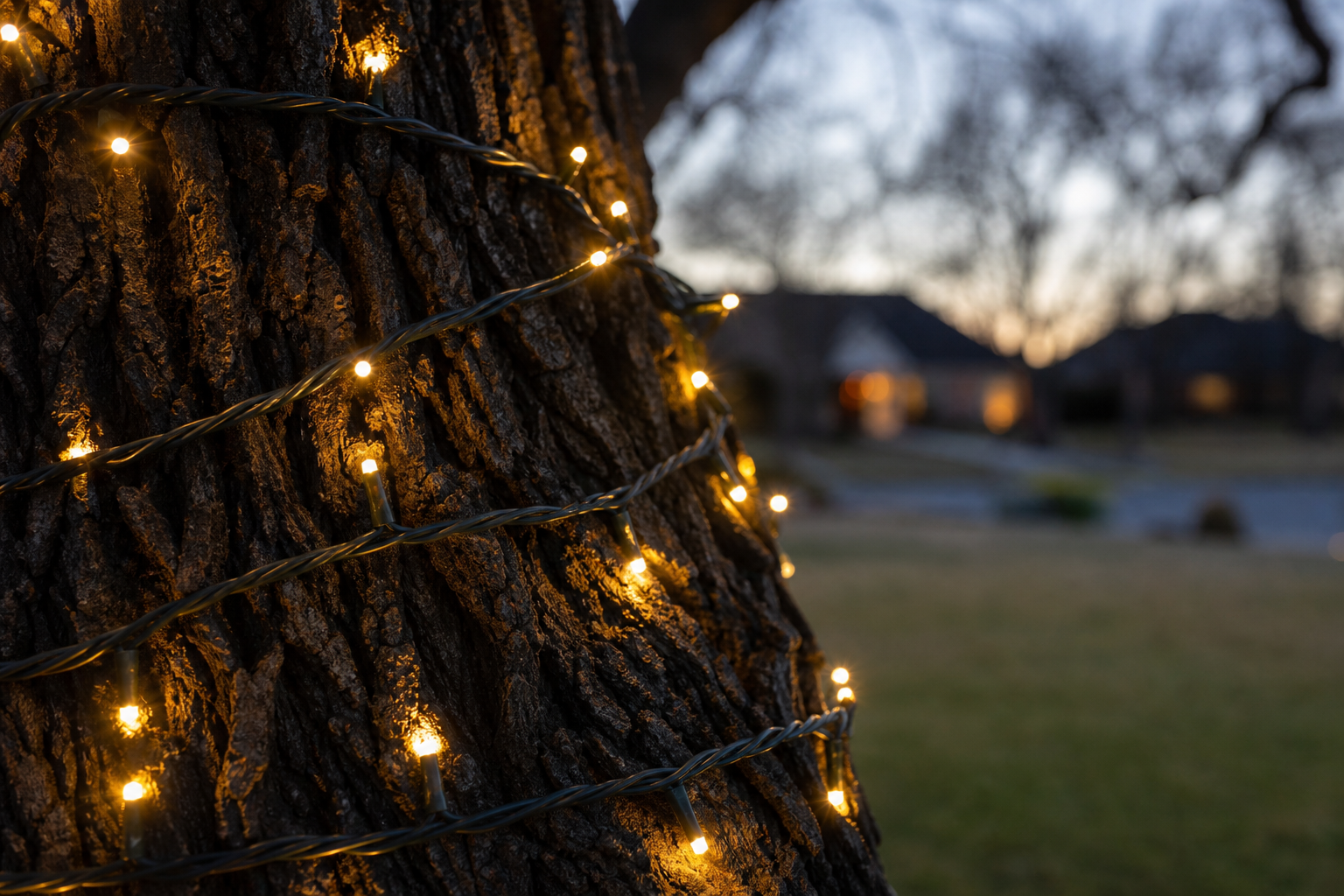
Start at the base of the tree and work upward. Distribute lights evenly across the crown rather than concentrating weight on a few branches. Use soft fasteners at each connection point, and keep all wraps loose enough for a finger to fit underneath.
- Select healthy, established trees only. Do not place lights on any tree under 3 years old, any tree currently recovering from disease, pests, or drought stress, or any tree with visible bark damage, cankers, or open wounds.
- Measure the trunk circumference and desired height before buying materials. This prevents overpurchasing or running short mid-installation.
- Begin at the base. Wrap trunk sections from bottom up with 2 to 3 inch spacing between rows. Secure each junction with soft twine or electrical tape, never with anything that digs into bark.
- Move outward from the main trunk into primary branches. Distribute strand weight across multiple branches rather than loading one limb heavily.
- Work upward toward the crown. Keep each wrap loose enough to slip a finger underneath.
- Use outdoor-rated extension cords for all connections. Route cords along the ground rather than tying them high in the tree structure.
- Step back and assess overall weight distribution before the display goes live. Heavy concentrations on one side increase wind-load and structural stress.
Which Trees Should Not Have Holiday Lights
Not every tree in a North Texas landscape is a good candidate for holiday lighting. Certain conditions make a tree too vulnerable to handle the additional stress.
Avoid placing lights on trees that are fewer than 3 years in the ground. Young trees are still establishing their root systems and building structural strength. Additional weight and bark contact stress slow that process.
Trees currently recovering from summer drought stress, pest damage, disease treatment, or bark wounds need the dormant season to rebuild. Adding lights and fasteners to a tree already under stress compounds the recovery challenge. Trees Hurt Too's Licensed Plant Health Care Professionals can tell you whether a specific tree in your yard is a good candidate or should be left clear this season.
Any tree with visible bark cankers, open wounds, spiral bark indentations from previous seasons, or active disease treatment should carry no lights this year. Revisit after a full season of healthy growth. Learn more about specific tree health concerns through the tree care services and shrub and tree pest information at treeshurttoo.com.
When to Remove Holiday Lights from Trees
The removal date matters as much as the installation method. Trees grow through spring and summer. Any material left on branches from a November installation sits tighter on the same branch every week from January through June.
Remove all holiday lights by early March at the latest. February is better. January is best. Every week a strand remains on a growing branch in spring tightens its grip on the bark.
After removal, walk each tree and inspect the bark where strands were fastened. Look for spiral indentation patterns, discolored bark patches, or any sunken area in the branch surface. Early detection of girdling pressure prevents permanent damage. Dieback in branches above the tightest wrapping points is a sign the damage has already progressed.
Signs of Holiday Light Damage to Watch for After the Season
Homeowners in North Richland Hills, Fort Worth, and surrounding communities should inspect trees in February or March after lights come down.
- Spiral bark indentations: Visible grooves or channels running in the pattern of where light strands were wrapped. These are evidence of girdling pressure.
- Sunken or discolored bark areas: Dark, sunken sections along where strands contacted the bark indicate cambium stress below the surface.
- Branch dieback above wrapped zones: If limbs above tight wrapping points fail to leaf out in spring, the vascular tissue was disrupted. This requires a professional assessment.
- Bark entry wounds: Any visible puncture, split, or rough texture at staple or nail sites should be evaluated, especially on oaks and elms where disease pressure is higher.
Trees Hurt Too provides professional assessments for trees showing any of these signs. A licensed ISA Certified Arborist can determine whether damage is cosmetic or structural. For external guidance on safe holiday light installation, the Davey Tree holiday lights guide offers additional detail from certified arborists.
Frequently Asked Questions About Holiday Lights and Tree Damage
Can holiday lights kill a tree?
Yes, in severe cases. A single season of properly hung lights rarely causes lasting damage. Lights left on year-round, wrapped too tightly, or attached with nails or staples can cause girdling, bark wounds, and disease entry that kill individual branches or, over time, the entire tree. LED lights and soft fasteners lower the risk significantly.
How long can holiday lights stay on a tree without causing damage?
Remove lights by early March at the latest. Trees begin growing again in late winter, and any material on branches tightens with each week of new growth. Lights installed in November and left through a full spring growing season can cause permanent girdling damage to branches that felt fine at installation.
What fasteners are safe to use when hanging lights on trees?
Soft ties, velcro straps, plastic clips or S-hooks, and natural twine are safe fasteners for tree lights. Nails, screws, staples, rigid wire, and tight zip ties all damage bark. Whatever fastener is used, keep it loose enough to slip one finger underneath at any point around the branch.
Protect Your Trees This Holiday Season
Trees Hurt Too Inc. has served Fort Worth and surrounding Tarrant County for over 28 years. Call or text to schedule a consultation.
Call: (972) 521-1552 | Text: (972) 521-1552 | treeshurttoo.com