

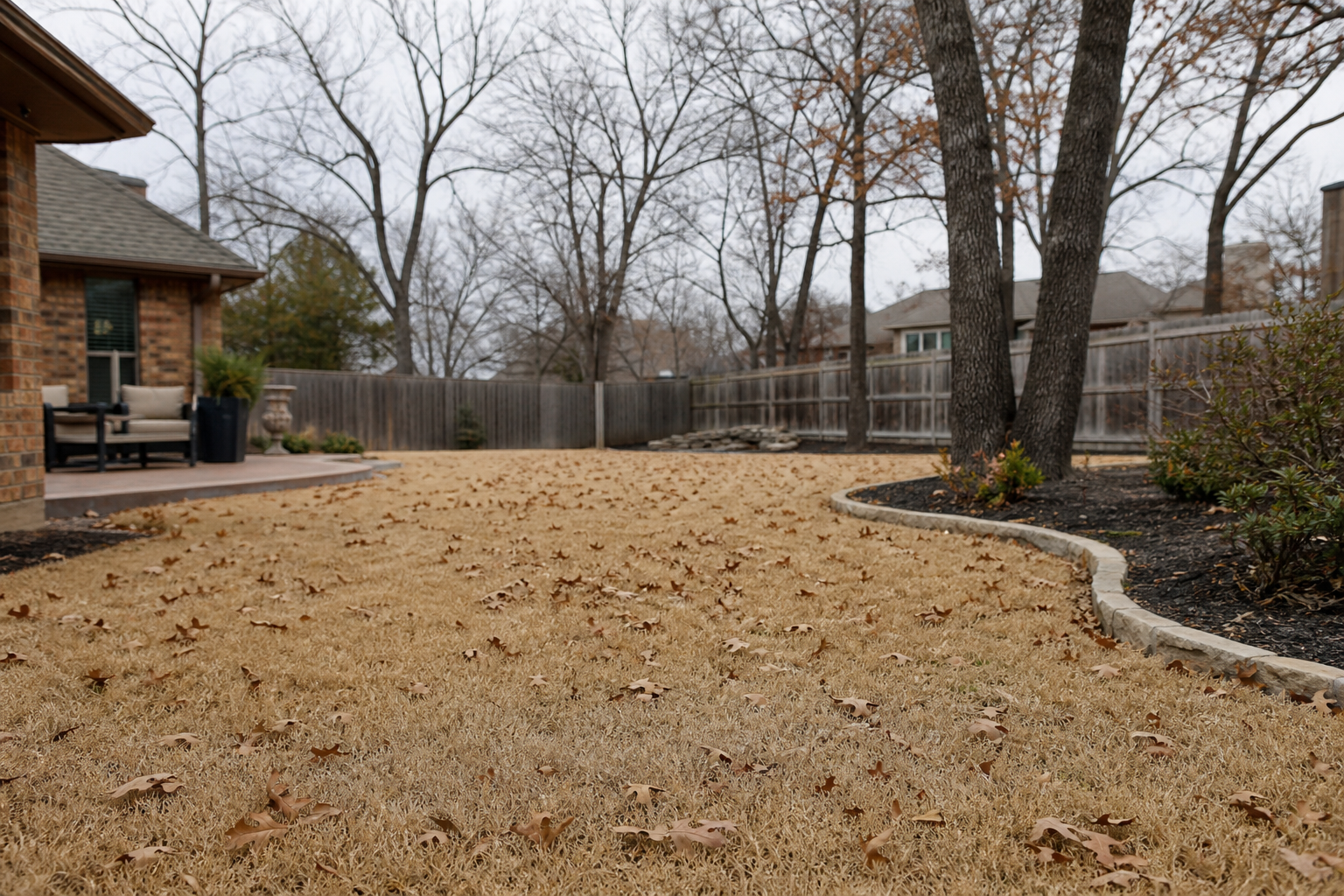
Bermuda, Zoysia, and St. Augustine lawns across Fort Worth and Arlington go dormant every November, turning tan and straw-colored as temperatures fall below 42.8 degrees Fahrenheit. The grass is not dead. Dormancy is a survival state, not a failure state. A dormant lawn is alive, holding energy reserves underground, and will return green in spring.
What homeowners do during the dormant period, roughly mid-November through mid-to-late April in Tarrant County, determines how well the lawn recovers. Overwatering, heavy foot traffic on frozen grass, fertilizing at the wrong time, and leaving leaf cover on the lawn all cause problems that show up in spring when the grass tries to green up.
This guide covers what dormancy means for North Texas grass, how to tell dormant from dead, and the specific care steps to take from November through February to protect the lawn through winter.
What Does Dormancy Mean for North Texas Lawns?
Dormancy is a biologically programmed response in warm-season grasses. When soil and air temperatures consistently drop below 42.8 degrees Fahrenheit, Bermuda, Zoysia, and St. Augustine grasses stop active top growth and shift into a maintenance state. Photosynthesis slows. Shoot growth stops. The plant preserves energy reserves in the crown and root system until spring temperatures return.
In Tarrant County, dormancy typically begins in mid-to-late November and lasts through mid-to-late April. The actual start date varies each year with first cold fronts and soil temperature changes. The end date tracks with consistent daytime temperatures reaching 65 degrees Fahrenheit in spring.
Dormant Grass vs. Dead Grass: How to Tell the Difference
The most common concern homeowners in Mansfield, Burleson, and Euless bring to plant health care professionals each spring is whether their tan lawn is dormant or dead. The visual difference is minimal. The functional difference is complete.
A dormant lawn turns tan, straw-colored, or light brown uniformly across the lawn surface. The color change is consistent and even. The grass blades are dry and withered in appearance but intact. Dormant grass returns green in spring once soil temperatures rise consistently above 50 degrees Fahrenheit.
Dead grass also turns brown, but the pattern is usually irregular, patchy, or follows stress lines. Dead grass blades pull out easily without resistance. When you tug on a dormant grass blade, it holds. When you tug on a dead grass blade, it pulls free from the crown.
How do you know if your lawn is dormant or dead in North Texas winter?
Pull a small section of brown grass firmly from the lawn. If it resists and holds at the crown, the grass is dormant and alive. If it pulls free easily with no resistance, it is dead. Dormant Bermuda and Zoysia return reliably in Tarrant County every spring. St. Augustine is somewhat less cold-tolerant and can sustain winter kill in extended hard freeze periods.
Watering a Dormant Lawn in North Texas
Watering needs drop significantly once warm-season grass enters dormancy. Natural rainfall in Tarrant County typically supplies enough moisture to keep dormant roots hydrated through November and December. Active summer irrigation schedules should stop.
Overwatering a dormant lawn creates two serious problems. First, saturated soil in cool temperatures encourages fungal disease. Large patch (Rhizoctonia solani) and take-all root rot (Gaeumannomyces graminis) both spread in wet, cool conditions on dormant warm-season grass. Second, standing water around dormant crowns stresses root systems that have reduced capacity to process excess moisture.
The right approach: water deeply every 3 to 4 weeks during extended dry periods of 10 or more days without rain. The goal is to keep roots from desiccating completely, not to maintain active growth. A single deep watering of 30 to 45 minutes covers this need. Supplemental water is not needed at all in weeks with normal fall and winter rainfall.
Should you water dormant Bermuda grass in Fort Worth?
Water dormant Bermuda only during dry spells lasting 10 or more days with no rain. One deep watering every 3 to 4 weeks during extended dry periods is sufficient. Bermuda's dormant root system needs just enough moisture to avoid complete desiccation. Keeping winter irrigation schedules identical to summer schedules causes fungal disease and root stress.
One exception applies to overseeded lawns. If ryegrass was overseeded onto a dormant Bermuda or Zoysia lawn in fall, the ryegrass is actively growing and needs regular water throughout winter. Adjust irrigation timing to support the ryegrass without saturating the dormant base grass.
Should You Fertilize Dormant Grass?
No. Do not fertilize dormant warm-season grass. This is one of the most damaging mistakes homeowners make in November and December.
Dormant grass cannot absorb or use fertilizer nutrients. Applied nutrients leach through the soil profile into groundwater without benefiting the lawn at all. Worse, any nitrogen that does reach active root cells can trigger out-of-season growth responses that weaken the plant's dormancy and make it vulnerable to subsequent freeze damage.
Wait until spring green-up is visible and consistent. When daytime temperatures stay above 65 degrees Fahrenheit and the lawn shows active new green color, fertilization resumes. Applying fertilizer to a dormant lawn is waste at best and damaging at worst.
Traffic and Frost: Protecting Dormant Turf
Frozen and frost-covered grass is brittle. The water in grass cells freezes, making blades rigid and fragile. Foot traffic on frost-covered turf crushes and breaks cells that cannot repair themselves until active growth resumes in spring.
Footprints in dormant frozen grass often remain visible for the entire dormant season. The damaged blades do not recover until new growth emerges in spring, and in some cases, damaged crowns do not recover at all. Keep foot traffic off frost-covered turf, especially during the morning hours when frost is still present.
Pets walking on frost-covered lawns in Grand Prairie, Keller, and similar neighborhoods cause this damage consistently through December and January. Limiting pet access to frosted turf during morning hours protects the lawn from cosmetic and structural damage that lingers until April.
Leaf Management During Dormancy
Leaves accumulating on a dormant lawn create conditions that favor disease and pest survival.
Thick, wet leaf cover blocks the limited sunlight reaching dormant grass and traps moisture against the turf surface. This combination encourages fungal disease including large patch, gray leaf spot, and other cold-weather turf pathogens. Matted leaf layers also provide ideal overwintering habitat for grubs near the surface, chinch bug eggs, and other lawn pest species that will emerge as active problems in spring.
Light raking or leaf blowing through December and January removes the leaf layer without disturbing dormant turf. The goal is to keep the surface reasonably clear, not to manicure it to summer appearance. Two or three passes through November and December are typically sufficient for most yards in Tarrant County.
Winter Weed Control During Dormancy
Lawn dormancy does not stop weed germination. Winter annual weeds, specifically henbit, chickweed, and annual bluegrass, germinate and establish actively during the dormant period. These weeds exploit the dormant turf's reduced competition to root in aggressively.
If pre-emergent herbicide was applied in October, most winter annual weeds are controlled before they establish. If pre-emergent was missed, spot treatment with broadleaf herbicide on warm days above 60 degrees Fahrenheit handles active winter weeds. Apply herbicide only when weeds are actively growing. Cold, dormant weeds do not translocate herbicide effectively and treatments applied below 50 degrees produce inconsistent results.
Pest Awareness During Dormant Season
Dormancy does not mean pest-free. Several damaging lawn pests remain active through winter in North Texas lawns.
White grubs continue feeding on grass roots at depth through winter months. Grub damage appears as dead patches in late winter that pull up easily because root systems have been consumed. Fire ant colonies in Tarrant County remain active on warm winter days above 60 degrees Fahrenheit, with workers emerging to forage and expand mound networks during warm spells.
Moles follow earthworms into yards as soil cools in November and December, producing the raised ridges and volcano-shaped mounds that appear across North Texas lawns from fall through early spring. Monitoring through winter allows problems to be caught and addressed before active grass growth resumes in April. For moisture-related issues affecting turf health through winter, moisture management services address root zone drainage and saturation problems. Comprehensive lawn care programs address the full range of dormant season needs.
Preparing for Spring Green-Up
Late February and early March bring the transition window between dormancy and active growth. Planning ahead for what the lawn needs makes the difference between a fast, even green-up and a slow, patchy one.
If a soil test was not completed in fall, schedule one in late February. Soil pH, nutrient levels, and organic matter content all affect how well the lawn recovers from dormancy. Tarrant County clay often needs pH correction and organic matter additions to support strong spring growth.
Pre-emergent herbicide for crabgrass applies when soil temperatures consistently reach 50 degrees Fahrenheit, typically in late February or early March in Fort Worth and Arlington. Missing this window by even a week allows crabgrass to establish before the pre-emergent creates a barrier.
The first spring fertilization applies after visible green-up is well established, typically when the lawn shows at least 50 percent green color. Applying fertilizer before the grass is actively growing pushes the same problems as winter fertilization: leaching, waste, and out-of-season growth response.
Frequently Asked Questions About North Texas Lawn Dormancy
When does Bermuda grass go dormant in Tarrant County?
Bermuda grass enters dormancy in Tarrant County when temperatures consistently drop below 42.8 degrees Fahrenheit, typically mid-to-late November. The dormant period runs through mid-to-late April when consistent soil warming at 50 degrees Fahrenheit triggers spring green-up. Timing varies each year based on actual temperature patterns during fall and winter months.
Is it normal for a North Texas lawn to be completely brown in winter?
Yes. Bermuda, Zoysia, and St. Augustine lawns all go dormant and turn tan to brown in North Texas winters. This is normal for warm-season grasses and does not indicate a problem. The grass is alive and will return green in spring. Dormant grass that holds firm when tugged at the crown is healthy and in proper dormancy.
Can you walk on dormant grass in Fort Worth in winter?
Avoid walking on frost-covered or frozen grass during winter mornings. Grass cells freeze in cold conditions, making blades brittle. Foot traffic crushes frozen blades, causing damage that remains visible all season because dormant grass cannot repair itself until spring growth begins. Footprints and pet traffic paths on frozen turf often show through April in Tarrant County yards.
Get Your Lawn Ready for Spring Before Winter Sets In
Trees Hurt Too Inc. has served Fort Worth and surrounding Tarrant County for over 28 years. Call or text to schedule a consultation.
Call: (972) 521-1552 | Text: (972) 521-1552 | treeshurttoo.com