

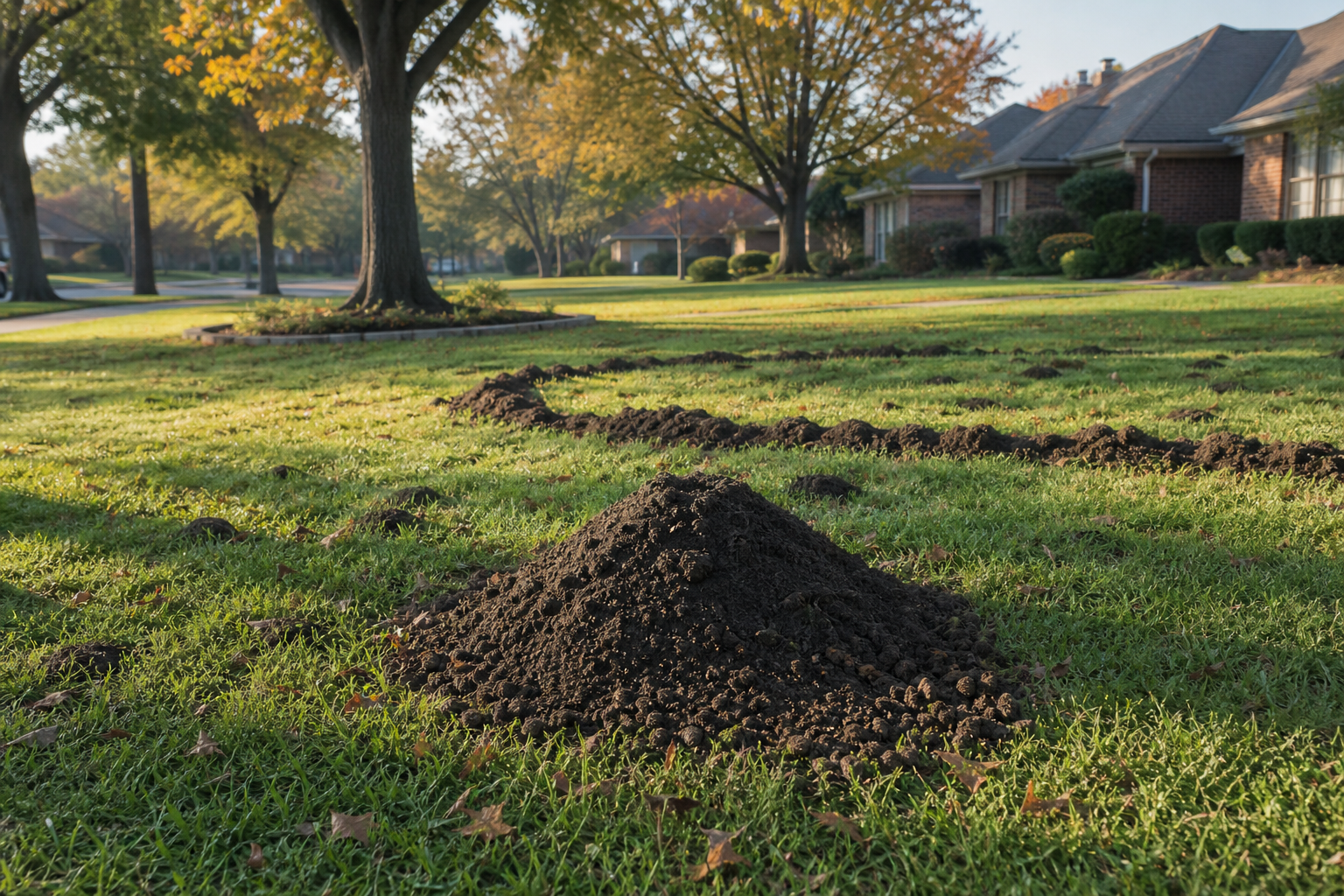
Volcano-shaped mounds and raised ridges appear across Fort Worth and Arlington lawns every November, and most homeowners blame the wrong animal entirely. Moles cause this damage in North Texas yards during fall, when cooling soil and returning moisture bring earthworms back to the surface. The moles follow their food supply upward, and the signs show up fast.
The Eastern mole (Scalopus aquaticus) is an insectivore, not a rodent. It does not eat plant roots, grass, or garden vegetables. Every bit of lawn damage a mole causes comes from physical tunneling, not feeding on plants. Understanding that distinction changes how you approach control.
This guide covers what moles are, why fall is peak activity season in Tarrant County, how to tell mole damage from gopher or vole damage, and what control methods actually work.
What Are Moles and What Do They Eat?
The Eastern mole is the species most homeowners across North Texas encounter. It weighs roughly 4 ounces, grows up to 7 inches long, and carries grayish-brown fur over a compact, cylindrical body. Its snout is pointed, its eyes are hidden in its fur, and its broad front feet with strong claws are built entirely for digging.
Moles are insectivores. Their diet consists of earthworms, grubs, beetles, spiders, and insect larvae. They do not eat plant roots, grass seed, or vegetable matter. A single mole consumes between 32 and 70 percent of its body weight in food every day. That level of consumption requires nearly constant tunneling to locate prey.
Why does everyone think moles eat plants?
The confusion is understandable. Dead grass, disturbed soil, and dying plants all appear along mole tunnels. The damage looks like something is eating the roots. The actual cause is physical: tunneling lifts the root zone away from soil contact, and the roots dry out and die. The mole was never eating anything in the ground except earthworms.
Moles are mostly solitary. One or two animals can produce surprising amounts of visible surface disruption across a large lawn. They live up to 3 years and maintain the same tunnel systems over time, returning to productive feeding grounds season after season.
Why Mole Activity Peaks in North Texas in Fall
Mole activity in Tarrant County yards reaches its highest visible point in fall, typically through October and November. The reason is soil moisture and food supply, not the season itself.
After North Texas summers, which drain soil moisture and drive earthworms deep below the surface, autumn brings cooling temperatures and returning rainfall. As soil moisture levels recover from summer drought, earthworms move back toward the upper soil layers. Moles track their food supply. When earthworms rise, moles follow, producing the surface feeding tunnels and mounded soil that homeowners suddenly notice.
Moles are most active on overcast days and after warm rains. Surface tunneling is most visible in spring and fall. In summer and winter, they drop to deep runways 16 to 18 inches below ground, where earthworms still live but surface signs largely disappear.
When do moles become most visible in Fort Worth yards?
Homeowners across Fort Worth, Mansfield, and Burleson typically start noticing fresh mole activity in October and November. The timing tracks closely with the first significant fall rainfall following the dry summer period. A warm rain in October can trigger visible surface tunneling within days.
Moles vs. Gophers vs. Voles: Which Animal Is in Your Yard?
Identifying the right animal before attempting any control is the most important step. Pocket gophers and voles are common in North Texas too, and they cause different types of damage through different mechanisms.
Moles are insectivores. They create volcano-shaped mounds of excavated soil and raised ridge tunnels running just below the surface across open lawn areas. The damage is physical, not from feeding on plants.
Pocket gophers eat plant roots and tubers. Their mounds spread flat and fan-shaped rather than volcano-shaped. They directly kill plants and can damage tree root systems. Gopher damage is root damage.
Voles, sometimes called meadow mice, eat plant roots and grass. They do not create distinct mounds. Their runway patterns run along the soil surface, often under leaf litter or mulch. Voles gnaw on tree bark and roots near the soil line, causing damage that looks like rodent or mouse activity.
The mound shape is the fastest visual diagnostic. Volcano-shaped, with soil pushed up from a central point, almost always indicates a mole. Flat, spread-out soil pushed to one side points to a gopher. No distinct mound at all, with surface runways through grass, points toward voles.
Signs of Moles in Your North Texas Yard
Mole activity produces four distinct signs in lawns across Keller, North Richland Hills, and Grand Prairie.
- Volcano-shaped mounds: Conical piles of loose soil pushed up from below, often appearing overnight after rain.
- Raised surface ridges: Linear raised areas running through turf where subsurface feeding tunnels run just below the surface. These ridges are the daily feeding tunnels the mole uses to hunt.
- Dead grass strips: Brown, dying grass following the path of surface tunnels. Root systems are lifted from soil contact and dry out.
- Active runways: Press a raised tunnel flat with your foot. If the ridge pops back up within 24 to 48 hours, the tunnel is active and currently in use.
The active runway test is the best way to target control efforts. Inactive tunnels are part of the system but may not be traveled daily. Placing traps or bait in active runways produces better results than working in abandoned sections.
The Tunnel System Under Your Lawn
A mole's tunnel network is more extensive than surface signs suggest. Subsurface feeding tunnels run just below the soil surface and are used daily. Deep runways run 16 to 18 inches below ground and connect feeding areas to nesting sites.
Research from the Natural Science Research Laboratory at Texas Tech University documented a single mole burrow in Van Zandt County, Texas at 360 meters long, nearly a quarter mile. The tunnels visible in a typical lawn represent only the active feeding portion of a larger underground system.
One often-overlooked aspect of mole activity: tunneling aerates and mixes soil. The damage far outweighs that benefit in maintained lawns, but moles are not entirely negative for soil biology. Their tunneling introduces air and redistributes organic matter through the soil profile.
How to Control Moles in Fall
Four main control approaches exist for moles in North Texas yards. Their effectiveness varies, and the best approach depends on the scale of the problem and property specifics.
What is the most effective way to get rid of moles?
Trapping is the most reliable control method for moles. Traps placed in confirmed active runways produce consistent results when set correctly. Confirm active runways first by pressing tunnels flat and checking for rebound within 24 to 48 hours.
- Trapping: Set traps in active runways. Multiple trap types work, including harpoon, scissor-jaw, and pinch traps. Check traps daily. Professional trapping is more consistent than DIY methods because tunnel identification and placement require experience.
- Bait products: Products designed to simulate earthworms or grubs are placed in active tunnels. Moles ingest the bait and die underground within 12 to 24 hours. Bait works best in active runways confirmed by the press-and-check test.
- Castor oil repellents: Granular or liquid castor oil products discourage moles from feeding in treated areas. Results vary. Products require reapplication after rain and typically shift moles to adjacent untreated areas rather than eliminating them.
- Physical barriers: Quarter-inch mesh galvanized hardware cloth, buried 12 to 30 inches deep with 6 inches above ground, excludes moles from garden beds and specific areas. This method is practical for protecting raised beds or small defined zones, not entire lawns.
Grub control reduces one food source for moles. However, earthworms are the primary food supply and are beneficial soil organisms. Eliminating earthworms to deter moles causes more damage to soil health than the moles themselves. Grub control is worthwhile for grub damage, not specifically for mole control.
For reliable guidance on trapping techniques, the University of Minnesota Extension mole trapping guide covers trap selection and placement in detail.
When to Call a Professional Mole Service
Professional mole control produces more consistent results than DIY methods for most homeowners in Euless, Arlington, and surrounding areas. Moles maintain extensive tunnel systems, and locating active sections requires time and experience. Misidentified tunnels lead to wasted bait or traps.
A professional service identifies active tunnels accurately, places controls correctly, and monitors results over follow-up visits. Mole populations in North Texas yards rarely involve just one animal, and one round of control does not always resolve the problem completely. Ongoing monitoring during fall and spring activity periods keeps yards protected.
Trees Hurt Too Inc. provides professional mole services across Tarrant County and surrounding communities. The team also handles other lawn pests active during fall, and full pest control services are available for homeowners dealing with multiple pest problems at once.
Frequently Asked Questions About Moles in North Texas
Do moles eat grass roots or plant roots?
Moles do not eat grass roots, plant roots, or any vegetation. They are insectivores that feed on earthworms, grubs, beetles, and insect larvae. Root damage along mole tunnels happens because tunneling physically lifts the root zone away from soil contact, cutting off moisture and causing grass to die above the tunnel.
How do I know if mole tunnels in my yard are active?
Press a raised tunnel ridge flat with your foot. If the ridge pops back up within 24 to 48 hours, the tunnel is active and currently used by the mole. Inactive tunnels do not rebound. Always set traps or place bait only in confirmed active runways for the best results.
Why do moles appear in my yard every fall in Fort Worth?
Fall mole activity follows earthworm movement. After summer drought, fall rain and cooler temperatures bring moisture back to the upper soil. Earthworms move toward the surface in those conditions. Moles track their food supply upward, producing visible surface tunnels and mounds that homeowners notice in October and November across Tarrant County yards.
Get Mole Activity Under Control Before It Spreads
Trees Hurt Too Inc. has served Fort Worth and surrounding Tarrant County for over 28 years. Call or text to schedule a consultation.
Call: (972) 521-1552 | Text: (972) 521-1552 | treeshurttoo.com