

Bermuda grass goes dormant and turns brown when soil temperatures in Tarrant County consistently drop below 55 degrees Fahrenheit. That typically happens in late October to early November across Fort Worth, Arlington, and surrounding communities. For homeowners who want a green lawn through winter, overseeding with cool-season ryegrass is one option. For others, a dormant brown lawn from November through March is entirely acceptable.
Overseeding is a deliberate choice with real trade-offs, not a standard annual practice. This guide explains what overseeding does, when the timing window opens in Tarrant County, how to do it correctly, and why homeowners who plan to apply fall pre-emergent weed control need to choose between the two approaches before acting.
Both paths are valid. The goal here is to give homeowners the information they need to make the right choice for their lawn, their schedule, and their goals.
What Is Overseeding and Why Do North Texas Homeowners Do It?
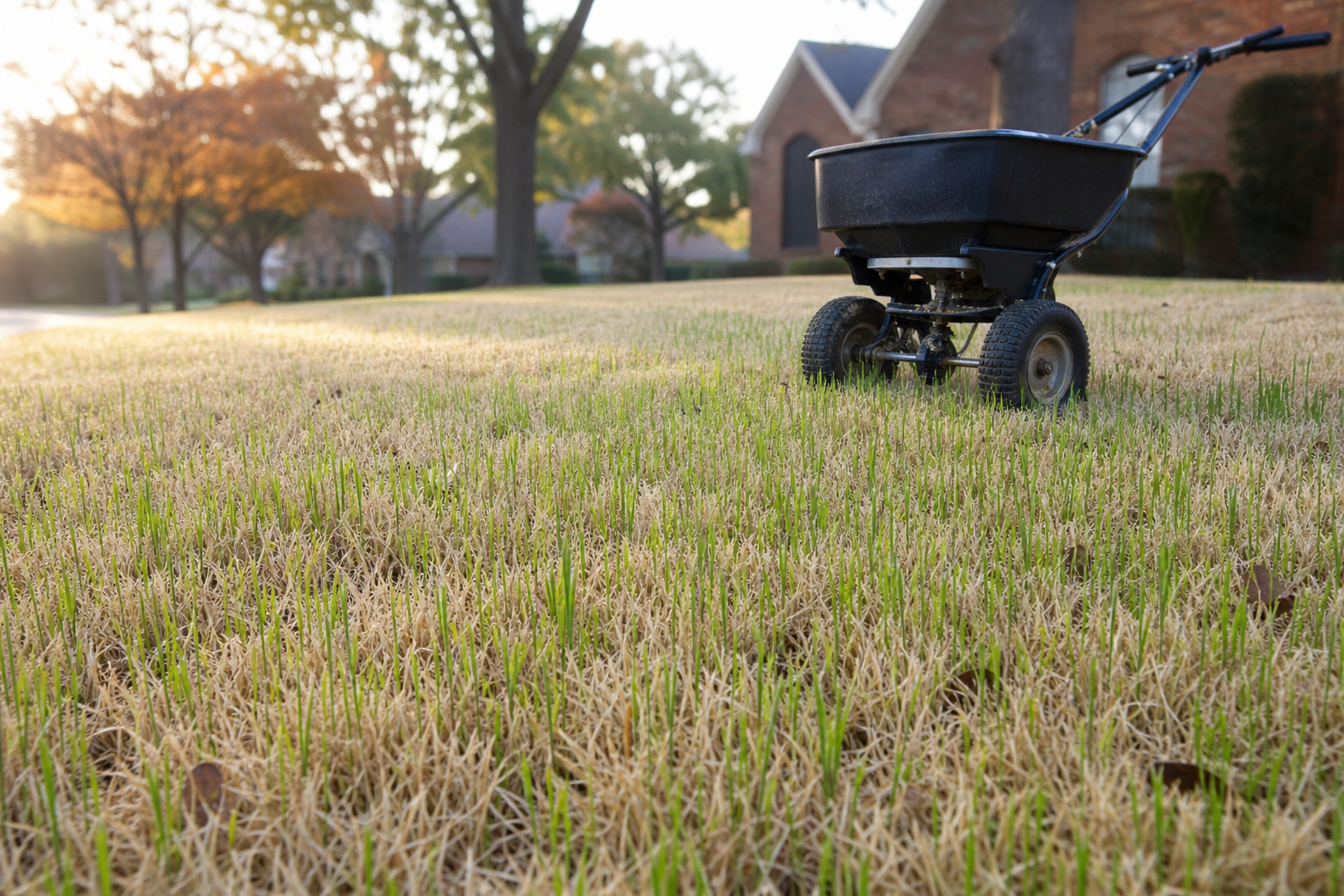
Overseeding means broadcasting cool-season grass seed over an existing dormant lawn. In North Texas, perennial ryegrass is the most common choice. It germinates quickly, holds a fine texture and rich green color, and grows actively through the mild North Texas winter when Bermuda is dormant.
The result is a green, usable lawn from November through March. For homeowners with dogs, children who play outdoors year-round, or properties where winter curb appeal matters, overseeding delivers visible value throughout the dormant season.
Annual ryegrass is a lower-cost alternative. It has a coarser texture and a shorter lifespan but costs less per pound. Most homeowners in Tarrant County prefer perennial ryegrass for its finer appearance and more consistent performance.
Overseeding is not about fixing a damaged Bermuda lawn. It is about maintaining visual and functional use of the turf space during Bermuda's natural dormancy period. The Bermuda itself is alive and healthy underground. Come spring, it will push back to the surface.
Should You Overseed Your Bermuda Lawn This Fall?
The answer depends on four factors: how you use your yard in winter, whether you applied fall pre-emergent weed control, the current health of your Bermuda, and whether you can commit to proper spring transition management.
Overseeding makes the most sense for homeowners who use their lawn actively in winter. A yard used by children and dogs benefits from a green surface that can take foot traffic. A front yard on a high-visibility street benefits from the curb appeal of living green turf.
Overseeding is a poor choice if you have already applied fall pre-emergent weed control. Pre-emergent products prevent seeds from germinating. The same chemistry that stops winter weed seeds will stop ryegrass seed as well. If pre-emergent went down, overseeding will fail.
Bermuda that came through the summer with significant drought stress is not an ideal candidate for overseeding. Ryegrass establishes by competing for root space and water. Adding that competition during a recovery period works against the Bermuda's return to full health in spring.
When to Overseed Bermuda Grass in Tarrant County
Soil temperature is the critical variable. Ryegrass germinates reliably when soil temperatures are between 60 and 70 degrees Fahrenheit. In Tarrant County, that window typically opens in mid-to-late October and closes by mid-November.
Seeding when soil temperatures are still above 75 degrees Fahrenheit, which can occur in early October during warm fall stretches, exposes ryegrass seed to heat stress during germination. Establishment is slower and less consistent.
Seeding after soil temperatures drop below 50 degrees Fahrenheit, which can happen if November runs cold, slows germination to the point where seed may fail entirely. Ryegrass needs 4 to 6 weeks of active growth before hard winter cold arrives.
Check soil temperatures rather than air temperatures. Soil holds heat longer than air, so a string of warm days in October may mean the soil is warmer than it feels outside. Local soil temperature data for Fort Worth and Tarrant County is available through Texas A&M AgriLife Extension resources.
Overseeding vs. Pre-Emergent Weed Control: You Cannot Do Both
This is the most important decision point for fall lawn management in North Texas. Fall pre-emergent weed control, applied in October, prevents winter weed seeds from germinating. Common targets include annual bluegrass, chickweed, and henbit, which are winter weeds that invade dormant Bermuda lawns.
Pre-emergent products create a chemical barrier at the soil surface that blocks seed germination. Ryegrass seed, broadcast after pre-emergent application, will hit that same barrier. The result is failed overseeding and money spent on seed and labor with nothing to show for it.
Homeowners must choose one goal for fall: a green overseeded lawn through winter, or pre-emergent weed control that keeps winter weeds out of the Bermuda. Both are legitimate goals. They cannot both be achieved in the same season through timing-compatible applications.
For lawn care guidance that covers both fall options, the lawn care page explains the programs available from Trees Hurt Too Inc. The weed control page covers pre-emergent programs and timing in detail.
How to Overseed Bermuda Grass Step by Step
Correct technique determines whether overseeding succeeds or fails. These steps apply to residential lawns in Fort Worth, Grand Prairie, Mansfield, and the rest of Tarrant County.
Scalp the Bermuda first. Mow the Bermuda as short as possible before overseeding. A low-cut surface allows ryegrass seed to reach the soil rather than sitting on top of existing turf canopy. This step requires a mower capable of setting a low blade height. Lawn scalping should be handled by a mowing service if the homeowner does not have the right equipment.
Dethatch if needed. If the Bermuda thatch layer is thicker than half an inch, dethatch before seeding. Thick thatch prevents seed-to-soil contact, which is required for germination. A thatch layer under half an inch does not require removal.
Apply seed at the right rate. The standard seeding rate for overseeding Bermuda is 5 to 10 pounds of perennial ryegrass per 1,000 square feet for full coverage. Use a broadcast spreader for even distribution.
Rake lightly after broadcasting. A light raking after seed application improves seed-to-soil contact without burying the seed too deep. Ryegrass seed germinates best at the soil surface, not buried under half an inch of soil.
Water lightly and frequently until germination. Keep the seeded surface consistently moist until germination occurs, typically 7 to 14 days after seeding. Light, frequent watering, two to three times per day in dry conditions, prevents the seed from drying out between irrigation cycles. Once ryegrass is established, reduce watering frequency and increase depth per session.
Managing the Spring Transition When Bermuda Comes Back
Spring transition is the point where Bermuda reclaims the lawn from ryegrass. Managed correctly, the transition is clean and Bermuda establishes full coverage by May or June. Managed poorly, thick ryegrass suppresses Bermuda's return and delays recovery by weeks.
In April, stop supplemental irrigation of the ryegrass. Bermuda begins pushing as soil temperatures warm above 65 degrees Fahrenheit. Ryegrass, which prefers cooler temperatures, starts going dormant under spring heat. Stopping irrigation accelerates that stress and allows Bermuda to take over.
Scalp the lawn low in April to remove the ryegrass canopy and open the surface to direct sunlight. Bermuda spreads through above-ground stolons and needs sunlight to push across the lawn surface. A dense ryegrass canopy blocks that sunlight and delays Bermuda coverage.
Perennial ryegrass typically dies out by May or June in North Texas heat even without intervention. Annual ryegrass dies even sooner. By mid-summer, the Bermuda will have fully reclaimed the lawn if the transition was supported rather than allowed to stall.
If persistent ryegrass patches remain and Bermuda has not filled in by June, additional scalping and reduced watering usually resolve the situation. Suppression of ryegrass through heat stress is the most practical approach for residential lawns in Tarrant County.
Is Overseeding Worth It for Your North Texas Lawn?
For homeowners who use their yard actively through winter, overseeding delivers genuine value. A green lawn from November to March supports outdoor activity, maintains curb appeal, and keeps the lawn surface functional during Bermuda's dormant period.
For homeowners who prioritize weed control, spring Bermuda health, or simply do not need a green lawn in winter, skipping overseeding is a sound choice. A properly maintained dormant Bermuda lawn recovers to excellent condition in spring without the added cost and effort of an overseeded winter season.
The trade-off comes down to what matters most: winter aesthetics and use versus simplified fall management and clean spring transition. Neither choice is wrong. Both serve different homeowner needs in different North Texas lawns.
The Texas A&M AgriLife Extension Bermudagrass Management Calendar provides a season-by-season guide to Bermuda care at agrilifeextension.tamu.edu. For full-season lawn care programs that include both weed control and seasonal lawn management, the full-service lawn and ornamental package covers Tarrant County lawns throughout the year.
Get Expert Lawn Guidance for Your Tarrant County Bermuda Lawn
Trees Hurt Too Inc. has served Fort Worth and surrounding Tarrant County for over 28 years. Call or text to schedule a consultation.
Call: (972) 521-1552 | Text: (972) 521-1552 | treeshurttoo.com