

Preparing your lawn soil for fall in North Texas involves four specific actions in a defined sequence: soil testing, core aeration, fertilization, and pre-emergent weed control. Each step has its own timing window, and doing them out of order reduces how well each one works. Getting the sequence right makes a measurable difference in how your lawn enters dormancy and how it comes back in spring.
Tarrant County clay soil faces a concentrated set of challenges by fall. Summer heat and drought compact the soil, reduce organic matter activity, and deplete nutrients faster than they are replaced. The alkaline pH of most DFW yards locks up iron and other nutrients. Thatch builds up on the surface, blocking water infiltration further.
Fall soil preparation in North Texas is not about fixing the lawn for next week. It is about setting up the root system for a winter period where roots continue working underground even after the grass goes dormant above. A lawn with well-prepared soil going into dormancy in Fort Worth or Arlington comes out of winter stronger than one that did not receive that preparation.
This post covers the complete fall soil preparation sequence for warm-season lawns in Tarrant County, with specific timing for each step and the reasoning behind the order.
Why Fall Is Critical for Lawn Soil Preparation in North Texas
Fall is the most consequential soil care window of the year for Tarrant County lawns because of what happens underground during dormancy. Warm-season grass roots continue absorbing nutrients and building energy reserves through fall even after above-ground growth slows. Soil prepared well in September and October supports that underground activity through the winter.
By September, most North Texas lawns have accumulated a season of compaction. Summer foot traffic, irrigation cycles, and the expansion and contraction of clay soil under heat all compress the soil over time. That compaction restricts the root zone heading into the season when roots are building their winter reserves.
The fall application windows for fertilizer, pre-emergent weed control, and soil amendments align with this underground activity. Nutrients applied in fall reach roots that are still absorbing. Pre-emergent applied in mid-October stops winter annual weeds before they establish. Both applications work better in aerated, well-structured soil than in compacted clay. That is why the sequence matters.
Step 1: Soil Testing Before Making Any Changes
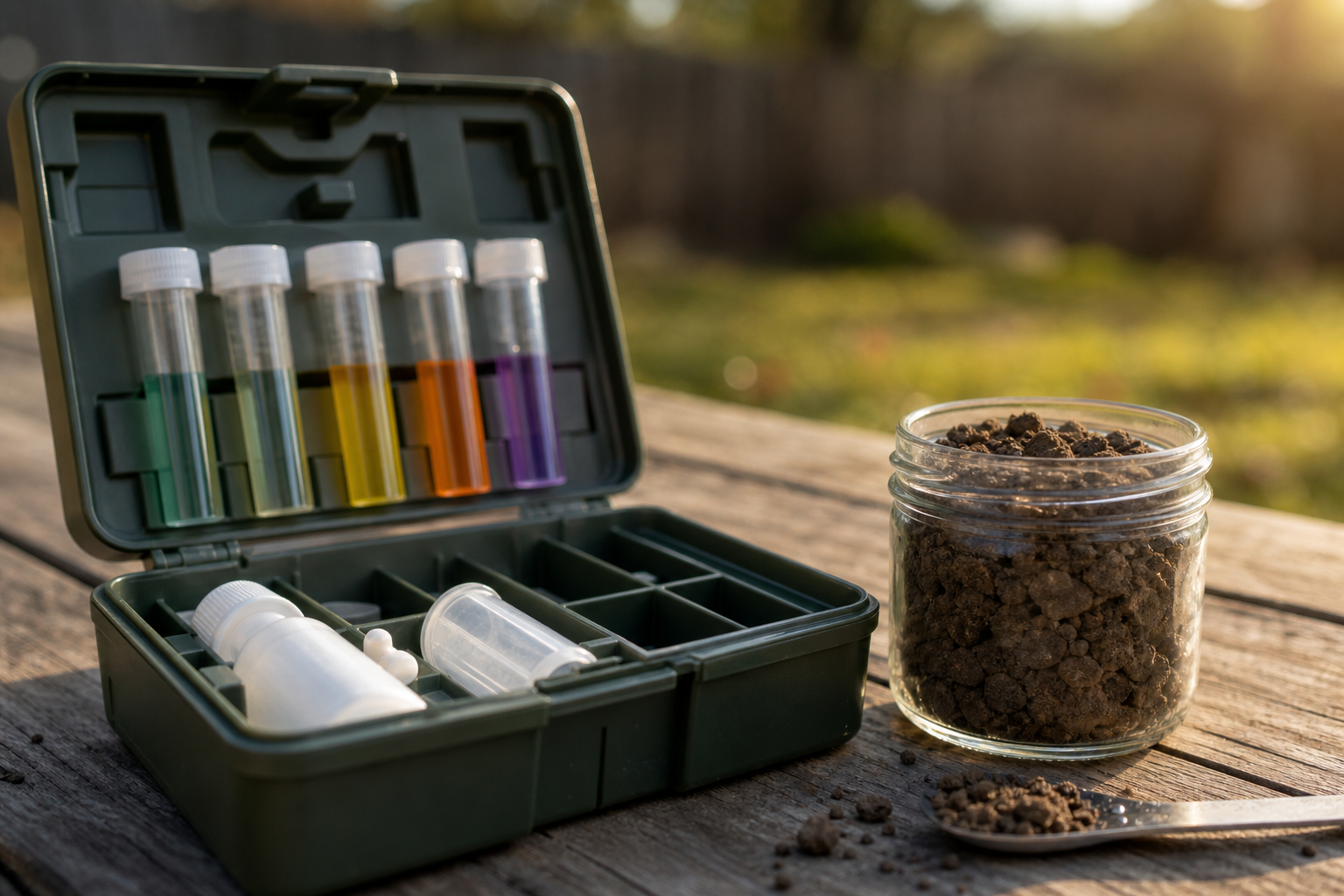
Soil testing in September gives you the actual data behind every other decision in the fall preparation sequence. Without a test, you are guessing at what your soil needs. Over-correcting soil chemistry causes problems as real as under-correcting it.
How to test your North Texas lawn soil
Texas A&M Soil Testing Laboratory and county Extension offices offer affordable soil tests. Send a sample in September and results typically return within one to two weeks, leaving time to act within the fall preparation window.
North Texas clay soil is typically alkaline, compacted, and low in organic matter. The most common deficiencies identified in DFW lawns are nitrogen, iron, and organic matter. A soil test confirms which of these apply to your specific yard and at what levels, so you apply only what is needed rather than a generic formula that may not match your soil's actual condition.
Soil pH in Tarrant County often runs above 7.5, which significantly reduces iron availability to grass roots. If your test confirms high pH alongside iron deficiency, that guides the amendment approach differently than a test showing adequate pH with only nitrogen depletion.
Step 2: Core Aeration as the Foundation of Fall Soil Prep
Core aeration is the mechanical step that makes every other fall preparation more effective. It opens the compacted soil surface so that fertilizer, amendments, and water can reach the root zone rather than sitting on top of the clay layer.
The timing for fall aeration of warm-season grasses, Bermuda, St. Augustine, and Zoysia, is early September. These grasses need 4 to 6 weeks of active growth after aeration before dormancy begins. Tarrant County's first frost typically arrives in mid-November, so early September aeration stays within that recovery window. October aeration is too late.
Core aeration removes plugs of soil roughly 2 to 3 inches deep and half an inch in diameter, spaced about 2 to 3 inches apart. The plugs remain on the lawn surface and break down in one to two weeks, returning organic matter to the soil. Aeration done before the remaining fall preparation steps ensures fertilizer and amendments have direct soil access through those open channels.
Step 3: Organic Amendments and Carbon-Based Products Post-Aeration
The window immediately after aeration is the best time to apply organic amendments and carbon-based soil products. The open aeration holes provide direct access to the root zone that is not available through compacted clay under normal conditions.
Compost applied post-aeration works down into the channels and begins improving soil structure over the fall and winter period. Clay soil in Fort Worth, Keller, and North Richland Hills benefits substantially from organic matter additions that open soil pore space and support beneficial microbial activity.
Carbon-based soil products, which Trees Hurt Too uses as a core part of its approach, introduce organic compounds that improve soil biology over time. Unlike synthetic amendments that produce an immediate chemical change, carbon-based products support the long-term biological capacity of the soil. Applied in fall, they work through the winter months and produce improved soil structure by spring.
Step 4: Fall Fertilization Timing for Tarrant County Lawns
Fall fertilization for warm-season grasses in North Texas should happen after soil temperatures cool below 75 degrees Fahrenheit consistently, which typically occurs in late September through early October in Tarrant County. Applying too early risks stimulating a flush of growth that cannot harden before first frost.
Fertilizer selection for North Texas warm-season lawns
Use a slow-release formula for fall fertilization. Slow-release products deliver nutrients steadily over weeks rather than all at once, which matches the root absorption pattern of a grass transitioning toward dormancy. Fast-release nitrogen forces a burst of tender growth that is vulnerable to cold damage.
Bermuda and Zoysia lawns in Mansfield, Burleson, and Colleyville benefit from a potassium-rich fall formula that supports cold hardiness in the grass tissue. St. Augustine lawns require a lighter fall fertilization approach. Excessive nitrogen on St. Augustine in fall stimulates too much top growth before dormancy and can weaken the plant going into winter.
Apply fertilizer after aeration so the nutrients reach the root zone directly through the open channels. This sequencing produces measurably better results than applying fertilizer to an unaerated surface.
Step 5: Fall Pre-Emergent Weed Control Timing
Fall pre-emergent weed control targets a completely different set of weeds than the spring application. The fall window addresses winter annual weeds: annual bluegrass, henbit, and chickweed. These weeds germinate when soil temperatures drop consistently to the 55 to 65 degree Fahrenheit range, which typically happens in mid-October in Tarrant County.
Pre-emergent works by preventing weed seed germination. It must be present in the soil before seeds germinate, not after they are already visible. Applying in mid-October, just ahead of when soil temperatures reach the germination threshold, stops these weeds before they establish in the lawn.
The spring pre-emergent, applied in February and March, targets crabgrass and other warm-season annual weeds. These are separate applications with separate targets and separate timing windows. Missing the fall pre-emergent window means dealing with annual bluegrass and henbit through the entire winter season.
Step 6: Adjusting Irrigation as Temperatures Cool
Fall soil preparation includes adjusting the irrigation schedule as temperatures drop through September and October. Overwatering a lawn approaching dormancy promotes fungal disease and creates overly saturated soil conditions that counteract the benefits of aeration and fertilization.
The goal is to maintain the root zone at consistent, moderate moisture, not wet and not dry. As evapotranspiration rates drop with cooler temperatures, reduce irrigation frequency while maintaining adequate soil moisture depth. Soil that is slightly moist through the dormancy transition supports root activity better than soil that is either waterlogged or drought-stressed.
Homeowners in Euless, Arlington, and Fort Worth with irrigated lawns often over-irrigate through September and October because summer habits carry forward. Monitoring actual soil moisture at 2 to 4 inches depth, rather than applying water on a fixed schedule, gives a more accurate picture of what the lawn actually needs.
The Complete Fall Soil Preparation Sequence for North Texas
Follow these steps in order for the best results in Tarrant County lawns:
- September: Soil test. Send a sample to Texas A&M Soil Testing Laboratory. Results guide all amendment decisions.
- Early September: Core aerate. Complete before mid-September to maintain the 4 to 6 week recovery window before first frost.
- After aeration: Apply organic compost or carbon-based amendments. Use the open channels for maximum soil penetration.
- Late September to early October: Apply slow-release fall fertilizer. Wait until soil temperatures cool consistently below 75 degrees.
- Mid-October: Apply fall pre-emergent weed control. Target the soil temperature window of 55 to 65 degrees before winter annual weeds germinate.
- September through October: Adjust irrigation downward. Reduce frequency as temperatures cool while maintaining consistent root zone moisture.
Each step in this sequence builds on the one before it. Aeration makes fertilization more effective. Fertilization applied at the right temperature timing avoids forcing growth at the wrong time. Pre-emergent applied after aeration reaches the soil more effectively than on a compacted surface. The sequence is not arbitrary.
Fall Lawn Soil Care Services in Tarrant County
Trees Hurt Too provides lawn soil care services including aeration, fertilization, pre-emergent weed control, and carbon-based soil amendments across Fort Worth, Arlington, Keller, Mansfield, Burleson, North Richland Hills, Colleyville, and surrounding Tarrant County communities.
The lawn care program covers the full preparation sequence across the growing year. The moisture management service addresses soil water retention through the fall transition, including fall applications that extend moisture management support into dormancy. The Full Service Lawn and Ornamental Package integrates all eight annual service visits, including fall soil preparation at the right timing for each step.
Texas A&M's soil testing program at soiltesting.tamu.edu provides the baseline soil data that guides every other fall preparation decision.
Frequently Asked Questions About Fall Lawn Soil Preparation in North Texas
What order should I follow for fall lawn soil preparation in North Texas?
The correct sequence is: soil test in September, core aerate in early September, apply organic amendments post-aeration, apply slow-release fertilizer in late September to early October when soil temperatures cool below 75 degrees, apply fall pre-emergent in mid-October, and reduce irrigation frequency as temperatures drop. Each step builds on the one before it for best results.
When should I apply fall pre-emergent weed control in Tarrant County?
Apply fall pre-emergent in mid-October, when soil temperatures approach the 55 to 65 degree Fahrenheit range where winter annual weeds germinate. The application must be in the soil before weed seeds germinate. This targets annual bluegrass, henbit, and chickweed and is a separate application from the spring pre-emergent that addresses crabgrass in February and March.
Should I fertilize my Bermuda lawn in fall in North Texas?
Yes, but with careful timing. Wait until soil temperatures cool below 75 degrees consistently, which happens in late September to early October in Tarrant County. Use a slow-release formula with potassium to support cold hardiness. Stop fertilization 2 to 3 weeks before the first frost in mid-November. Applying too early stimulates tender growth that winter cold can damage.
Does soil testing matter for a North Texas lawn with visible problems?
Soil testing is especially important when visible problems exist. The specific deficiency drives the correct remedy. North Texas clay is typically alkaline, low in organic matter, and iron-deficient, but the severity varies by property and location within the yard. A test result showing the actual pH and nutrient levels prevents over-correction, which causes secondary problems as serious as the original deficiency.
Start Your Fall Lawn Soil Preparation in Tarrant County
Trees Hurt Too Inc. has served Fort Worth and surrounding Tarrant County for over 28 years. Call or text to schedule a consultation.
Call: (972) 521-1552 | Text: (972) 521-1552 | treeshurttoo.com