

October is the month that determines whether ornamental shrubs in North Texas survive winter intact or die to the ground. The average first frost in Tarrant County arrives around November 15. A hard freeze, defined as temperatures at 28 degrees Fahrenheit or below for five or more hours, can kill tender shrubs entirely. Winter Storm Uri in February 2021 killed thousands of ornamental plants across Fort Worth and the broader DFW region.
The shrubs that survived Uri best had two things in common: adequate soil moisture going into the freeze and a layer of mulch protecting their root systems. Both are achievable through preparation completed in October. Waiting until freeze warnings appear gives homeowners far less control over outcomes.
This guide walks through each preparation step in order, explains which shrubs face the greatest risk in Tarrant County winters, and covers how to assess damage and support recovery in spring.
Why October Is the Right Time to Act in Tarrant County
North Texas winters arrive quickly. The window between consistently warm fall days and the first hard freeze is narrow, often only four to six weeks. October gives homeowners time to complete all preparation steps before overnight temperatures consistently fall below 40 degrees Fahrenheit.
Preparation steps completed in November, after temperatures have already dropped, are less effective. Mulch applied after the ground has cooled provides less insulation than mulch applied while soil still holds warmth. Anti-transpirant sprays applied below 40 degrees Fahrenheit do not adhere properly to foliage.
Acting in October also avoids the panic of a sudden freeze forecast. When a hard freeze appears in the five-day forecast, garden centers sell out of frost cloth. Mulch delivery slots fill up. Completing preparation before those moments removes the time pressure entirely.
Which Ornamental Shrubs Need Winter Protection in Tarrant County?
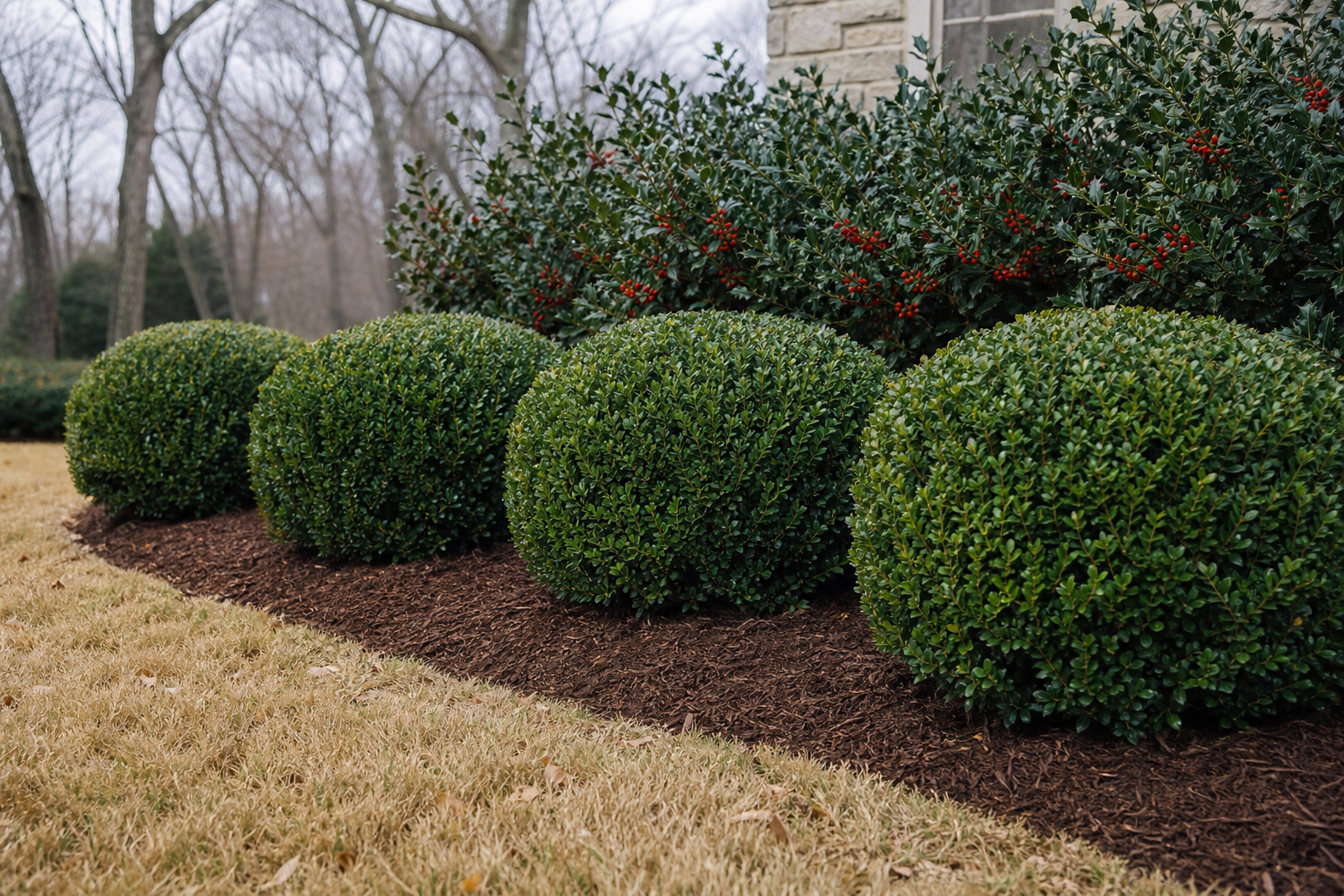
Not all ornamental shrubs face equal risk in North Texas winters. Cold-hardy species like hollies, yaupon, nandina, liriope, ligustrum, Indian hawthorn, and boxwood handle Tarrant County winters reliably. Tender species require active protection.
Azaleas are root-sensitive. Their shallow root systems sustain more freeze damage than those of deeper-rooted species. Mulching the root zone before winter is essential for azaleas in Fort Worth and Burleson landscapes.
Wax myrtle dies to the ground in a hard freeze but typically recovers from roots in spring. Homeowners who value the screening or privacy that wax myrtle provides should protect the root system to ensure that recovery is possible.
Mexican sage, Confederate jasmine, and pittosporum occupy a borderline zone in Tarrant County winters. They survive mild winters and sustain significant damage in hard ones. Preparation reduces the severity of that damage and improves recovery speed.
Dwarf crape myrtles may die to the ground in a hard freeze but usually recover. However, repeated ground-level dieback each winter weakens these plants over time. Root zone protection limits dieback and keeps plants growing from established wood rather than starting over each spring.
Step One: Apply Mulch by Mid-October
Mulch is the single most effective winter preparation step for ornamental shrubs. A 2 to 4 inch layer of organic mulch around the base of each shrub insulates the root system by trapping soil warmth. Roots survive temperature extremes that would kill above-ground tissue entirely.
Apply mulch by mid-October, before overnight temperatures drop consistently below 40 degrees Fahrenheit. The goal is to trap warmth that is still in the soil rather than insulating already-cold ground.
Keep mulch away from the stems of shrubs. Mulch piled against stems traps moisture against the crown, which creates conditions for fungal disease and crown rot. Leave a gap of two to three inches between the mulch ring and the stem base.
Old mulch does not need to be removed before adding a fresh layer. Organic mulch continues breaking down and feeding soil organisms and root systems as it ages. Adding to an existing layer is entirely appropriate. The critical thing is achieving the target depth of 2 to 4 inches around each plant.
Step Two: Water Thoroughly Before a Freeze
Moist soil holds heat better than dry soil. As moist soil freezes, it releases latent heat, which slows the temperature drop in the root zone. Dry soil freezes faster and provides less thermal protection to roots during extended cold periods.
Soak beds deeply the day before any predicted hard freeze. This is not a light sprinkling. The goal is soil saturation down to the depth of the root zone, which requires slow, deep watering rather than brief surface irrigation.
Continue weekly deep watering through November dry spells. Evergreen shrubs continue losing moisture through their leaves even during dormancy, a process called transpiration. Soils that dry out in November leave evergreens vulnerable to desiccation damage that looks like browning and leaf burn by late winter.
Do not water frozen soil or soil with surface ice. Adding water to frozen ground creates runoff and does nothing to improve root zone conditions.
Step Three: Stop Fertilizing After Mid-September
Fertilizer stimulates new growth. New growth produced in October and November is soft, tender, and highly vulnerable to frost damage. A shrub that pushes new growth just before the first hard freeze will lose that growth and the energy it cost to produce it.
The last fertilizer application for ornamental shrubs in North Texas should occur no later than mid-September. This gives any stimulated growth time to harden off before frost arrives. Growth that hardens off, meaning it firms up and reduces its moisture content as temperatures cool, survives cold better than fresh, actively growing tissue.
This rule applies to all fertilizer types, including granular slow-release products. Check the application date on any recent treatments and avoid adding additional fertilizer to beds that were fed in late September or October.
Step Four: Do Not Prune Before Winter Dormancy
Pruning stimulates new growth at the cut sites. Like fertilizer-induced growth, this new tissue is tender and vulnerable to frost. Pruning also removes outer tissue that naturally insulates the crown and buds from temperature swings.
Wait until full dormancy before pruning ornamental shrubs. Full dormancy in Tarrant County typically falls between December and February, once overnight temperatures have consistently stayed below freezing and plant growth has completely stopped.
Spring pruning, after the final frost and once new growth has confirmed which stems survived, is another sound option. Pruning in late winter or early spring also allows the gardener to assess freeze damage before cutting, avoiding the removal of stems that may still be alive.
One exception applies: remove dead, diseased, or physically damaged wood at any time of year. This is different from pruning for shape or size. Removing a broken branch or a fungus-infected stem does not stimulate the same growth response that structural pruning does.
Step Five: Use Anti-Transpirant Sprays on Evergreens
Hollies, junipers, and other broadleaf evergreens continue losing moisture through their foliage all winter. When soil is frozen, roots cannot replace that moisture. The result is desiccation damage that shows as browning, leaf scorch, and tip dieback by late winter and early spring.
Anti-transpirant sprays, such as Wilt-Pruf, coat foliage with a thin protective layer that reduces moisture loss through leaf surfaces. Applied in late October, before temperatures drop below 40 degrees Fahrenheit, they significantly reduce desiccation damage on evergreen shrubs.
Apply anti-transpirant sprays to dry foliage on a day when temperatures are between 40 and 60 degrees Fahrenheit. The product needs time to adhere and dry before any precipitation or hard freeze occurs. A second application in December or January extends protection through the coldest part of the season.
Step Six: Keep Frost Cloth Ready for Tender Plants
Frost cloth, made from breathable fabric rather than plastic, provides a critical extra layer of protection for tender ornamental shrubs during hard freeze events. Keep frost cloth on hand through April, since late-season freezes in Tarrant County occasionally arrive in March.
Cover tender shrubs before dark on the evening before a predicted hard freeze. The goal is to trap daytime warmth beneath the cloth. Covering after sunset captures only nighttime cold air and provides far less benefit. Heavier frost cloth or burlap works better than lightweight fabric for freezes lasting five or more hours below 28 degrees Fahrenheit.
Plastic is not an appropriate substitute for frost cloth. Plastic does not breathe, traps moisture against foliage, and can cause heat damage when temperatures rise again. Breathable frost cloth allows some air exchange while blocking the full force of freeze temperatures.
Remove frost cloth promptly once temperatures rise above freezing. Extended coverage in rising temperatures creates heat and moisture buildup that can damage the plants the cloth was meant to protect.
Assessing and Recovering from Winter Damage in Spring
After a hard freeze, damaged shrubs often look dead. Many are not. The key rule is to wait before cutting anything back. Some shrubs that appear completely dead will produce new growth from living roots or from living tissue below the damage line.
Test stems before removing them. Scratch the outer bark with a fingernail or a knife. Green or white tissue beneath the bark indicates a living stem. Brown, dry, or shrunken tissue beneath the bark indicates dead wood. Work your way down the stem from the tip until you reach living tissue.
Spring is the right time to remove freeze-damaged growth. Once temperatures stabilize and new growth begins emerging from living tissue, the extent of the damage becomes clear. Removing dead wood at that point lets the plant direct its energy into viable new growth rather than supporting dead stems.
Texas A&M AgriLife Horticulture provides additional guidance on plant freeze protection and recovery at aggie-horticulture.tamu.edu. For site-specific assessment of your ornamental plants in Fort Worth, Keller, or Mansfield, a consultation with a licensed plant health care professional gives you the most accurate picture.
Trees Hurt Too Inc. provides ornamental care services for Tarrant County landscapes. The ornamental care page covers available treatments and programs. Moisture management for ornamentals is described at the moisture management page. For full-season ornamental care, the full-service lawn and ornamental package covers preparation, monitoring, and treatment throughout the year.
Get Your Ornamental Shrubs Ready for Winter in Tarrant County
Trees Hurt Too Inc. has served Fort Worth and surrounding Tarrant County for over 28 years. Call or text to schedule a consultation.
Call: (972) 521-1552 | Text: (972) 521-1552 | treeshurttoo.com