

Tree microinjection places treatment directly inside a tree's vascular system. The method bypasses soil entirely, delivering fungicides, insecticides, or nutrients straight into the channels that move water throughout the tree. For homeowners in Fort Worth and across Tarrant County, this technique has become the most reliable way to treat oak wilt, iron chlorosis, and borer damage in mature trees.
North Texas soil creates a specific problem for conventional treatments. Tarrant County clay compacts and cracks in summer heat. Soil drenches pool in surface cracks rather than reaching feeder roots deep in the ground. Foliar sprays work only on healthy, active vascular tissue. Microinjection skips both obstacles and delivers treatment exactly where the tree needs it.
Understanding how the process works helps homeowners make informed decisions about high-value trees. The following sections explain the mechanics, the treatments available, and the timing that produces the best results in North Texas.
What Is Tree Microinjection and How Does It Work?
Tree microinjection delivers liquid treatment into a tree's xylem and phloem, the internal channels that transport water and dissolved nutrients from roots to canopy. Once the treatment enters these channels, the tree's own hydraulic pressure carries it upward and outward through the entire crown.
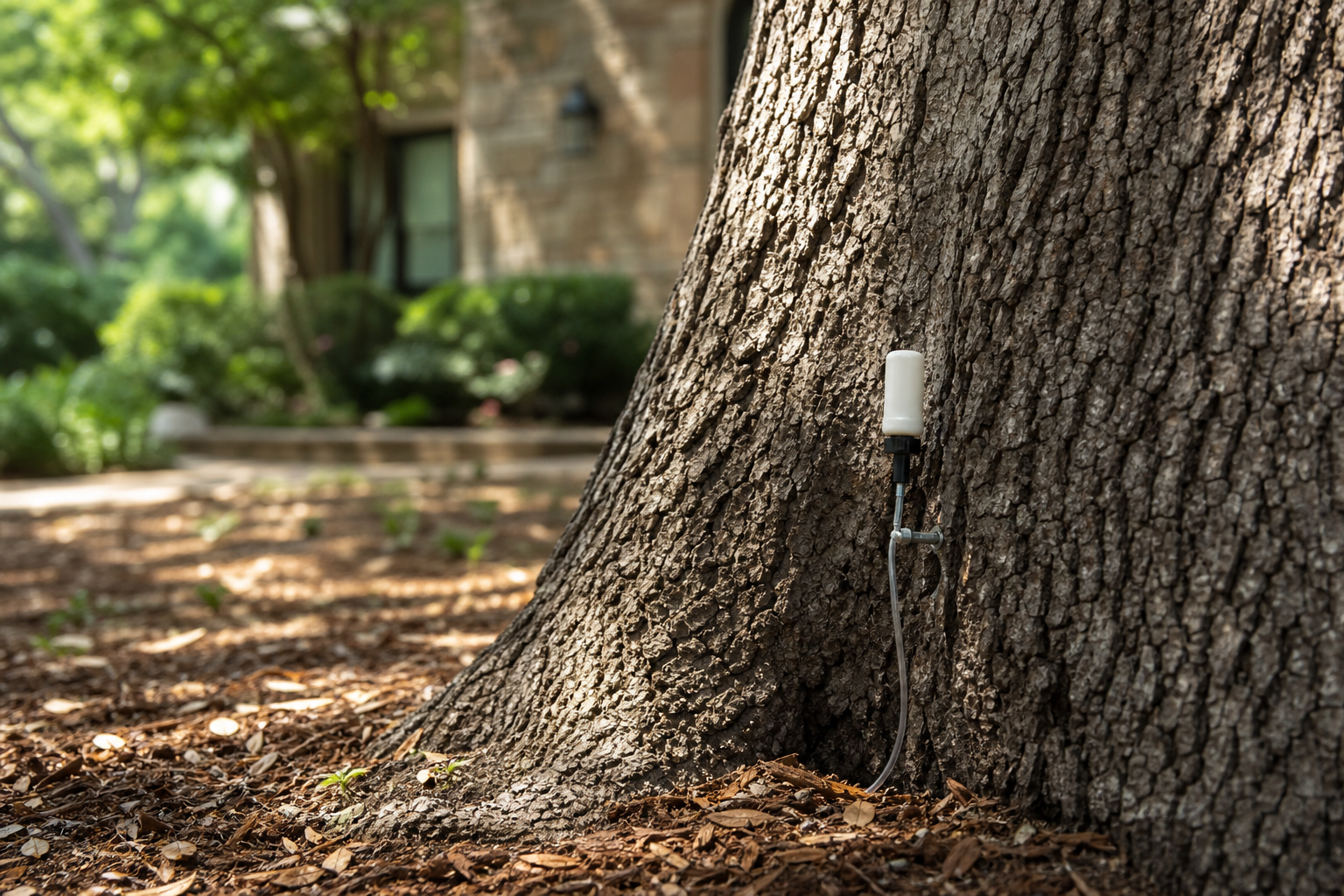
The process begins at the base of the trunk or along the root flare. A certified arborist drills small injection ports, typically 3 to 5 millimeters in diameter. Pressurized capsules or gravity-fed systems then deliver liquid treatment directly into the cambium layer, which is the active growth tissue just beneath the bark.
The injection sites are small and the tree heals over them naturally. The process leaves no residue on exterior surfaces and no product in the surrounding soil. Neighbors and pets face no exposure during or after treatment.
Some providers use the terms trunk injection or tree injection interchangeably with microinjection. All three refer to the same vascular delivery method. The critical factor in any of these approaches is placement. Treatment delivered into active vascular tissue reaches the crown. Treatment sitting in soil or on leaf surfaces may never get there at all.
What Can Be Treated with Tree Injection in North Texas?
Four categories of treatment move effectively through the vascular system: fungicides, insecticides, nutrients, and combination formulas. Each serves a specific set of conditions common in Fort Worth and surrounding communities.
Fungicides for Oak Wilt and Vascular Diseases
Propiconazole, sold under the brand name Alamo, is the most widely used fungicide for oak wilt in North Texas. When injected before symptoms appear or at the first sign of infection, it interrupts fungal activity in the vascular tissue. Treatment is most effective before the disease progresses to severe vascular blockage.
Live oaks and red oaks in Southlake, Keller, and Colleyville represent some of the most valuable trees in Tarrant County. Preventive injections protect entire groves, not just individual trees. Because oak wilt spreads through connected root systems, treating a single tree without addressing its neighbors provides incomplete protection.
Hypoxylon canker, another vascular stress disease, also responds to systemic fungicide support when trees receive treatment in early stages. Trees under drought stress are most vulnerable to hypoxylon canker infections.
Insecticides for Borers, Scale, and Aphids
Imidacloprid and emamectin benzoate are the two primary insecticide options for trunk injection. Both work systemically, meaning insects feeding on vascular tissue absorb a lethal dose through the tree itself rather than through direct contact with a sprayed surface.
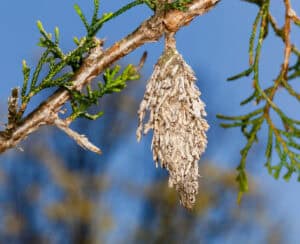
Borers are the most damaging insect threat to stressed trees in North Texas. They target drought-weakened oaks, elms, and other species, tunneling through vascular tissue and cutting off water movement. An injected insecticide reaches borer larvae working inside the wood, where no foliar spray can reach them.
Scale insects and aphids on ornamental trees in Grapevine and North Richland Hills respond well to systemic insecticide injection. Trees that resist foliar treatment due to dense canopy or difficult access become manageable through trunk injection without any spray application.
Nutrients for Iron Chlorosis and Deficiency Correction
Iron chlorosis is the most common tree health problem in the Dallas-Fort Worth area. Alkaline soil chemistry, which is standard throughout Tarrant County, locks up iron in a form tree roots cannot absorb. Leaves yellow while veins stay green, a visible sign of iron starvation. Pin oaks are especially susceptible.
Chelated iron injected directly into the vascular system bypasses the soil chemistry problem entirely. The tree receives iron in a form it can use immediately, without depending on soil conditions that will not change. Micronutrient packages for other deficiencies work the same way, delivering correction where soil cannot.
Combination Treatments
Some situations call for a single application that addresses both nutrient deficiency and pest pressure at the same time. Combination treatments pair nutrients with pest protection in one injection session, reducing the number of separate visits and shortening the window of tree stress.
Tree Injection vs. Soil Drench vs. Foliar Spray
Each application method has a different pathway to the vascular system. Understanding the difference explains why injection outperforms the alternatives in Tarrant County conditions.
Soil drenches apply liquid treatment to the root zone, depending on soil absorption to move the product to feeder roots. In North Texas, compacted clay soil cracks during dry weather. Treatment runs along those cracks rather than absorbing into the root zone. Drenches work in loose, permeable soils. They are unreliable in Fort Worth clay.
Foliar sprays coat leaf surfaces and depend on the tree's normal water movement to carry the product inward. Vascular diseases block that water movement specifically. Spraying a tree for oak wilt works only in the earliest stage, before the disease has reduced internal flow. Once vascular blockage is significant, foliar sprays sit on the surface without reaching the disease.
Injection places treatment directly in the vascular tissue where disease, pests, or deficiencies are present. The tree's own hydraulic system then distributes that treatment through the crown. No soil chemistry, no surface evaporation, and no reliance on intact water movement stands between the product and its target.
Oak Wilt and Tree Injection: Timing and How It Works
Oak wilt prevention injections should be completed before the high-risk wound season. Red oaks are most vulnerable from February through June, when spore mats develop and sap beetles carry the fungus from diseased wood to fresh wounds. Live oaks face year-round risk whenever pruning or wounding occurs.
Preventive injection on high-value oaks in Arlington, Mansfield, and Fort Worth builds a chemical barrier in the vascular tissue before any infection pressure arrives. This is a different strategy than reactive treatment. Reactive treatment after symptoms appear still slows disease progression, but the tree has already lost vascular function in affected areas.
Once symptoms appear, early-stage injection with propiconazole can halt spread and protect adjacent healthy tissue. Injection is most effective when the tree is actively moving water, which means spring flush and early fall are the two best windows. Full summer dormancy and winter dormancy both slow internal water movement and reduce product distribution throughout the crown.
The oak wilt treatment page at Trees Hurt Too explains the full disease cycle and how injection fits into a long-term protection plan for high-value oaks.
Iron Chlorosis and Micronutrient Injection
Spring is the best time to inject for iron chlorosis. Active growth in spring drives rapid water movement, which distributes the chelated iron quickly through the entire canopy. Trees that receive iron injections in spring often show visible green-up within two to four weeks.
Alkaline soil in Fort Worth and surrounding cities will not change. Acidifying amendments help temporarily but cannot maintain the soil chemistry shift required to make soil-applied iron available to roots over the long term. Injection addresses the deficiency directly without depending on soil correction that cannot hold.
Pin oaks on residential lots in Colleyville, Southlake, and Keller show iron chlorosis consistently due to the naturally high pH of Tarrant County soils. Annual or biennial injections keep these trees in good health without prolonged soil amendment programs that rarely produce consistent results.
How Long Does Tree Injection Last?
A single properly applied tree injection provides protection for up to two years, depending on the specific product and the tree species being treated. Fungicide products like propiconazole maintain effective levels in vascular tissue through a full two-year cycle in most oak species.
Insecticide injections vary by product and pest pressure. Emamectin benzoate typically provides two years of borer protection in a properly calibrated injection. Imidacloprid may require annual reapplication for high-pressure pest situations.
Nutrient injections like chelated iron correct deficiency quickly but do not prevent future deficiency caused by ongoing alkaline soil conditions. Most trees in Tarrant County benefit from iron injection on a two-year cycle to maintain consistent canopy health.
A licensed plant health care professional can assess each tree individually and build a treatment schedule based on species, condition, and the specific threats present in that location. Learn more at the tree injections page.
When Is the Right Time for Tree Injection in Fort Worth?
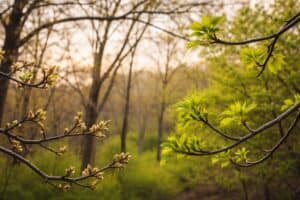
The best injection timing corresponds to periods of active water movement inside the tree. Spring flush, when buds break and new growth pushes out, is the highest-efficiency window. Early fall, from late August through October, is the second-best window. Both periods drive strong hydraulic flow that distributes treatment rapidly.
Mid-summer dormancy reduces injection effectiveness. When Fort Worth temperatures push above 100 degrees Fahrenheit, many trees reduce internal water flow to conserve moisture. Injection is still possible in summer, but distribution through the canopy is slower and less complete.
Winter dormancy from December through February slows water movement to its lowest point of the year. Injections applied during dormancy may sit in place for weeks before the tree begins distributing them in spring. For most treatments, scheduling in fall or early spring produces better outcomes than winter injection.
October is a particularly strong month for injection in Fort Worth, Keller, and Mansfield. Temperatures have dropped from summer peaks, water movement has resumed after heat-season slowdown, and the tree still has weeks of active growth ahead before dormancy sets in.
The International Society of Arboriculture provides additional guidance on tree pest identification and treatment at treesaregood.org. For site-specific recommendations in North Texas, a consultation with an ISA Certified Arborist gives the most accurate picture of what each tree needs.
For trees dealing with pest damage, the shrub and tree pests page covers the most common species threatening North Texas landscapes.
Protect Your Trees with Professional Microinjection in Fort Worth
Trees Hurt Too Inc. has served Fort Worth and surrounding Tarrant County for over 28 years. Call or text to schedule a consultation.
Call: (972) 521-1552 | Text: (972) 521-1552 | treeshurttoo.com