

Knowing when to fertilize trees in Texas, especially in the Fort Worth area, changes the outcome more than any other variable. The two best windows are early spring before new growth begins and fall from September through late October. Every other time carries real risk of damage to the tree.
North Texas trees face conditions that forests never encounter. Homeowners rake fallen leaves away, removing the decomposing organic matter that naturally feeds tree roots in the wild. The soil under most Fort Worth and Tarrant County yards is alkaline clay sitting on shallow limestone bedrock, which locks up nutrients before roots can reach them. Supplemental fertilization is not optional for trees in these conditions. It is part of keeping them alive.
Fall fertilization in particular prepares trees for a healthier dormancy and a stronger spring. Roots continue absorbing nutrients from the soil even as above-ground growth slows in September and October. A well-timed fall application supports root development through the winter months when the tree is building reserves.
This post covers the best timing windows for tree fertilization in Fort Worth and surrounding Tarrant County, the conditions that make North Texas soil challenging, when not to fertilize, and how deep root feeding works differently from surface application.
The Best Time to Fertilize Trees in Fort Worth and North Texas
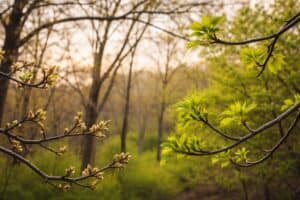
Early spring and fall are the two windows when North Texas trees benefit most from nutrient applications. Early spring means before new growth flushes, typically February through March in Tarrant County. The fall window opens in September and closes in late October.
Spring fertilization feeds the tree at the moment it begins drawing on its stored reserves for new leaf and branch growth. Fall fertilization supports the root system during the period when above-ground activity slows but underground activity continues. Both windows align with when roots are actively absorbing.
Trees receiving fertilization in both windows show stronger overall growth, better canopy density, and improved resistance to disease and pest pressure compared to trees receiving a single annual application.
When NOT to Fertilize Trees in North Texas
The period from August 1 through late summer is the single most important window to avoid. Fertilizing trees during late summer stimulates new growth at the worst possible moment. That growth flushes tender new tissue right before cold weather arrives, and that tissue is highly susceptible to winter injury.
Why August fertilization causes winter damage
Trees in the Fort Worth area begin preparing for dormancy through July and August. The internal chemistry of the tree shifts during this period, building cold hardiness into the tissues. A fertilizer application during this transition interrupts that process and directs the tree's energy into new growth instead.
New growth produced in August or September does not have time to harden before the first frost, which in Tarrant County typically arrives in mid-November. That soft tissue dies back when temperatures drop, leaving dead branch tips and weakened structure going into winter.
The fall fertilization window opens after the worst heat has passed, typically in September, when new growth is no longer a concern and root activity remains high. Stop fall applications 2 to 3 weeks before the expected first frost, which means late October as the cutoff in Tarrant County.
Avoid fast-release nitrogen at any time
Fast-release nitrogen forces a flush of growth regardless of timing. That flush creates exactly the kind of tender tissue that invites disease and pest pressure. Slow-release formulas deliver nutrients over weeks or months rather than all at once. For North Texas trees, slow-release is always the correct choice.
Some products available to homeowners provide nutrients for up to 6 months from a single application. This sustained release pattern matches how tree roots actually take up nutrients, steadily and continuously rather than in spikes.
Why North Texas Soil Makes Tree Fertilization Essential
Most soil in the Fort Worth, Arlington, and Keller area is alkaline, compacted, and sits on shallow limestone bedrock. This combination creates nutrient availability problems that soil chemistry in other regions does not face.
High soil pH locks iron into a form that tree roots cannot absorb. Iron deficiency, called iron chlorosis, is the most common tree health problem in North Texas. The signs are clear: leaf veins stay green while the tissue between them turns yellow. This yellowing, called interveinal chlorosis, appears most commonly on oaks and other trees in alkaline Tarrant County soil.
Nitrogen, phosphorus, and potassium are present in many DFW soils but remain unavailable to roots due to compaction and pH. Nutrients applied to the surface may never reach the root zone in hard clay. That is why deep root feeding produces consistently better results than surface application in this region.
Deep Root Feeding vs. Surface Fertilization in North Texas
Surface fertilizer applied to a compacted North Texas lawn sits at the surface. It may wash off in rain, volatilize in heat, or simply fail to penetrate the clay layer before it reaches the feeder roots that actually absorb it. Deep root feeding bypasses this problem entirely.
How deep root feeding reaches the root zone
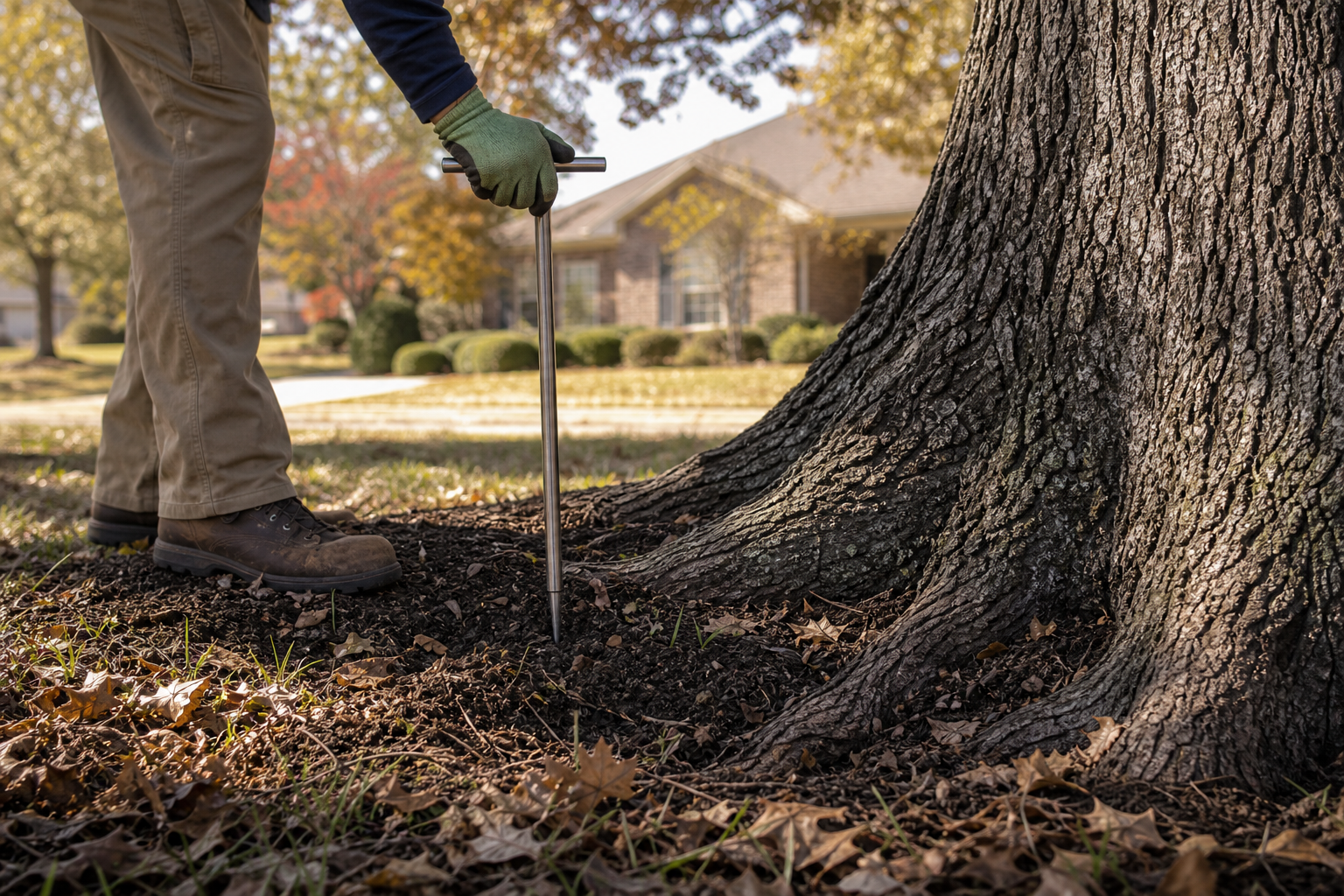
Deep root feeding delivers carbon-based nutrients directly into the root zone under pressure. A probe is inserted into the soil at multiple points around the tree's drip line, and nutrients are injected at the depth where feeder roots are active. Compacted clay at the surface is not a barrier when the delivery goes under it.
Mycorrhizal inoculants applied with deep root feeding expand the effective root surface area dramatically. These beneficial fungi form a network around root tips and extend their reach far beyond what the physical roots cover. A well-inoculated root system accesses nutrients and water across a much wider soil area than it could on its own.
Trees Hurt Too uses carbon-based, natural products in its deep root feeding approach. Carbon-based amendments improve soil biology and structure over time, not just in the application window. Each treatment contributes to soil health that persists through subsequent seasons.
Iron Chlorosis and Fall Fertilization Timing
Fall is an ideal time to address iron chlorosis in North Texas oaks and other affected trees. Treating in fall allows the corrected nutrient levels to support root development through winter and improves how the tree comes out of dormancy in spring.
Microinjection delivers iron and other micronutrients directly into the tree's vascular system. This method bypasses soil alkalinity entirely, which is important because soil-applied iron amendments may still be locked up by high pH before roots reach them. The tree injection service at Trees Hurt Too handles this approach for Fort Worth area oaks.
For long-term improvement, soil acidification addresses the underlying cause. Lowering soil pH improves iron availability for future seasons and reduces how often direct injection is needed.
Which Trees Benefit Most from Fall Fertilization
Every tree in a managed North Texas landscape benefits from supplemental fall fertilization, but some trees gain more than others based on their current condition and location.
Oaks in compacted soil or alkaline areas of Fort Worth, Southlake, and Colleyville show the clearest response to fall feeding. Trees that produced smaller leaves than usual during the growing season, or leaves that turned color early, are signaling nutrient stress. Trees recovering from summer drought are also strong candidates for fall fertilization before dormancy.
Young trees establishing root systems benefit significantly from fall fertilization because roots continue growing through fall even after the canopy has slowed. A fall application supports that root establishment work directly.
Trees that received treatment for insects or disease during the growing season spent considerable energy on recovery. A fall fertilization application replaces some of that spent energy and supports the tree heading into winter with fuller reserves.
The Connection Between Soil Health and Tree Nutrition
Fertilization works best when the soil around the root zone is biologically active and structurally sound. Clay soil in Tarrant County, North Richland Hills, and Grapevine often has low organic matter and reduced microbial activity compared to healthier soils. Both conditions reduce how efficiently roots take up applied nutrients.
Carbon-based soil amendments improve this situation over time. Adding organic matter to clay soil changes its structure, opening pore space for air and water and giving beneficial soil organisms something to work with. The result is soil that holds nutrients in plant-available form rather than locking them up or leaching them away.
Texas A&M AgriLife Extension addresses the relationship between soil health and tree nutrition in its Earth-Kind guide to fertilizing woody ornamentals. The guidance consistently points to soil conditioning alongside fertilization as the complete approach for North Texas landscapes.
Tree Fertilization Services Across Fort Worth and Tarrant County
Trees Hurt Too serves homeowners and property managers across Fort Worth, Arlington, Keller, Southlake, Colleyville, Grapevine, North Richland Hills, Mansfield, and all surrounding Tarrant County communities. ISA Certified Arborists provide free on-site evaluations to assess tree health and recommend the right fertilization approach for each property.
The deep root feeding service and the tree fertilization program are both available for fall appointments. September and October are the highest-demand months for fall tree fertilization in North Texas. Scheduling early ensures your trees receive treatment while the timing window is still open.
Frequently Asked Questions About Fertilizing Trees in North Texas
When is the best time to fertilize trees in Fort Worth, Texas?
The two best windows are early spring before new growth begins, typically February through March, and fall from September through late October. Fall fertilization is particularly valuable in North Texas because roots continue absorbing nutrients while above-ground growth slows. Stop fall applications 2 to 3 weeks before the first frost in mid-November.
What is iron chlorosis and how does fall fertilization help?
Iron chlorosis is a nutrient deficiency where leaf veins stay green while tissue between them turns yellow. It is the most common tree health problem in DFW due to the high soil pH of Tarrant County clay. Fall treatment using microinjection delivers iron directly into the vascular system, bypassing the soil alkalinity that blocks iron uptake.
Why is deep root feeding better than surface fertilization for Texas trees?
Compacted clay soil in North Texas blocks surface fertilizer from reaching feeder roots. Deep root feeding injects nutrients directly into the root zone under pressure, bypassing the compaction layer. This method consistently delivers better results in Fort Worth, Arlington, and surrounding Tarrant County communities where clay soil is the norm.
Schedule Fall Tree Fertilization in Fort Worth and Tarrant County
Trees Hurt Too Inc. has served Fort Worth and surrounding Tarrant County for over 28 years. Call or text to schedule a consultation.
Call: (972) 521-1552 | Text: (972) 521-1552 | treeshurttoo.com