

Every December, Fort Worth homeowners stare at leafless trees in their yards and wonder the same thing: is that tree dead, or is it just sleeping? The question "dead or dormant tree" is one of the most common calls ISA Certified Arborists receive across North Texas each winter.
The short answer: a dormant tree has firm buds on its branch tips, green tissue just under the bark, and flexible twigs that bend without snapping. A dead tree shows none of these signs. Three simple tests take less than 60 seconds to perform and can save you from a costly, unnecessary mistake.
This post walks through each test step by step, explains what North Texas trees look like in winter, and tells you exactly when to wait versus when to call a professional for a proper diagnosis.
Why North Texas Trees Look Dead in Winter
Deciduous trees in North Texas drop their leaves every fall as a natural response to shorter days and cooling temperatures. This process is called dormancy, and it is a healthy survival mechanism. The tree slows its metabolism, stops photosynthesizing, and conserves energy until spring conditions return.
A bare tree in December in Arlington or Mansfield is almost always doing exactly what it should. The problem arises when a tree has experienced real stress during the growing season. After the severe drought years between 2022 and 2024, many North Texas trees entered winter carrying hidden damage. That damage often becomes visible in winter, months after the original stress occurred.
After Winter Storm Uri in February 2021, many trees across Fort Worth and North Richland Hills appeared completely dead well into spring. The scratch test proved to be the deciding factor. Trees that showed green tissue in March were still alive, and many pushed healthy new growth in April and May. Thousands of trees that passed the scratch test would have been removed unnecessarily if homeowners had acted on appearance alone.
Test 1: The Bud Inspection
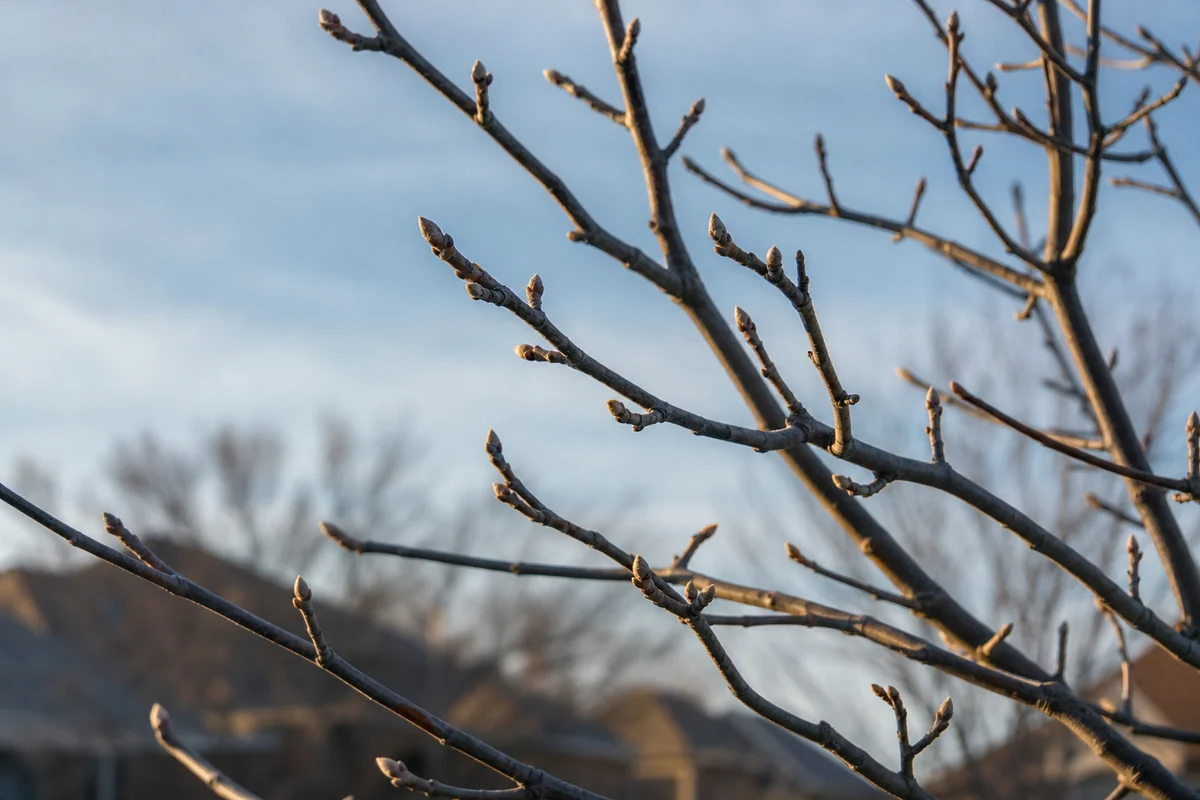
Even in full dormancy, living trees carry visible buds at the tips of their branches. These buds contain the compressed beginnings of next spring's leaves and growth. Checking for buds is the fastest first step in evaluating any leafless North Texas tree in winter.
How do you check a tree's buds in winter?
Walk to the end of a few branches at different heights and locations on the tree. Look at the very tips for small, rounded structures attached to the branch. Healthy dormant buds are firm and solid when you press them gently between your fingers.
Signs of a living tree:
- Buds present at branch tips
- Buds feel firm and solid, not soft or crumbly
- Buds appear symmetrical and intact
Signs of a problem:
- No buds visible on branch tips
- Buds that crumble or fall apart when touched
- Shriveled, dried, or collapsed buds
A few missing buds on one branch are not cause for alarm. A tree with no firm buds across most of its branches deserves closer inspection with the tests below.
Test 2: The Scratch Test
The scratch test is the most reliable method for determining whether a tree branch is alive or dead. It takes 30 seconds and requires only a fingernail or a small pocketknife. The Davey Tree Expert Company identifies this as the definitive field test used by professional arborists.
How do you perform the scratch test on a tree?
Select a small twig, about pencil-thickness, from one of the tree's outer branches. Lightly scratch a small patch of the outer bark with your fingernail or the tip of a knife. You are exposing the thin layer of tissue just beneath the bark surface, called the cambium layer.
Read the color of what you find:
- Green and slightly moist: the branch is alive and dormant
- Brown and dry: that branch location is dead
Perform this test on three to four different branches in different parts of the tree, not just one spot. Spot-check at different heights and different sides of the canopy. A tree that returns brown on all tested branches has likely died. A tree that returns green on even a few branches still has living tissue and the potential to recover.
One important note: perform the scratch test on small outer twigs, not the main trunk. The trunk tissue reads differently and is not the right location for this assessment.
Test 3: The Branch Flexibility Test
The flexibility test is the quickest of the three checks. Living wood holds water inside its cells, which gives it a degree of flexibility. Dead wood has lost that moisture and becomes rigid and brittle.
What does a dead branch feel like compared to a live one?
Select a small twig, roughly the diameter of a pencil. Bend it slowly but firmly with both hands. Living wood bends, resists, and may crack slightly but does not snap cleanly. Dead wood snaps immediately with little to no resistance and a clean, dry break.
Perform this test on several branches across different parts of the canopy. A tree where every tested branch snaps clean and dry is showing strong signs of decline. A tree where most branches bend with resistance still has living structure, even if it also shows some dead sections.
Examining the Trunk for Additional Clues
Branch tests tell you about the outer canopy. Trunk condition tells you about the core structure of the tree. After checking the branches, spend two minutes walking slowly around the trunk and looking at these indicators.
Missing bark: Patches of bark that have fallen away and left exposed wood beneath, with no new bark growing back, indicate that the underlying tissue died at some point. The longer the exposure without regrowth, the more concerning the finding.
Vertical trunk cracks: Deep vertical cracks running along the trunk surface indicate advanced structural decline in the wood below.
Fungal growth or conks: Shelf-like fungal growths on the trunk signal internal wood decay. These structures appear where the tree's internal defense has failed and wood-rotting fungi have established.
Southwest-side sunscald: Look at the side of the trunk that faces afternoon sun, generally the southwest. Sunken, discolored bark on this side, sometimes cracked or peeling, is a sign of sunscald damage. North Texas trees in Keller, Grapevine, and Southlake regularly show this pattern after hot summers. It does not always indicate a dead tree, but it needs professional evaluation.
North Texas Tree Types and Winter Appearance
Not every species behaves the same way in winter. Knowing what your specific tree should look like in December helps you interpret the test results correctly.
Texas live oaks are semi-evergreen. They should retain green foliage through most of winter and only drop leaves in early spring just before new growth begins. A Texas live oak that is completely bare in December is showing an abnormal pattern and warrants a closer look. Check for firm buds on bare branches.
Deciduous oaks (red oak, Shumard oak, water oak) are completely bare in winter in North Texas. This is normal. The presence of firm buds on bare branches is the primary sign of health. An arborist diagnosis may be needed if the scratch test returns mostly brown results.
Post-drought trees deserve extra attention this winter. Trees across Burleson, Mansfield, and Midlothian that experienced severe drought stress during 2022 through 2024 may show canopy dieback now that was not obvious during the growing season. The scratch test is particularly valuable for these trees because the death of individual branches may be scattered rather than uniform.
When to Wait and When to Call an Arborist
Not every concerning test result requires immediate professional intervention. The timing of your response matters in North Texas.
When to wait: If a tree fails the scratch test on one or two branches but passes on others, wait. The tree still has living tissue. Mid-April is the realistic test date for North Texas deciduous trees. If a tree has not pushed any new growth by mid-April, it is dead or severely compromised.
When to call a certified arborist: If a tree fails all three tests on every tested branch AND shows trunk damage such as missing bark, fungal conks, or deep cracks, schedule a professional evaluation now. An ISA Certified Arborist can assess whether any living tissue remains and whether treatment options exist.
The most important rule: Do not act on appearance alone in December through February. Hundreds of North Texas trees are removed each winter because they look dead while fully dormant. The three tests above take 60 seconds and protect you from an expensive, irreversible mistake.
The same principle applies to any tree that survived a recent stress event. After a hard freeze, a disease outbreak, or a drought summer in the DFW area, give the tree a chance. Use the scratch test. Check the buds. Wait for mid-April. You may find a tree that is very much alive.
Serving Fort Worth, Arlington, and Surrounding Tarrant County
Trees Hurt Too Inc. performs free on-site evaluations for homeowners throughout Fort Worth, Arlington, Keller, Grapevine, Mansfield, Burleson, Southlake, North Richland Hills, and surrounding Tarrant County communities. Ken Hewlett, ISA Certified Arborist with 28 years of experience, has performed winter tree evaluations across North Texas since 1998.
The company uses the same scratch test, bud inspection, and trunk evaluation described in this post, along with additional diagnostic tools, to give you a clear picture of what your tree needs. A professional evaluation also covers treatment options such as proven recovery approaches for trees showing early signs of decline.
Frequently Asked Questions: Dead or Dormant Trees in North Texas
How long should I wait before concluding my tree is dead in winter?
Wait until mid-April before drawing a final conclusion about any leafless North Texas deciduous tree. Many trees that appear fully dead in December and January push new growth in April and May. The scratch test in winter gives you a strong indicator, but mid-April bud break is the definitive confirmation in the DFW area.
Can a tree be partly dead and partly alive?
Yes. Trees frequently show mixed results on the scratch test, with some branches returning green and others returning brown. This pattern indicates partial dieback. The living sections of the tree can sometimes sustain recovery if the underlying cause, such as drought stress or root damage, is addressed. An ISA Certified Arborist can assess whether recovery is realistic for your specific tree.
Does the scratch test damage the tree?
A light scratch on a small outer twig causes no meaningful harm to the tree. You are removing a tiny patch of outer bark on a twig, not wounding the main trunk. The tree's natural defenses seal small surface scratches quickly. Keep the scratch area small and limit testing to pencil-sized twigs, not large branches or the main trunk.
Get a Professional Winter Tree Evaluation Before You Make a Decision
Trees Hurt Too Inc. has served Fort Worth and surrounding Tarrant County for over 28 years. Call or text to schedule a consultation.
Call: (972) 521-1552 | Text: (972) 521-1552 | treeshurttoo.com